|
| |
Mini
Biographies of Scots and Scots Descendants (C)
Cullen's of New
Zealand |
|
James Cullen - (1818-1905) - Farmer
Born at Lochwood Farm near Coatbridge in
1818, he was the third youngest son of William Cullen and Margaret Murray
who married at Hamilton in 1799. In 1839 he went to a meeting in Glasgow
sponsored by the Duke of Hamilton, the Duke of Argyll and the Lord Provost
of Glasgow to encourage colonisation schemes to New Zealand, which led to
him being selected as one of the first 89 emigrants and 33 children who
sailed on the ‘Bengal Merchant’ from Greenock on the 31st
October 1839. It was not until the 10th February 1840 that they
sighted the Southern Alps of South Island, but they first anchored off
D’Urville Island on the entrance to Cook Strait, before arriving at Port
Nicholson, near Wellington, 113 days after leaving Greenock.
At that time there were probably no more than 1,000
Europeans living around New Zealand, and Wellington was then a very
primitive little town, with a hut which had neither windows or doors being
the only ‘boarding house’. When other passengers told their tales of
Wellington winds and the howling at night of the wild dogs, he was glad
enough that he had decided to stay on board the ‘Bengal Merchant’.
For three weeks the passengers still living on the ship went ashore daily
to build their own huts. After cutting down tree ferns, they rammed them
into the ground, laced them together with bark, then daubed the interiors
with clay to make them watertight.
In spite of the many privations for these pioneers,
they did enjoy the pleasures of the unspoiled natural beauty of the
ancient forest. This tranquil beauty was regularly broken by the ring of
axes as the forest was cleared, the fallen trees burned and wheat and
potatoes planted among the charred logs. With the benefit of the woodash
and the compost from many centuries of fallen leaves, the potatoes grew to
the most enormous size and were of the finest flavour. ….. There were of
course many Maoris, not all of them friendly, and in those days the hakas
were full of real meaning. James found himself working with a Maori named
Topi in his first employment, sawing timber to build a house for a local
lawyer. It is said that Topi was surprised to find that such a small
man could keep pace with him at the end of a saw. Indeed the only
assets which James Cullen had were his youth, his good health and his
willingness to work hard.
He went on to do survey work around Wellington with one
Charles Kettle, but lack of funding by the New Zealand Company caused the
suspension of this work, and in 1843 he took up storekeeping with another
‘Bengal Merchant’ passenger, Archibald Anderson. This store was at
Thornton on the north end of the beach, selling groceries, wines and
spirits, oil and lamp wicks and men’s working clothes, but in 1845
both men decided to move south to Dunedin. At that time Dunedin was an
isolated spot with more wild pigs than domestic stock, but Cullen was
enchanted with the beauty of the virgin bush. Archibald Anderson
established a farm at Kelvin Grove overlooking the harbour at Koputai
(Port Chalmers), and James Cullen helped with the cattle and crops. The
following year Charles Kettle returned from England to survey the Otago
Block and both men assisted him with this work, but in April 1848 another
ship arrived at Dunedin with imigrants from Glasgow. This was of course a
day of great excitement for the settlers, and on board the ‘Philip Laing’
was the matron, Isabella Stevenson from Kilsyth with her four sons and two
daughters Jane and Ann. James Cullen and another friend Hopper Clearwater
were among the crowd gathered to greet the new arrivals, and were
immediately attracted to the Stevenson sisters. With his eight years
experience in the colony, James was able to show many of the settlers how
to go about building their tree-fern cottages, which was essential before
the winter set in, and he certainly helped the Stevenson family to build
their house of pungas. Both Cullen and Clearwater were regular visitors at
the Stevenson house during that first very severe winter, and in December
1848 Hopper Clearwater married Ann Stevenson.
James Cullen continued to work with Archibald Anderson,
but in 1849 he went into business as the first carrier in Dunedin. He set
up a stable in what is now Manse Street and had a cart sent out from
Britain. This business prospered and he was involved in the building of
the first jetty at Dunedin, but his aim was to have a farm of his own.
March 1849 was the first anniversary of the Stevenson’s arrival and after
the Thanksgiving service James proposed to Jane. They married the
following autumn in March 1850, and their first home was in Dunedin where
he developed his business of carting and ploughing for local farmers. It
was when one of these farmers returned to Australia that James got his
opportunity to purchase a farm at East Taieri. This was on the Taieri
plain, north west of Dunedin and apart from the farm produce they soon
developed Owhiro farmhouse to provide accommodation for travellers.
In 1860 he sent to Scotland for a number of Clydesdale
horses, which his youngest brother Peter Smith Cullen brought with him
when he emigrated to Dunedin in 1860. Soon after he arrived in New
Zealand, gold was discovered near Dunedin and the brothers worked
together, supplying their produce to the large number of prospectors who
arrived in the area.
James Cullen and Jane never returned to their native
Scotland, but they had a family of seven sons and two daughters and many
of their descendants still live in New Zealand. This information and the
quotations are taken from research done by their grand daughter, Pearl
Watt, between 1950 and 1970, which was published in a book entitled ‘The
Advance Guard’.
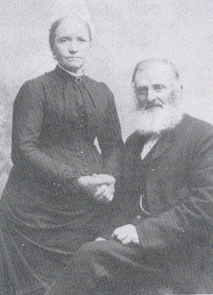
James Cullen and Jane Stevenson in 1900
Peter Smith Cullen – (1826 – 1918) - Farmer
The youngest son of William Cullen and Margaret Murray
who lived at Lochwood Farm near Coatbridge until about 1840, when they
moved to Kilsyth. Peter is recorded as having been a Wine & Spirit
merchant in Glasgow in the 1850’s, but in 1860 he emigrated to New Zealand
to join his brother James. On the 26th April 1860 he left
Greenock on the ‘Pladda’ with a consignment of Clydesdale horses for his
brother, arriving at Dunedin on the 24th August. These were in
fact the first stud horses to be shipped from Scotland to New Zealand. At
first he helped his brother on his farm at East Taieri, near Dunedin, but
in 1863 he married Ann Raeburn Russell who had emigrated with her family
from West Calder in 1857.
For 17 years they had their own farm at
North Taieri where they had eight sons and four daughters between 1864 and
1881. They continued farming in that district until 1891, and had another
son and daughter before they moved to Pine Bush Farm, near Gore in Eastern
Southland. Peter died in 1918 and Ann in 1922, and both are buried at Gore
Cemetery. Peter and Ann never returned to Scotland, but there are many
descendants who are still living in New Zealand.
David J
Hodgeton |
Return to
C Index
Return to Mini Bios Index |



