|
My pipe major when I
was a boy was Donald Rory Leslie, a native of Skye who had run away from
home, been turned back as too young by the Army, then ran away again this
time to sea, where he served as a cabin boy and later as man before the mast
in the old square-riggers, which were then still plying the seas.
When WW I broke out, he
served with the Camerons throughout the war, and later in the Irish
Rebellion in the 1920s.
 Donald
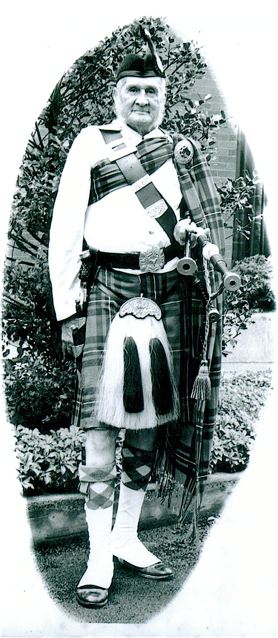
was a big man even in his old age, and a real Highlander! He was a gaunt,
rugged, craggy old man, then in his seventies, with the look of a Highland
eagle, a shock of white hair, and eyes as blue and chill as his native
lochs. Donald
was a big man even in his old age, and a real Highlander! He was a gaunt,
rugged, craggy old man, then in his seventies, with the look of a Highland
eagle, a shock of white hair, and eyes as blue and chill as his native
lochs.
He was a stern
Presbyterian, and past Grand Master of both his Orange and Masonic lodges.
He was a skilled custom builder, and still worked hard every day.
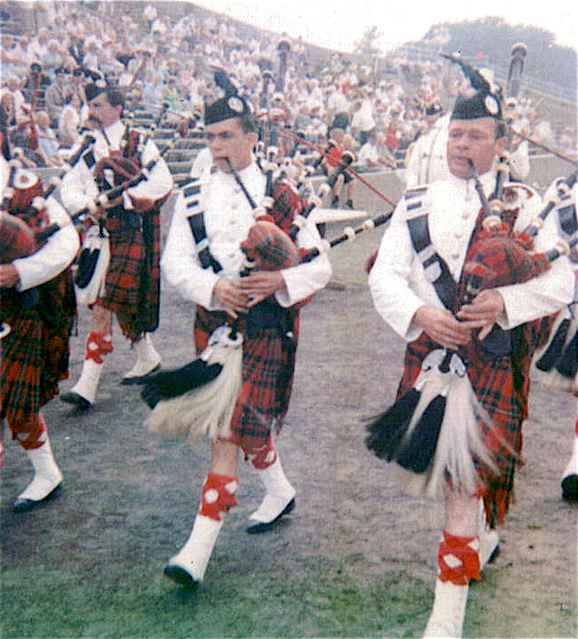
Our band, though
originally started as the Clan MacGregor Society pipe band, was dressed,
accoutred, and armed as the Camerons of a century ago. Though we wore
MacGregor kilts, our cap badges and gear were Cameron.
Our pipe chanters were
Hendersons (many of them very old), because Donald said only Henderson still
made them "right", (i.e., with the flat-pitched sound that he considered
important to piping because it produced a "Gaelic" sound).
Our tunes were the
great tunes of the Cameron Regiment, which had included the favorites of the
Cameron clansmen who had first embodied the Regiment; "Gaibhaidh Sinn an
Rathad Mor" (We'll take the High Road"), played and sung by the Cameron clan
as they marched behind the Gentle Lochiel to join their Prince at Glenfinnan,
"The White Cockade", "Hey, Johnnie Cope" and "Over the Water to Charlie" ,
and many other Jacobite tunes, as well as the great tunes of Regimental
history, speaking of places they had been, and battles lost and won.
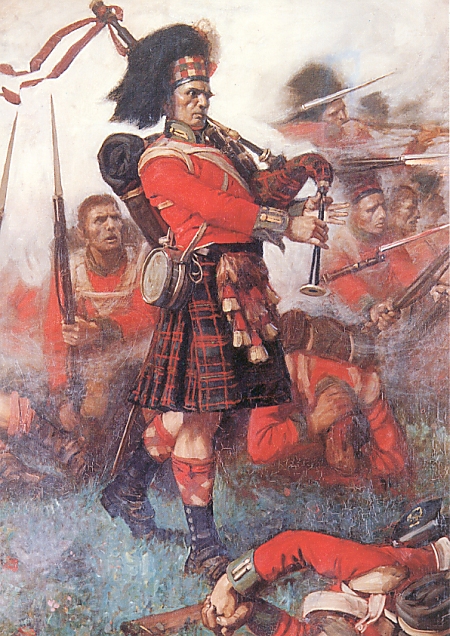
I remember him speaking
of Pipe Sergeant Kenneth MacKay of the 79th Cameron Highlanders at Quatre
Bras, part of the battle of Waterloo. When the French were trying their best
to break the Camerons' square, MacKay strode forth playing the famous
piobaireachd, "Cogadh no
Sith" (War or
Peace). His inspiration helped the Camerons hold firm. Donald told us his
story, then played for us "Cogadh no Sith".
Speaking of that, if
you wonder what Donald might have looked like in his youth, a good reference
is the famous portrait entitled "Cogadh no Sith". It depicts MacKay at
Quatre Bras, MacKay's face is very similar to what I imagine Donald's was
at the same age. A strong, indeed, almost uncanny resemblence!
The tunes were all played in the very hard-core Gaelic style that
characterized the Camerons in the old days.
As you may know, the
Camerons were the last of the truly Highland Regiments, in that they had a
preponderance of Gaelic speakers.
Donald told us that in
WW I, they had ordered the Camerons to stop speaking Gaelic in the trenches,
as it had led to some men being injured when green English troops in the
next trench thought the Germans had gotten into the trenches!
He was a very
hard-bitten, dour old man. Sometimes if we would ask him where Dougal or one
of the other fellows was, he'd snap back; "Hanging on the barbed wire at
Mons!"
After the Great War, he
went back to sea.
Once in a pub after a
parade, he was tossing back his Black & White scotch, and an ornery drunk
started on him - the usual - "Hey! Guys in skirts! What are you? Sissies?"
etc. Donald ignored the lout until he reached for his Cameron Officers'
dirk.
Faster than you would
believe, it was out of its sheath and quivering in the top of the bar!
Donald growled, without even looking at the idiot; "Touch it again and
you'll be wearing it!" The drunk stumbled back, and his friends hustled him
out. Luckily for him!
He was a tremendous
piper of over 60 years experience, and could also play "ceol mor" ("big
music" aka "piobaireachd" meaning "piping" - the classical form of Highland
pipe music), with the familiarity of a Gael who also knew the stories and
the words from earliest youth.
Donald had a bout with
laryngeal cancer in the early 60s, and beat it. He had part of his larynx
removed, though, and spoke in a crusty, hoarse voice, like a loud whisper.
Despite this, he still very impressive, and always got his point across!
He was generous also.
The small amount of money he took for tuition was put towards a set of pipes
if the pupil "graduated" into the band.
He had been told to
quit smoking and piping, but though he quit smoking, he told me (about 1963)
that he would die piping.
That proved true. Some
years later, after I had left the area, I was told that he had a piping
student one evening, and that he had then gone into his study after the
student left. His wife later found him there, slumped over the table, his
practice chanter still in his hands.
He had a son, Dougal, a
US veteran of Korea who unfortunately predeceased him, and Dougal had a son,
also named Donald, and another son, Robert, who I have since re-connected
with.
He was a tireless and
energetic man, a true son of the Gael, a stern taskmaster, and a great
teacher. I will always remember him.
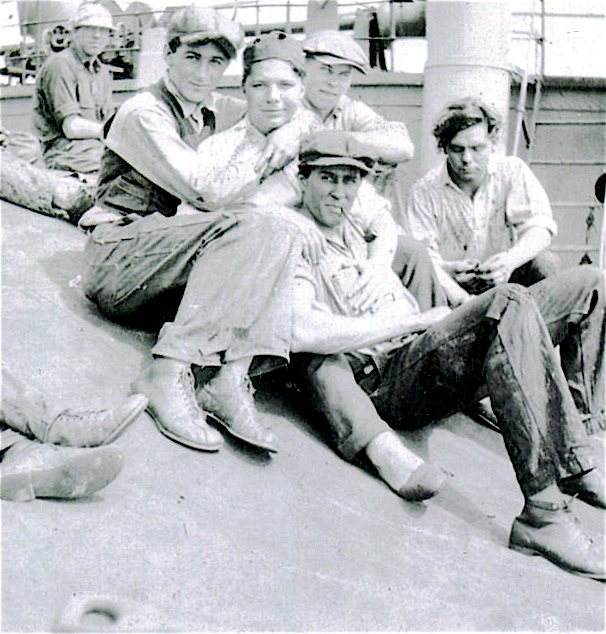
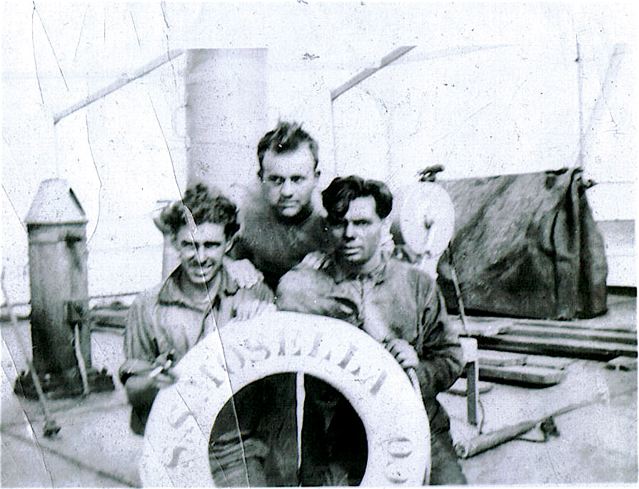
(Note: Since the
original publication of this article here, several members of the old
MacGregor Band and Donald's grandson, Robert Leslie, have gotten in touch
with me. They provided me with the pictures below, two of which show Donald
as a young man on one of his ships with his shipmates. I believe Donald is
the man in the center in both shipboard pictures. In the MacGregor Band
picture, the gentleman on the right as you view it is Donald's son, the late
Dougal Leslie, who sadly died quite young of cancer. I cannot recall the
name of the young man to his left, though I know his face, and the gentleman
in the left rear rank with the elegant mustachios is Carl McLaughlin, a
talented woodworker and custom framer who later became PM of the band. If
anyone has any further information or wishes to get in touch, you may
contact me here: seamus45@gmail.com)


|