|
Men of Bute Commemorative Ceremony held on
Saturday 19 July 2003 at Bute Cross, Falkirk Old Parish Church,
Falkirk in memory of Sir Willam Wallace, Sir John Stewart, and the men
from Bute who fought and died at the Battle of Falkirk on 22nd July
1298.
Address by Peter D Wright. Chairman, Scots
Independent & Organiser, Alexander III Commemoration Committee
Mister Chairman, Friends and Fellow Scots
It is an honour and pleasure to accept
your very kind invitation to address the Men of Bute Commemoration
ceremony . As someone who organises a historical commemoration in Fife
every year to remember the 'Golden Age' of Scottish history, the reign
of Alexander III, of which more anon, I know full well the amount of
work that goes in to holding such events. My congratulations to Marion
McMillan for all her hard work in organising today's event. Thank
goodness such events are now held all over Scotland, they tell our
people the story of our history, something that our Unionist-run
education service fails to do.
We meet today to honour the memories of
Sir William Wallace, Sir John Stewart and the Men of Bute who fought
and died at the Battle of Falkirk on 22 July 1298 - 705 years ago.
Only a man of Wallace's stature and
determination could have rallied the Scots, including the Men of Bute,
to take Scotland's side and face up to the mightiest army in Europe
led by one of the most ruthless men in Europe - Edward I, King of
England.
William Wallace 'the ae-man fortress,
fully manned' as the poet Tom Scott so well described him, must have
been an impressive sight and a natural born leader. He is without
doubt our greatest warrior HERO. But he was more than just a fighting
man, he was a statesman. Remember as Guardian of Scotland, one of his
first acts was to write to the Hanseatic League, the Common Market of
its day, informing them that Scotland was free again of English
domination and able to resume trade.
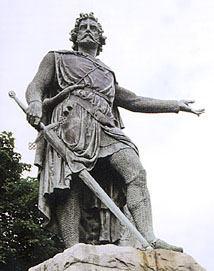 As
a wee, bittie boyackie, I well remember the first time that I saw the
Sir William Wallace statue in my home town of Aberdeen. The finest
statue of Wallace anywhere in the world. I was taken by my Grandfather
and told the story of Sir William Wallace. Like our National Bard,
Robert Burns, I felt a Scottish prejudice flowing through my veins,
which will continue until the day I die. As
a wee, bittie boyackie, I well remember the first time that I saw the
Sir William Wallace statue in my home town of Aberdeen. The finest
statue of Wallace anywhere in the world. I was taken by my Grandfather
and told the story of Sir William Wallace. Like our National Bard,
Robert Burns, I felt a Scottish prejudice flowing through my veins,
which will continue until the day I die.
Many years later, I was to learn that the
model for the Aberdeen Wallace statue was the Great-Uncle of a friend.
Uncle Willie was six feet six - like Wallace, himself, an impressive
sight. Uncle Willie worked, for his sins, for the British Secret
Service. I don't know how effective he was as a spy, today's secret
service certainly don't seem to be very effective! But Uncle Willie
used to spy incognito on the Continent dressed in his kilt - no one
would suspect a kenspeckil figure, six foot six, bearded and kilted of
being a spy - would they?
However I want to take you back to
the event which set in motion the course of history which led to
Stirling Brig, Falkirk, Bannockburn, The Declaration of Arbroath, the
Treaties of Edinburgh and Northampton and the continuing long Wars of
Independence. I want to take you back 717 years.
On 18 March 1286, Alexander III, King of
Scots, known as The Peaceable ,
chaired a meeting of his Council in Maiden Castle, Edinburgh Castle as
we know it today, discussing the problem which has bedivilled Scottish
history - how to deal with a larger, richer, stronger neighbour to the
south - in one word ENGLAND - which had territorial ambitions to
control all her neighbours. Under Edward I, Langshanks, who was to be
become the 'Hammer of the Scots', this was very much the case as
France, Ireland , Wales and our own beloved Scotland would learn to
their cost.
The meeting dragged on but no resolution
to the particular problem emerged. Eventually the King and his nobles
wined and dined and Alexander, in spite of the pleas of his nobles to
stay in Edinburgh because of the stormy weather, set off to return to
Fife. He was determined to rejoin his wife of six months, Yolande (Jolete
of Dreux) at Kinghorn Tower. Was the King driven by sex? Was Alexander
driven by the need for a male heir - for his two sons and daughter
were dead - and the heir to the Scottish throne was a wee quean in
Norway - The Maid of Norway. Alexander III knew full well that
Scotland needed a strong King to follow in his footsteps - well
capable of standing up to men like his brother-in-law, the King of
England.
Alexander III with a few companions rode
to Queensferry where the Ferryman pleaded with him not to cross the
Forth. But cross the gurlie waters he did, in an eight-oared boat, and
crossed safely to Inverkeithing. At Inverkeithing in the black, stormy
night the Saltmaster only recognised the King by his voice. The
Saltmaster implored him to go no further and stay the night but
Alexander insisted that he only needed two guides and determined to
ride on into the pit mirk nicht. In the darkness the King was
separated from his companions as they almost reached their
destination.......
That day the prophet Thomas of Erchildoun,
Thomas the Rhymer, was at Dunbar Castle and told Earl Patrick and his
company -
"Alas for the morrow, a day of misery
and calamity! Before the hour of noon there will assuredly be felt
such a storm in Scotland that its like has not been known for long
years past. The blast of it will cause nations to tremble, will make
those who hear it dumb, and will humble the high, and lay the strong
level with the ground."
On the morrow the stormy weather had given
way to a beautiful Spring day and as noon approached Earl Patrick and
his household, having watched the sky for the prophesied storm,
dismissed Thomas the Rhymer's warning, and went in for dinner. They
had barely sat down as the clock pointed to noon when a messenger
knocked on the Castle Yett demanding entrance to see the Earl
immediately. He was admitted and gave his urgent news -
"News he said " I have indeed and evil
news, which the whole realm of Scotland will mourn; for alas! its
noble King ended his life yesternight at Kinghorn; and this I am come
to tell you."
The Earl Patrick rose and smote his
breast, acknowledging that indeed Thomas was all too true a great
prophet. Indeed as the messenger said all Scotland would mourn the
loss of Alexander III, a most beloved monarch. His death marked the
end of the direct line of Scottish Kings descended from Kenneth
MacAlpin. His death also marked a turning point in Scottish History
and his reign was to be seen by future generations, poets
and historians as 'The Golden Age'.
Indeed the historian James Halliday has
said that the last luck Scotland enjoyed was the reign of Alexander
III. The next piece of luck we enjoyed was the discovery of oil in the
North Sea and a fat lot of good that has done the Nation of Scotland
as the revenues are swallowed up by the greedy maws of the English
Exchequer.
In 1286, Scotland after many years of
peace and prosperity, the customs of Berwick alone amounted to a
quarter of the whole of England, and responsible and good kings, such
as Alexander and his father Alexander II, was cast like a rudderless
ship on a stormy sea.
You all know what happened, the Maid of
Norway died, and the Scots asked Langshanks to adjudicate on the next
King of Scots. He chose John Balliol. Now I suspect that Balliol was
not totally 'The Toom Tabard' of history, after all winners write
history and he lost. He did secure The Auld Alliance with France and
angered Edward I into invasion. Also remember that William Wallace
fought the battle for Scottish Freedom in the name of Balliol.
But invade Edward did - Berwick was sacked
and put to the sword, the Scottish army was defeated at Dunbar,
Balliol was deposed and English garrisons installed all over our
Nation.
But thank goodness men of the mettle and
quality of William Wallace and Andrew de Moray arose to throw off the
English yoke. Alexander III had ruled and had ruled well. In his day
and age he put Scotland First. His ambition was to keep Scotland
Independent and to unite her people. He succeeded in making Scots feel
Scottish. He built a Nation. His success in achieving these ambitions
was to help carry our forebears through the long Wars of Independence.
But you can well understand that after
years of peace and rising prosperity and trade; the shock of
occupation, death and turmoil would make Scots of future generations
look back on Alexander's reign as 'The Golden Age' and
this is well summed up in the oldest surviving verse in Scots written
by an unkent haun -
Quhen Alysandry
oure Kyng wes dede,
That Scotland led
in luve and le,
Away wes sons off
ale and brede,
Off wyne and wax,
off gamyn and gle;
Oure gold wes
changyd in to lede.
Cryst borne in to
Vyrgynyte,
Succoure Scotland
and remede,
That stad [is in]
perplexyte.
Many of us still seek that remede for our
beloved Scotland, a Scotland that very much still stands in
perplexity.
In 1298 the Men of Bute were prepared to
give their lives for Scottish freedom as they followed Sir William
Wallace into battle; we only need to dedicate our lives to the
Scottish Cause and the rebirth of Scottish Nationhood. We only need to
live for Scotland and by doing so, we can truly honour Sir William
Wallace, Sir John Stewart and the Men of Bute.
|