The South Australian Gazette and
Colonial Register of Saturday, 27th October, 1838 published an
advertisement calling upon 'Brither Scots' for a general muster to take
place to do honour to their Patron Saint, Saint Andrew.
In response, a further advertisement on
Saturday, 17th November, 1838, advised that a Saint Andrew's Day Dinner
would be held at the Adelaide Hotel on the Saint's Day, 30th November, 1 8
3 8 . Dinner to be on the table at five o'clock precisely. Tickets £1.
each. George Stevenson, Esq., J.P., had been elected the Chairman.
From this early beginning in this
Colony, began the gathering of fellow Scotsmen to uphold and honour their
Patron Saint, their Country of birth and their traditions.
By 1881, a group of Scotsmen met
informally to discuss the formation of a Caledonian Society. Further
meetings were held and the South Australian Caledonian Society was
officially formed. The Hon. Alexander Hay, M.L.C., was appointed as Chief,
and a Council was established and Society Rules drawn up. The initial
Register of members, carrying all members’ signatures, is still in the
possession of the Royal Caledonian Society of South Australia.
In 1894 the Statue of Scotland's Bard,
Robert Burns, was presented to the City of Adelaide. In 1895 a Citizens
Fund for the erection of a statue of John McDouall Stuart was taken over
by the Society and upon completion this Statue was also handed to the City
of Adelaide.
The Society became an Incorporated Body
in 1911, and in July 1946, changed it's name to the Royal Caledonian
Society of South Australia, Inc., having received permission from His late
Majesty, King George VI, to use the term 'Royal'. Unfortunately, the term
'Royal Charter' has crept into some expressions of the Society. This is
not correct.
The Society does not hold a Royal
Charter, only written Royal permission to use the name Royal.
Educational Scholarships were allotted
by this Society for students from 1904 to 1 9 4 8 . Recipients were
students at Saint Peters College (Boys), Prince Alfred College and Scotch
College, and in later years to students at Presbyterian Girls College.
By the 1920’s, it was realised the
Society needed a “home” and in 1925 the foundation stone of its building
at 379 King William was laid. Additions were made in 1975 but finance
proved a disaster and the land at the rear of the hall had to be sold, the
Hall mortgaged and money borrowed from members. A small band of dedicated
members subsequently worked feverishly for many years to pay off the debt.
The mortgage was eventually repaid but by this time the Hall had fallen
into disrepair. By 2002, it was evident that the Society could not afford
to undertake the necessary upgrade to the Hall and the decision was made
to sell it.
The Society has prospered over the years
and has endeavoured to uphold the traditions and heritage of our beloved
Scotland. In 1899, a Bairns Highland Dancing Class was formed.
Regrettably, the Bairns Class was terminated in December 2000, 101 years
since it was initiated, due to a lack of numbers.
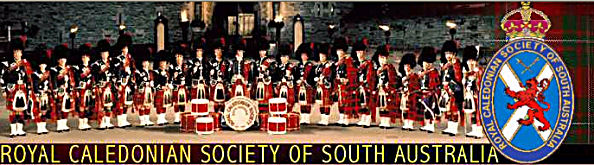
The Society’s Pipe Band has been in
existence since its inception in 1894. It is believed to be the oldest
continuously operating Pipe Band in the Southern Hemisphere. An honour in
its own right. A highlight of the Band was being invited to perform at the
Edinburgh Tattoo in Scotland in 2001 and in the Edinburgh Tattoo in Sydney
in 2005. It has again been invited to perform at the Edinburgh Tattoo in
Scotland in 2007.
In April 2001, the Society initiated
“Caly Capers” to replace the Bairns Class. This new venture was to be a
fun night for all ages and include a variety of Scottish traditional
activities. Whilst starting off with a good following, by the end of 2002,
Council regrettably had to make the decision not to continue with this
venture, again due to lack of support.
In 1999, The Society initiated a Tartan
Day March for all South Australians of Scottish descent. This has become
an annual event and is held on the Saturday nearest Tartan Day - 1 July.
It has grown from a march along either North Terrace or Grenfell street to
a march down Rundle Mall, the principal shopping centre of Adelaide
followed by a display of Scottish culture under the canopy at the
intersection of Gawler Place and Rundle Mall. The March is lead by massed
Pipe Bands followed by representatives of the various Societies and Clans,
each proudly bearing their respective banners.
Determined to foster Scottish dancing,
Highland, Country and Ballroom, in 2006, the Society initiated a Family
Scottish Dance Class in the Druids Hall at Collinswood. The classes are
held on Friday nights during school terms by renowned teacher - Mrs Leonie
Burgess.



