|
HOME
PAGE

HISTORY
THE NEWS
THE
GUIDE
BUSINESS
COMMUNITY
CONTACT
SEARCH
|

. |
 |
|
In
the beginning Top
|
There
is a great deal of controversy and conflicting opinion as to the
year when the club as such was in actual fact founded., but the
overwhelming evidence seems to come out in support of 1876.
Falkirk F.C. are better know as the "Bairns", a nickname
derived from the old Burgh of Falkirk motto - "Better meddle
wi' the deil than the Bairns O' Falkirk".
The first playing field of the club was Brockville Park, but in
1876 this was somewhat primitive compared with the stadium of the
present day, although, by current standards the present stadium
leaves a lot to be desired.
Falkirk's first match is generally recognised as being against the
Grasshoppers from Bonnybridge, who were their nearest rivals and
were formed about two seasons before the "Bairns". The
admission money to early matches was 4d, and Falkirk's first
'gate' totalled the princely sum of three shillings and fourpence
(about 17p in today's money!).
Brockville park was vacated about 1879 and the club secured a
playing field at Randyford, Grangemouth Road, where they remained
for a few years; then they flitted to Blinkbonny. It was on this
field that Falkirk scored a draw with Renton in a Scottish Cup
tie, the year that Renton were declared "Champions of the
World". Blinkbonny was vacated about 1882 and after a short
spell at another field in Hope Street, the present Brockville Park
was taken on lease about 1885.
It was not until East Stirlingshire came into existence in October
1880 that the local interest in the game began to get thoroughly
roused and clubs started springing up all over the district -
King's Park, Camelon, Campsie, Grangemouth, Barnsmuir (Slamannan),
Gairdoch, Stenhousemuir, Slamannan, Laurieston, Grahamston and
Tayvalla. The Stirlingshire Football Association was formed in the
year 1883/84 and comprised about 20 clubs, with a handsome trophy
(still competed for) put up to foster local rivalry. Falkirk took
part in the initial final for the trophy and had the honour of
being the first club to have their name inscribed as winners,
defeating East Stirlingshire 3-1 after a 1-1 draw.
|
| The
Leagues |
| In
seasons 1891/92 Falkirk became connected with the Scottish
Federation and did well to finish third in that competition.
Arthurlie and Albion Rovers were above them in the table. In the
following season they were not so successful and a year later
became connected with the Midland league, a combination of clubs
from Stirling, Clackmannan and Perth counties. They continued with
this body for three seasons, improving on their position each
year.
In
season 1896/97 Falkirk joined the Scottish Combinations, a
selection comprising Hamilton Academicals, East Stirlingshire and
the reserve sides of Rangers, Celtic, Hearts, etc. In 1897/98 they
joined the Central Combination which was comprised on similar
lines to the Midland League.
As
early as 1901 the drift over the Border began when Falkirk
transferred Jimmy Conlin to Manchester City and Sandy Young to
Everton.
Falkirk remained in the Central Combination until season 1902/03,
when they were admitted into the Scottish League Second Division
and from this point the "Bairns" have continued to play
a leading role, despite their share of expected ups and downs,in
the major leagues.
|
| The
Great Jocky Simpson |
Jocky
Simpson is still recognised as one of the greatest ever Falkirk
personalities. When the committee men recruited the services of
John Simpson for Falkirk, little did they know that they were, in
fact, recruiting a player who was to become one of the greatest
football stars and personalities that the game, in its long
history, has ever produced. In 1910 while still a Falkirk player,
although English born, he played for the Scottish League v
Southern League, and later the same year he played in the English
International Trial Game at Milwall. He had the unique distinction
to be selected to play for England while playing his football in
Scotland. One of his greatest triumphs as a Falkirk player was a
Scottish Cup tie at Motherwell. With 15 minutes remaining for play
Falkirk were losing 2-0, Jocky Simpson moved to centre and, before
Motherwell knew what had hit them, Simpson had displayed all his
natural genius by scoring a brilliant hat-trick to win the tie
single-handed for the "Bairns". Such was the jubilation
of the Falkirk fans, some of them perched on a boundary wall were
injured when it collapsed. It was surely, one of the most epic
victories the team ever achieved.
Despite the gnashing of teeth and grave misgivings throughout the
town, Simpson was eventually transferred to Blackburn Rovers, as
one of the big-name clubs in England at that time, for the
princely sum of £1,850. He was capped by England on no fewer than
eight occasions after he became a Blackburn Rovers player -
fitting testimony to his truly outstanding talent.
|
| Brockville's
First Grandstand Top |
The
first grandstand at Brockville Park, a wooden erection, was
destroyed by a controversial fire in 1907 and was rebuilt the same
year.
In season 1912/13 Falkirk was the toast of Scottish Football when
the "Bairns" won the Scottish Cup for the first time.
The route to Cup glory was as follows:
First Round a bye
Second Round Morton (away) 2-2
Replay (home) 3-1
Third Round Rangers (away) 3-1
Fourth Round Dumbarton (home) 1-0
Semi Final Hearts 1-0
Final Raith Rovers 2-0
|
| The
Great War years Top |
During
the war years competitive football in Scotland was more or less at
a standstill. During the hostilities several old Falkirk
favourites guested with the club, donning the old familiar navy
blue colours again, and did their bit to brighten the scene
locally in a football sense during the long, dark, grim days of
war. While these were difficult times, undoubtedly the impetus of
the Cup triumph just prior to the war did much to sustain interest
plus, of course, the appearance of the old stars and guests
gathered together at Brockville Park.
|
| The
Thirties |
| The
early thirties was the "Bairns" fortunes begin to ebb
until they were eventually relegated for the first time in their
history since being admitted to the First Division. However, under
the inspired leadership of Manager "Tully" Craig and
trainer Ernie Godfrey, from 1935 until the outbreak of the Second
World War in 1939, the "Bairns" enjoyed probably one of
the most prosperous periods in their history. From the tatters of
a relegated team "Tully" started reshaping the new
"Bairns" around Bob Shankly, who had joined the club in
1933, as a centre-forward, having previously seen service with
Glenbuck Cherrypickers, Tunbridge Wells and Alloa. With Shankly as
pivot, "Tully" laid the foundations of a team which was
to win its rightful place back in Division One at the first time
of asking, and at the same time, reach the semi-final of the
Scottish Cup. |
| The
Bairns lift the cup |
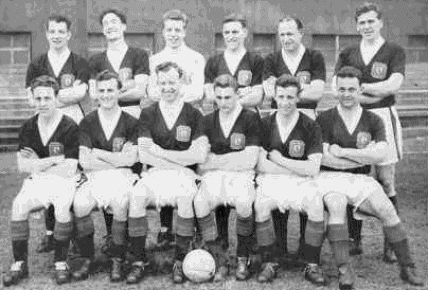
After the Second World War there was a tremendous upsurge in the
interest again being taken in football and the attendances
everywhere reached a peak as the crowds packed in to watch.
In season 1947/48 the "Bairns" reached the final of the
League Cup, but went through a very lean, struggling period for a
number of years after that.
In February 1957 Reggie Smith was tempted to Falkirk, as manager,
to face what looked like certain relegation. Miraculously, he gave
the team a completely new outlook, and the players, believing
their manager had waved a magic wand, began to have faith in
themselves and with each success, confidence rose. These boys just
did not know the meaning of defeat as they swept on to beat the
relegation drop. At the same time they were making a bit of a hit
in the Cup. Here they progressed at the expense of Aberdeen and
Clyde, to a semi-final against Raith Rovers at Tynecastle. This
resulted in a 2-2 draw and the "Bairns" upset all the
odds by winning the replay 2-0. The final too the "Bairns"
to Hampden to face the favourites Kilmarnock, on Saturday 21 April
1957. The game finished 1-1 and they replay the following
Wednesday turned out to be a nail-biting affair with everything a
final is expected to produce in the way of excitement, spills and
thrills as the teams battled for glory. As in the first game, it
was 1-1 after ninety minutes and the game went into extra time. In
the gathering gloom as darkness fast descended over Hampden,
Dougie Moran, who had run himself to a standstill, tenaciously
ploughed his way through a Killie defence which had been giving
nothing away and, as goalkeeper Jimmy Brown came out, he rammed
the ball home to score the most romantic goal ever in Falkirk's
history.
This was a fairy-take time in Falkirk's history which ended two
days after the Cup Final replay, at Kirkcaldy, when, because of
injury and the fact that they still had one more League fixture to
fulfil the next day against Motherwell, they were forced to field
a team of reserves, were fined £100 by the League as a result,
but still managed to win to escape relegation. What was to be a
gala day against Motherwell, with the Cup paraded round the town
headed by Murihead's Pipe Band, turned sour, with defeat something
of an anti-climax. After the Second World War there was a
tremendous upsurge in the interest again being taken in football
and the attendances everywhere reached a peak as the crowds packed
in to watch.
In season 1947/48 the "Bairns" reached the final of the
League Cup, but went through a very lean, struggling period for a
number of years after that.
In February 1957 Reggie Smith was tempted to Falkirk, as manager,
to face what looked like certain relegation. Miraculously, he gave
the team a completely new outlook, and the players, believing
their manager had waved a magic wand, began to have faith in
themselves and with each success, confidence rose. These boys just
did not know the meaning of defeat as they swept on to beat the
relegation drop. At the same time they were making a bit of a hit
in the Cup. Here they progressed at the expense of Aberdeen and
Clyde, to a semi-final against Raith Rovers at Tynecastle. This
resulted in a 2-2 draw and the "Bairns" upset all the
odds by winning the replay 2-0. The final too the "Bairns"
to Hampden to face the favourites Kilmarnock, on Saturday 21 April
1957. The game finished 1-1 and they replay the following
Wednesday turned out to be a nail-biting affair with everything a
final is expected to produce in the way of excitement, spills and
thrills as the teams battled for glory. As in the first game, it
was 1-1 after ninety minutes and the game went into extra time. In
the gathering gloom as darkness fast descended over Hampden,
Dougie Moran, who had run himself to a standstill, tenaciously
ploughed his way through a Killie defence which had been giving
nothing away and, as goalkeeper Jimmy Brown came out, he rammed
the ball home to score the most romantic goal ever in Falkirk's
history.
|
| The
Recent Years |
Over
the next 20 years or so, a tragic slump occurred in the fortunes
of most football clubs, and Falkirk was no exception. Falkirk's
Centenary Year (1976/77) brought relegation to Division Two
(again), with promotion again in 1979/80. 1985/86 saw promotion to
Premier League, but ever since then, Falkirk teams of today have
struggled, due mainly to cash flow problems, along with other
clubs like Raith Rovers, Partick Thistle, Motherwell and
Kilmarnock. The highlight of recent years was finishing 5th in the
Premier League in season 1994/95. Last season Falkirk were
relegated to their present status in the First Division (1995/96).
1996/97 saw the club reach the final of the Tennents Scottish Cup,
narrowly losing 1-0 to Kilmarnock. The players and supporters
however brought great credit to the club and town in what will be
remembered as the "family final".
|
| The
Stadium |
Immediately
following the 1914/18 war Brockville Park was purchased by the
club. In the light of today's land values the foresight of the
Directors of that time had much to commend it.
In 1926 the club Directors were contemplating changing from
Brockville to a more commodious and suitable site and asked the
late Mr Tom Copeland, architect, to report on the suitability of
the Bell's Meadow for development as a football stadium. It
transpired, however, that the ground was totally unsuitable and
the costs involved too hefty even to consider any further.
With the crowds rolling up in those days the Directors, under the
Chairmanship of Mr Bob Waugh, were still toying with the idea of
an area near where Graeme High School now stands. Plans were drawn
up, but again the heavy expenditure involved ruled out the
possibility of a move.
The feeling persisting for Brockville Park as a permanent home was
subsequently fulfilled with the building of the present grandstand
and the carrying out of ground improvements. The stand cost £7,600
and was officially opened on 29 August 1928. Since then very
little has been added to the Stadium, apart from the introduction
of floodlights in 1953.
Since the introduction of the Taylor Report, which stated that
each spectator should be seated and that, if necessary, spectators
should have access to a safe route from the stadium, Brockville
Park has been under fire from all quarters. As a Town Centre
stadium, Brockville has limited scope for development and causes
real problems for supporters and other members of the public as
well as the people whose houses surround the ground. Possible
sites were therefore investigated and a decision was taken that a
site near the motorway and outwith the immediate Town Centre was
suitable. |
|




