|
Preserves and candied
products both owe their flavor, appearance, and keeping qualities to the
large amount of sugar used in their preparation. Preserves are put up in
a heavy sirup while candied products contain more sugar than do
preserves and are packed dry. Both are expensive because of the sugar
necessary and the care and time required in their preparation.
58. Preserves.
Preserves are fruits or vegetables containing so much sugar in the form
of a heavy sirup that they are in the nature of a confection. Because of
their exceedingly high sugar content, sterilization is not usually
necessary. Fruits for preserves should retain their shape well during
cooking. Pears, quinces, many varieties of peaches, figs, kumquats,
pineapple, and watermelon rinds are all good for preserves. For most
fruits it is desirable to start cooking the fruit in a dilute sirup of
about 30% sugar, or one cup of sugar to about two or three of water. If
too heavy a sirup is used at first the fruit is apt to be tough,
regardless of the amount of cooking given. A dilute sirup penetrates the
fruit. When the fruit has become tender enough in the light sirup the
sirup is concentrated by boiling down to 65% sugar or 221° F. as for
jellies. The hydrometer test may be used to test the sirup.
Strawberries are often
used for preserves, but must be handled with care. In this case sugar
equal in weight to the berries used is added. They are cooked only a
short time and left to stand in the sirup until they will absorb the
sirup and become plump. Commercial factories add artificial color in the
form of Ponceau 3R and Amaranth to give the proper tint to the berries,
because the natural strawberry color soon fades.
Preserves are packed hot
into jars or glasses and sealed with ordinary jar caps or with hot
paraffin.
Soft fruits can be used
for preserves if cooked only a short time in a heavy sirup and then left
in shallow dishes in the sun to permit concentration of the sugar by
solar evaporation. This method is especially good for strawberry
preserves.
59. Candied Fruits.
Candied fruits are confections made by impregnating fruit with a very
heavy sirup, followed by draining and partial drying so that the fruit
may be handled easily. They should be glossy or "glaced" in appearance,
semitransparent, of the shape and size of the original fruit; the flesh
should be free from sugar crystals and the surface should not be sticky.
The process is one of
covering the partially cooked fruit with a dilute hot sirup which from
day to day is gradually increased in sugar content until it becomes a
very heavy sirup, which impregnates the fruit with a high sugar content,
65 to 70%. The slow increase in sugar is necessary to avoid shrivelling
and toughening of the fruit. In order that the shape and appearance of
the fruit may be retained, long boiling as in making preserves is
objectionable. Whole fruits, such as cherries, apricots, figs, etc., are
punctured thoroughly, through and through, in numerous places with
coarse wooden or copper needles to permit penetration of the sirup.
Large pears and peaches are peeled and cut in half. Pineapple slices
from the canned product are excellent for candying purposes.
The fruit is then cooked
until tender in a dilute sirup made up of glucose or corn sirup. Karo
Korn sirup is good for the purpose. Use one cup of this sirup or of
glucose to three cups of water.
The fruit and sirup are
allowed to stand twenty-four hours in this sirup in a pot or stoneware
crock. A wooden float will keep them immersed. On the next day, the
sirup is poured off and increased to 30% sugar or 15% Baume or about. a
half a cup of sugar is added to each six cups of sirup. The sirup is
heated to boiling and poured back over the fruit. After twenty-four
hours it is increased to 35% sugar, or another half a cup of sugar is
added to each six cups of sirup and the sirup again poured boiling hot
over the fruit. This is repeated with a 5% Balling or 3% Bauine or half
a cup sugar to 6 cups of sirup, increase each day until a sirup of 68%
Balling or 36° Baume' is reached, or until the sirup is about as thick
as honey.
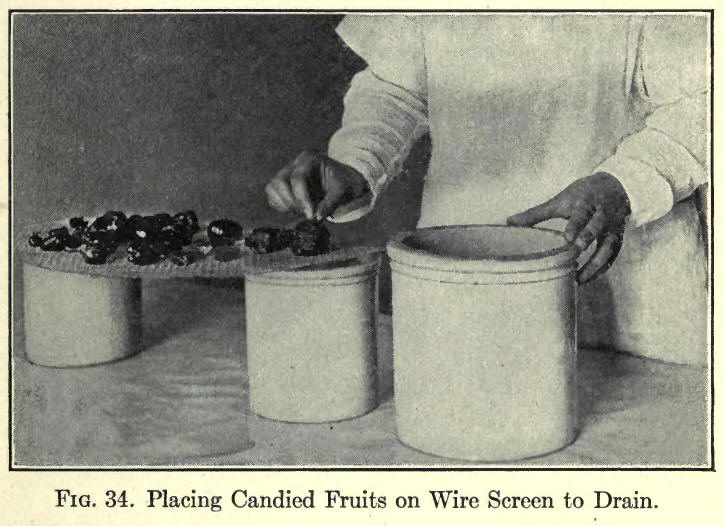
The fruit is then drained
on a screen a few days and when dry enough to no longer he sticky can be
packed in candy or other pasteboard boxes.
A moderate amount of
glucose in the product prevents hardening of the fruit and the formation
of crystals of sugar in the fruit. It also gives a glossy appearance and
causes the fruit to remain semitransparent. Glucose used alone produces
a flat tasting product; hence the desirability of using cane or beet
sugar with it as directed above. |