|
Many surplus vegetables
can be dried and thus made available for use throughout the year. The
methods are similar to those used for fruits. In regions of dry summers,
sun drying may be used; under other conditions, artificial evaporation
must be resorted to.
Vegetables contain from
80% to 95% water; drying, therefore, decreases the weight from five to
twentyfold.
71. Vegetables for
Drying. Certain vegetables give very good products when dried;
others do not lend themselves well to this method of preservation or are
more satisfactory when preserved in some other way, e. g., by salting or
fermentation, etc. Corn, green peas, green string beans, potatoes,
turnips, carrots, onions, and tomatoes may be dried very satisfactorily.
Artichokes, asparagus, cucumbers, cabbage, sweet peppers, and
cauliflower do not dry well, and give better results when preserved by
salting or fermentation.
72. Preparation.
The vegetables should be clean and of good quality. Root vegetables
should be washed thoroughly.
Potatoes must be peeled.
Vegetable peelers are available for this purpose, for the peeling of all
root vegetables. These machines vary from small kitchen sizes to large
power driven peelers of several tons' daily capacity. Turnips, carrots,
parsnips, and onions are best peeled without parboiling. Beets are
parboiled for fifteen or twenty minutes, after which the skin may be
slipped off easily.
Other vegetables are
prepared as for cooking for the table.
73. Blanching.
Certain vegetables, such as potatoes, corn, and beets, are improved if
heated in boiling water a short time before drying. Carrots, turnips,
onions, and vegetables of green color, such as peas and string beans,
need not be blanched because it results in loss of color in these cases.
Blanching is useful in
preventing the darkening of Irish potatoes where sulphuring is not used.
Potatoes contain a substance called oxidase which causes darkening when
the cut surfaces of the potato are exposed to the air. This oxidase is
destroyed by heating the potatoes through in boiling water. Vegetables
that have been blanched before drying are more tender than those not so
treated and can be cooked in a shorter time.
74. Sulphuring.
Potatoes turn black in color unless parboiled or sulphured before
drying. The most attractive dried potatoes are made by sulphuring the
sliced vegetable for twenty minutes before drying. Any of the forms of
fruit sulphuring devices previously described may be used. Turnips,
tomatoes, carrots, and onions are improved by sulphuring. Other
vegetables should never be sulphured because of the bleaching action.
Tomatoes should be sulphured about two hours. Potatoes, carrots, onions,
and turnips for twenty minutes. The sulphuring is carried out after the
vegetables have been sliced and placed on trays.
75. Sun Drying.
The prepared vegetables may be dried on trays in the sun as described
for fruits. Vegetables, with the exception of tomatoes, dry very
quickly. They should be allowed to become nearly "bone" dry, not merely
leathery in texture. Any sort of tray may be used, such as those
previously described for fruits. (See paragraph 66.)
When the vegetables are
nearly dry, the trays should be stacked so that drying will proceed more
uniformly and so that less darkening of color will take place.
Peas, string beans, and
other vegetables with much chlorophyll should be dried in the shade.
This can be done by exposing the vegetables to the sun on trays a short
time and then allowing the vegetables to dry after the trays are
stacked. This gives a brighter green color than that obtained where the
vegetables are dried coinpletely in the sun.
76. Artificial Drying.
Any of the driers described for fruits under paragraph 68 may be used
for vegetables. In large commercial dryers continuous systems are
largely in use. The prepared vegetables pass on endless metal cloth
conveyors or by screw conveyors through a drying chamber through which
is circulated a strong counter current of hot air. The vegetables are
handled largely by automatic machinery in order to cut down labor costs.
The dried product is pressed into bales or boxes after drying to
economize on shipping space.
Artificial evaporators
are necessary in many vegetable growing localities because of fogs and
rain. In general, higher grade dried vegetable products can be made by
artificial, than by sun evaporation.
Apple dryers and hop
kilns can be used for vegetable drying when not in use for the purpose
for which they were built. Temperatures of drying and approximate
lengths of time required are given in the vegetable drying recipes in
Part III.
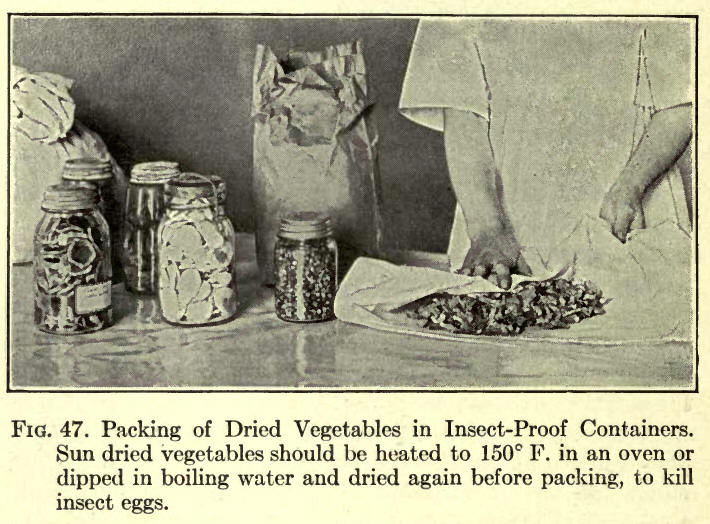
77. Processing Sun
Dried Vegetables. Sun dried vegetables must be sterilized by
steaming a short time or plunging in boiling water for about half a
minute or by heating through in an oven to destroy insect eggs. The
excess moisture can then be dried out before packing.
Artificially dried
vegetables do not require sterilization if they are packed soon after
drying.
78. Packing and
Storing Dried Vegetables. Vegetables should be packed in
insect-proof containers and stored in a dry place secure from rodents.
Ordinary cloth or burlap sacks are not insect-proof; but if the dried
vegetables are first wrapped in paper or placed in paper bags they may
then be safely stored in sacks. It is a good plan to hang the sacks of
vegetables from a rafter so that mice or rats will not reach them.
Dried vegetables may be
pressed into cubes or bales. This economizes on space and checks insect
injury. |