|
Sirups for table use and
for cooking purposes may be made in the kitchen or in a small way on the
farm with the materials found at hand or constructed at small expense.
Usually, these home made sirups will not be as light colored as the
factory made products but will be of pleasing flavor, if carefully
prepared. Grapes and apples are especially well suited to the
manufacture of sirups. Sorghum is also excellent. The general principles
of sirup manufacture will be found in Chapter VIII.
(51) Fruit Sirups for
Cooking Purposes.
1. Crush the fruit and
press out the juice. Apples and berries may be heated to boiling after
crushing to facilitate extraction of the juice.
2. Heat the pressed juice
to boiling and filter through a jelly bag or other form of filter until
clear. The juice may also be clarified by methods described in Recipe
50. This will give a clearer and more attractive sirup.
3. Boil the juice down
rapidly in a shallow pan. Long boiling causes the sirup to be dark
colored and of poor flavor. The hot sirup should finally test 63%
Balling or 35° Baumé or must be boiled until it becomes of the desired
consistency.
4. Pack the sirup boiling
hot into scalded jars or bottles and seal at once. Sirup that tests 63°
Balling hot or 68° Balling cold will keep without packing hot in scalded
jars or bottles. The sugar test is not necessary if the sirup is sealed
hot.
Sirups made as above are
suitable for use in mincemeat etc., but are somewhat too sour for table
use. Grapes and apples are the most suitable fruits for this purpose.
(52) Fruit Sirups for
Table Use.
1. Clarify the fruit
juice. To do this, heat to boiling and strain till clear or clarify
according to Recipe 50.
2. Divide into two lots
representing 1/4 and 3/4 of the juice respectively.
3. To 3/4 of the juice
add 2 oz. (3 tablespoonfuls) of precipitated chalk per gallon. Heat to
boiling and allow to stand overnight. Filter through a jelly bag to
remove the chalk. The juice may also be treated with baking soda instead
of chalk. Add the soda in small amounts until there is no longer any
acid taste. Do not add too much soda.
4. To the filtered juice
add the 1/4 of untreated juice. Boil the juice down to a sirup and seal
boiling hot in bottles or jars. This sirup is less acid than that made
by the preceding recipe and can be used on griddle cakes, etc.
Precipitated chalk may be
bought from any drug store. Ground limestone may also be used. It is
harmless.
(53) Fruit Sirups by
Sun Evaporation. (See Chap. VIII, par. 35.)
1. Crush the fruit, press
out the juice and strain or filter it until clear.
2. Place the juice in a
shallow pan or make a shallow wooden water-tight trough. Place whole
apparatus in a sunny place. Hang from a clothesline or other support
above the container several strips of cheesecloth. (See Fig. 29 for
diagram of such an arrangement.) Dip the cloths in the juice and hang
them above the pan or trough. In a few minutes the juice will dry to a
sirup on the cloth. Dip them in the juice; wring out the sirup into the
juice; dip again and hang up to dry. Repeat this until the sirup reaches
65% to 68% Balling or 35% to 37% Baumé. (See Chap. II, par. 11, for use
of these testers.) Store in bottles or jars.
This sirup will have a
great (leal of the fresh fruit flavor and may be diluted as a beverage
or may he used in cooking. Sirups for table use may he made in a similar
way by modifying Recipe 52 accordingly.
(54) Fruit Sirups made
by the Addition of Sugar.
Highly flavored and tart
juices may often be sweetened with sugar to give heavy sirups suitable
for use in soda fountains or as bases for home made beverages.
1. Lemon, Orange and
Grape Fruit Sirups. Grate off the oil cells from 1/2 doz. fruits. To the
gratings add 2 1/2 lbs. of sugar and 1 pint of the juice of the fruit
used. Warm until sugar dissolves. Stir and allow to stand with
occasional stirring for three or four days. Press through a cloth to
remove gratings.
2. Pomegranate, red grape
juice, strawberry, loganberry, raspberry, and blackberry juices may be
made by adding 1 3/4 lbs. sugar to each pint of juice. This sirup will
keep without sterilization.
(55) a. Sorghum Sirup.
Home Recipe.
1. Crush the green sugar
sorghum canes. A food chopper may be used for small scale work; for
larger scale work a cane mill will be needed. The ground cane may be
boiled with a small amount of water and pressed a second time.
2. Heat the juice to
boiling and strain until clear.
3. Boil down until the
sirup will test 63% hot or 68% Balling cold, or until of desired
consistency. Seal hot in scalded jars, bottles, or cans.
(55) b. Manufacture of
Sorghum on Small Commercial Scale.
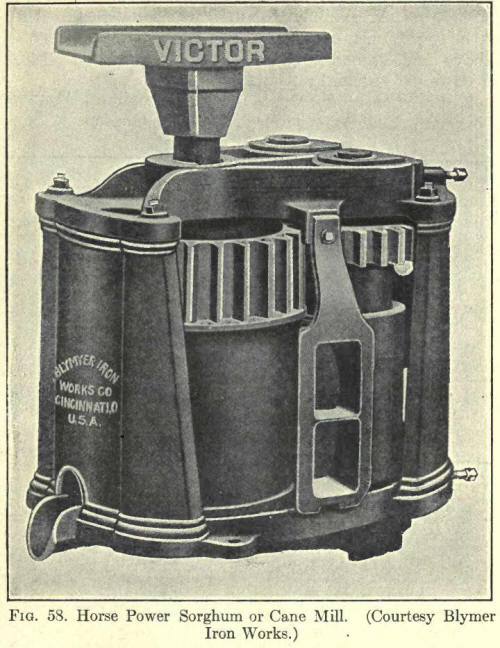
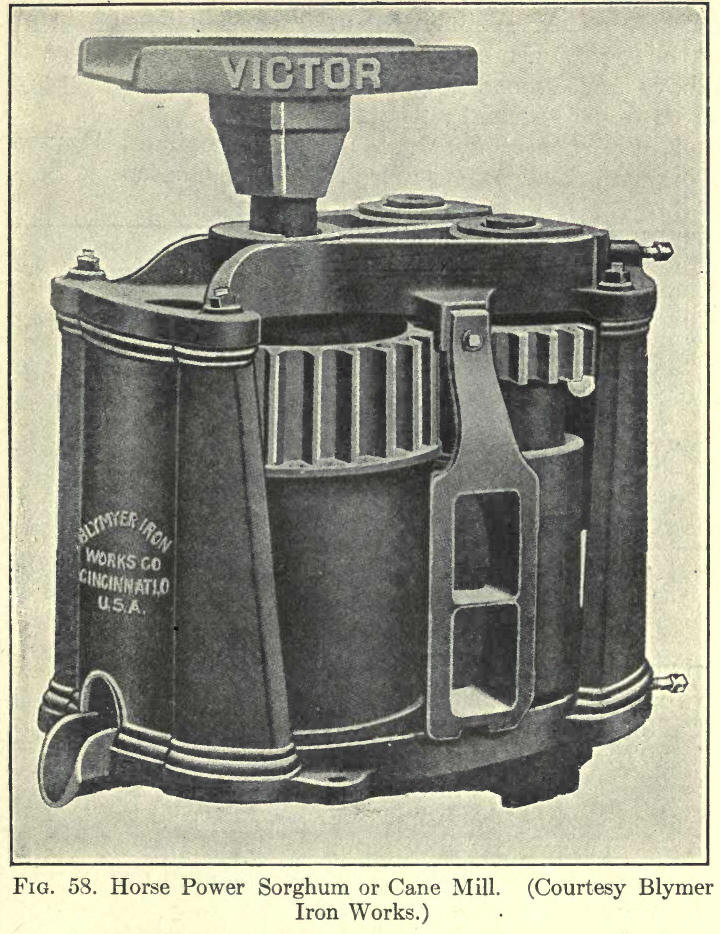
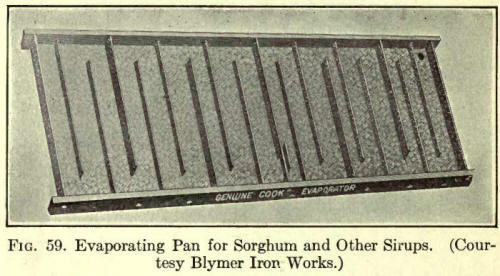
1. Equipment. Small horse
power mill (see Fig.); galvanized iron or copper evaporating pan 8 to 10
ft. long (see Fig.); portable furnace for pan; settling pan at crusher
about 6 to 8 ft. long to permit settling of juice (this pan may be made
of galvanized iron to receive juice at upper end of pan and to allow
settled juice to flow out at lower end into a settling tank); settling
tank or barrel of 50 gals. capacity for fresh juice; two open 50 gal.
barrels; skimmer for use during boiling of sirup; 10 or 15 gal. open
barrels or tubs with spigot, to be placed above and at one end of
evaporating pan to supply juice to pan; several buckets and dippers.
2. Varieties of Sorghum..
Honey Sorghum, Orange Sorghum, Red Amber Sorghum, and Gooseneck Sorghum
are all good varieties. Plant quick maturing varieties in Eastern states
and late maturing varieties in California.
3. Harvesting. Strip off
leaves from canes when seed is almost ripe; cut canes at 6 to 8 inches
from ground. Cut off seed heads and haul stripped cane to the mill at
once. Leaves and seed heads spoil the flavor of sirup and make it hard
to clear, therefore, they should be used for forage only and not for
sirup.
4. Press juice from
stripped cane by running it through a sorghum mill (see Fig.). The mill
is set on supports so that bottom of rollers is about 40 inches from the
ground and is operated by a sweep fastened to top of rollers and drawn
by one or two horses. Power mills may be used for larger factories.
5. Allow juice from mill
to flow continuously through settling pan and from settling pan into a
50 gal. settling tank.
6. Heat to boiling and
allow to settle 4 or 5 hours in settling tank. This can be done by
running the juice through the pan at such a rate that it will be heated
to boiling but not concentrated to a sirup. Skim off floating material
and draw settled juice off from sediment. The settled juice is used for
sirup; the sediment may be used for stock feed or strained and used for
sirup.
7. Fill the evaporating
pan with the juice and boil down to a sirup. Allow sirup to flow from
the pan and the juice to flow into the pan at such a rate that the sirup
tests when hot, 36° to 40° Baumé or 65° to 73° Balling or Brix. A very
hot fire is essential; quick burning wood is best; crude oil can be used
if a special burner is installed.
8. Allow sirup to settle
4 or 5 hours in a shallow vessel. Draw it off and fill into sirup cans
or kegs.
Sorghum sirup outfits may
be obtained from dealers in farm machinery. (See par. 12, and par. 46,
for description of sugar and sirup testers.)
(56) Sugar Beet Sirup.
1. Wash and cut in thin
slices. The thinner the slices the better.
2. Place slices in a pot
and barely cover with water. Bring to the simmering point or to 175° to
180° F. and keep at this temperature about 45 min. Strain off the hot
sugary liquid through a cheesecloth. It is not necessary to press the
beets. A second more dilute juice can be obtained by heating the slices
with fresh water.
3. Strain the juice till
fairly clear. Boil down rapidly to a heavy sirup and skim off material
that comes to the surface. Seal hot in scalded jars, bottles, or cans.
This sirup will be dark colored but is suitable for some forms of
cooking and for table use. |