|
Many fruits and other
substances may be used as sources of sugary liquids which may be
evaporated to sirups suitable for cooking and table use. In most cases
the ordinary kitchen utensils will be all that is required in the way of
equipment.
33. Sources of Sirups.
Maple, sugar, beet, cane, and sweet sorghum saps; grape, apple, peach,
prune and some other fruit juices can all be used as sources of table
and cooking sirups. They can be prepared with ordinary kitchen
equipment. Such sirups will be more or less dark colored and will not be
equal in flavor to the best grades of commercially prepared table sirup,
but still very palatable sirups can be produced in the home.
34. Clearing the Juice.
The juices should be expressed as for fruit juices. The juice should be
made as clear as possible before concentration by heating to boiling for
a short time with clarifying agents as described in paragraph 30 or by
filtration after boiling. The clearer the juice is before concentration
the more attractive will the sirup be. The juice will filter more
rapidly hot than cold.
35. Deacidification.
Some juices are improved for table use by removing a portion of the
acidity before concentration. This is especially true of grape, sorghum,
and apple juices. Precipitated chalk will combine with and remove fruit
acids. It maybe obtained at any drug store.
The acidity must not be
completely neutralized or the sirup will be very dark colored and of
poor flavor. Partial deacidification is best accomplished as follows:
The cleared juice is
divided into two portions, one equivalent to three-fourths and the other
one-quarter of the total. To each gallon of the larger portion is added
an ounce of the chalk. It is heated with constant stirring to boiling.
It is then removed from the fire and allowed to stand twenty-four hours.
The clear juice is poured off from the sediment and filtered. The
sediment may be filtered to recover the juice contained in it.
To the treated juice is
added the untreated portion. This will give a combined juice of
one-fourth the acidity of the original fresh juice.
Juices of very low acid
need not be treated with chalk.
36. Concentration.
The sirup must be boiled down until it will test 700 Brix or Balling or
37° Baum6 in order that it will contain enough sugar to prevent
spoiling. The concentration should be carried out as rapidly as possible
in shallow vessels to minimize scorching the sirup and darkening the
color.
Large factories carry out
the concentrating process under a vacuum, which causes the juice to boil
at a lower temperature than 212° F. This prevents darkening of the color
and scorching. Vacuum evaporators are too expensive for small scale
operations and the housewife or farmer must use open pans or kettles.
The shallower the pan, the more rapid the evaporation will be and the
less the injury to flavor and color. A large rectangular tin lined pan
built in over a brick furnace can be used for larger scale work. These
pans are usually so arranged by partitions that the juice may be added
at the upper end of the pan and sirup will flow from the lower end, the
excess water being boiled off as the juice flows from the upper to the
lower end.
During evaporation,
samples of the sirup should be taken and transferred to a tall jar and
tested with a hydrometer. A tall olive bottle or tall narrow can will
answer for a hydrometer jar. The hydrometer may be purchased from any
chemical supply house for about fifty to seventy-five cents or through a
drug store. The druggist will usually order one on request. The Brix or
Balling hydrometers ordered should read from 0 to 70° and the Baume from
0 to 50°. A glass cylinder for the hydrometer, if desired, can be
obtained for about fifty cents. If the purchase of a tester is not
deemed worth while the sirup is simply boiled down to a very thick
consistency. It may also be boiled down only partially and sealed in
jars or bottles boiling hot. If this is done the sirup will keep with
less than 65% sugar.
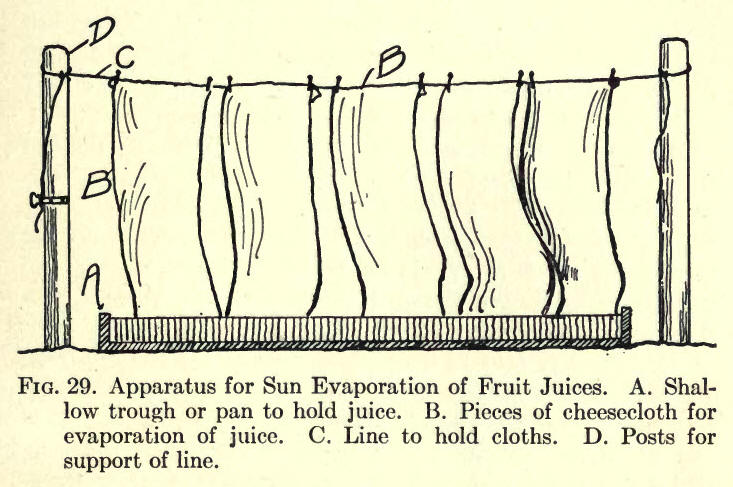
Sun Evaporation: Sirup
may also be made by evaporation in the sun by the Waterhouse method. The
clear juice is placed in a broad shallow pan or in a shallow wooden
trough. Above this is hung a number of lines from which hang pieces of
cheese cloth. The whole apparatus is placed in the open. The cheese
cloth is dipped in the juice and hung on the lines. The air and sun
quickly dry the juice on the cloth to a sirup. The cloths are then
dipped in the juice and the sirup wrung out into the juice. They are
again wet with the juice and hung up to dry. The process is repeated
until the consistency of a heavy sirup is reached. This process was
developed by Addison G. Waterhouse, and was patented by him a number of
years ago. He devised a number of methods by which the cheesecloth was
made in the form of a long endless belt which revolved slowly. It passed
through the juice at one end of the circuit and through rollers at the
other end which squeezed out the evaporated juice.
The method is easy of
application and inexpensive. (See Fig. 29.)
37. Storing the Sirup.
If concentrated so that the juice will test 700 Balling or Brix or 370
Baume when cold, the sirup may be stored in any sort of tin, glass, or
wooden container without sterilization. If less concentrated than this,
it should be poured boiling hot into scalded jars, bottles, or cans, and
sealed hot. It will then keep indefinitely. |