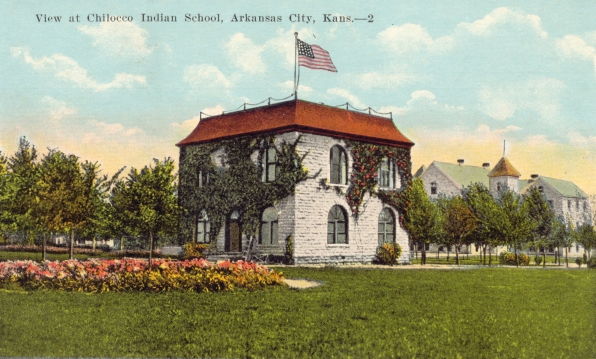
|
Disclaimer
This material was taken from old annuals and historical records of the
Chilocco School. There is no infringement of copyright because there is no
entity existing to defend a copyright at this time. Chilocco is no long
functioning since 1980. These old records have been handed to me by
family members who had parents and grandparents that saved their annuals.
There is no agreement or disagreement on the part of the compiler, Donna
Flood, but merely a recording of history.
Click
here to find contacts to get further information
This is the month of January 1881. A wagon
train is rumbling slowly across the plains of Oklahoma. For four long
weeks it has held to its course which runs to the northeast. Closer
examination reveals the occupants are weary and travel worn and more
than a little frightened as they realize the journey is drawing to a
close. These occupants are Kiowa and Comanche Indian children who are on
their way to Chilocco, the newly established Government boarding school.
Their irresponsible, carefree days are done and they are among the first
group which is to receive an education at government expense.
On May 17, 1882, the United States congress
passed a bill, known as the Indian Appropriation Act, whereby a sum of
money was to be appropriated for the building of a school for Indian
youth. The secretary of the Interior then authorized the construction of a
building which would be adequate to care for 150 children. That same year
James M. Haworth, Superintendent of Indian Education, was sent to
investigate the possibility and advisability of such a plan.
The first tract of land which he took under
consideration was located near where Ponca City now stands. This land was
rejected, however, as it was found to be unsuitable. The site which was
eventually selected consisted of 1191.06 acres which bordered on the
Kansas state line. Haworth then made his report to Washington and upon
receiving orders soon had men at work on the project.
A quarry of magnesium limestone was located
and stone cutters began the task of shaping stone for the building. since
it had been decided that the best and most economical way of launching
this project was to place all departments under one roof. This was the
then gigantic structure which soon began to rear its form to the sky. By
January 1883, it was pronounced completed. It was ready for
occupancy.
Cowboys and Indian who rode by gazed at the
huge three storied building with wonder mixed with awe. It is quite easy
to understand why children who had lived in small cabins and teepees
should be frightened at the prospect of leaving their homes and parents to
live in such a large building around which the cold north wind so
mournfully howled. The building was called Home two and it was used to
house the small boys.
Jasper M. Hadley had received his
appointment as the first superintendent of the new school and was there to
welcome the little homesick waifs who soon began to feel very much at home
in the building which housed all the students, all the employees, and all
the activities pertaining to the school.
It was soon decided that since the boys
were to be taught how to farm, more land was needed. Accordingly, on July
12, 1884, the president issued an order whereby the tract was increased to
8640 acres. In 1886, the Cherokees had deeded a portion of their outlet to
the government for school purposes. it is not presently known
whether the school occupies that land.
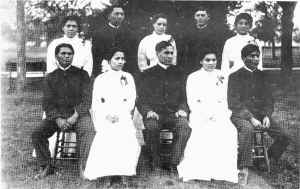 The
children fell readily if awkwardly into the scheme of work which consisted
only of the traditional three R's and the rudiments of such vocational
training as farming, black smithing and simple leather work. In a short
time it was found that the school was too small to accommodate adequately
the dozen of children who were clamoring for admission. Accordingly, other
buildings were erected. Year after year the school has been enlarged until
at the present time, November 1932, there are some nine hundred children
adequately cared for in the six large dormitories. still many are turned
away each year for lack of accommodations. The
children fell readily if awkwardly into the scheme of work which consisted
only of the traditional three R's and the rudiments of such vocational
training as farming, black smithing and simple leather work. In a short
time it was found that the school was too small to accommodate adequately
the dozen of children who were clamoring for admission. Accordingly, other
buildings were erected. Year after year the school has been enlarged until
at the present time, November 1932, there are some nine hundred children
adequately cared for in the six large dormitories. still many are turned
away each year for lack of accommodations.
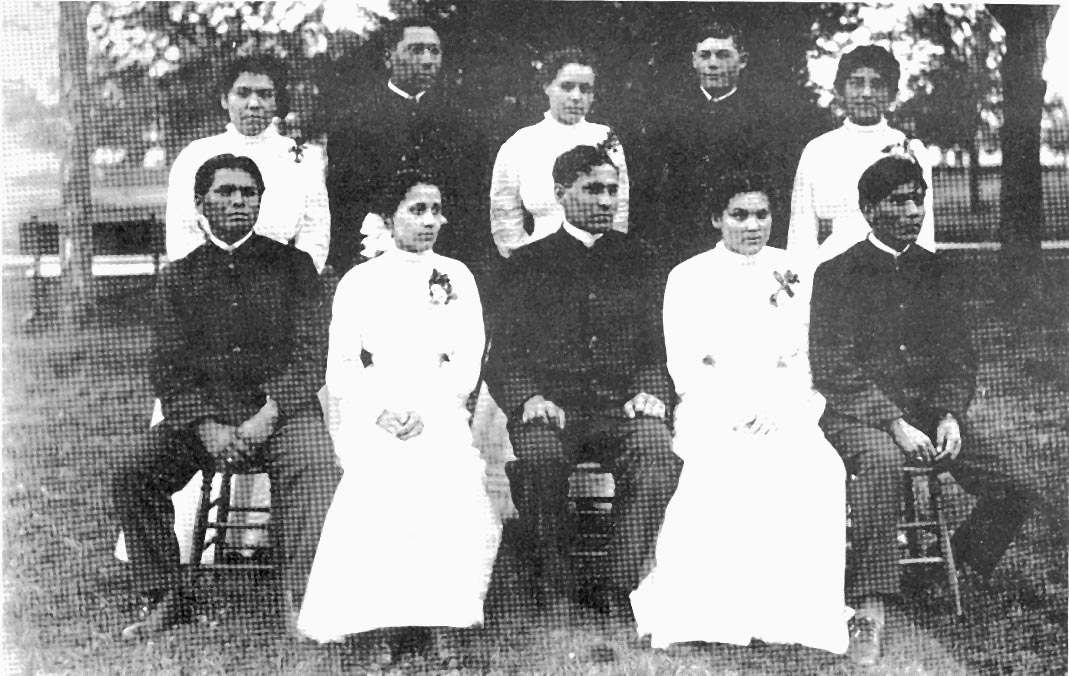
In 1894, ten years after the establishments
of the school, the first class consisting of six boys and nine girls,
marched proudly up to receive their diplomas for a work well done.
Finally in the evolution of education the
school was graded. Then after some time a two years high school course was
instituted. In 1925 the eleventh grade was added and in 1927 the first
class of twenty-eight students was graduated from the twelfth grade. One
of the girls, Josephine Washburn, is now an assistant adviser in one of
the girls' dormitories. The academic department became fully accredited
under the laws of the Oklahoma state schools in the spring of 1932. (It
might be interesting here to note that the same spring sixty-eight young
men and women bade the school and employees a fond farewell and went forth
with their diplomas packed carefully among their belongings.)
While the academic department has been
moving onward and upward the vocational departments have been making
equally rapid progress. While the children had been receiving very
valuable instruction in vocations all through the years it was not until
1932 that a truly vocational school was organized. Over -aged children who
find the regular academic work tedious or difficult are now classified in
the vocational school where they are taught a means of livelihood and are
given diplomas at the end of the course. All students attending Chilocco
are allowed to select vocations tentatively while in the junior high
school but they cannot make their decisions final until they enter the
senior high school. All are required to choose and learn a vocation before
graduating.
Each year hundreds of car loads of people
leave the highway and ride down the beautiful tree bordered drive to visit
the school and view the attractive campus which is one of the show places
of this section of Oklahoma. Without exception they are visibly
impressed with the opportunities offered to, and the courtesy and
graciousness shown by the student body. However, it takes the real old
timers to remember that at one time the pleasant tree shaded campus which
is surrounded by so many beautiful vine covered buildings, was once only a
sun baked prairie where stood just one tall, bleak building, upon which
the heat of the summer sun beat mercilessly down, or around which the
winter wind howled dismally as it did when that first group of
lonesome, frightened little Indian boys and girls came to Chilocco.
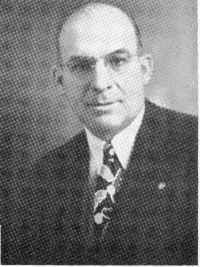 Mr.
Ernest C Mueller was the principal at the year of 1953 when I first
entered the Indian School of Chilocco. My first memory of him was when my
mother and I were sitting in his office. There was something deep and
strong about the man. He had all my paper work in his hand while he seemed
to dismiss all the incoming responsibilities while he spoke directly to
me. "We are offering you an opportunity. Our school is under the
guidelines of the federal government and these are the people to whom we
answer, not state, not local authorities but to our country of the United
States of America. Work hard, be a good student, stay out of trouble and
you will do well as I am sure, from looking at your grades, you will
do." Mr.
Ernest C Mueller was the principal at the year of 1953 when I first
entered the Indian School of Chilocco. My first memory of him was when my
mother and I were sitting in his office. There was something deep and
strong about the man. He had all my paper work in his hand while he seemed
to dismiss all the incoming responsibilities while he spoke directly to
me. "We are offering you an opportunity. Our school is under the
guidelines of the federal government and these are the people to whom we
answer, not state, not local authorities but to our country of the United
States of America. Work hard, be a good student, stay out of trouble and
you will do well as I am sure, from looking at your grades, you will
do."
His statement short, concise, and it was
with this he was busily off to some other part of his work. I always was
struck with his strength of character. These are his words to the
graduating class of 1952...
You are to be congratulated for having
completed the requirements for high school graduation and so it is with
sincerity and appreciation that I offer you these congratulatory
greetings.
Sincerity, because I realize that you are
due a great deal of praise. You have come a long way on the road to
successful living. No boy or girl could have accomplished what you have
without having developed within his inner-self a determination to
accomplish a definite purpose in life.
Appreciation, because it has been a genuine
pleasure for me to work with you during the four years that you have been
at Chilocco. You came to Chilocco as a high school freshman and during the
days and years that you have been here, you have not only grown and
developed physically but you have also developed socially, morally and
spiritually. You have developed mental attitudes and aptitude skills.
As your school principal, I take pride in
you as a product of this school.
Ernest C. Mueller,
Principal
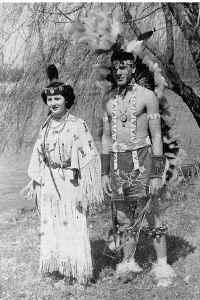 Like
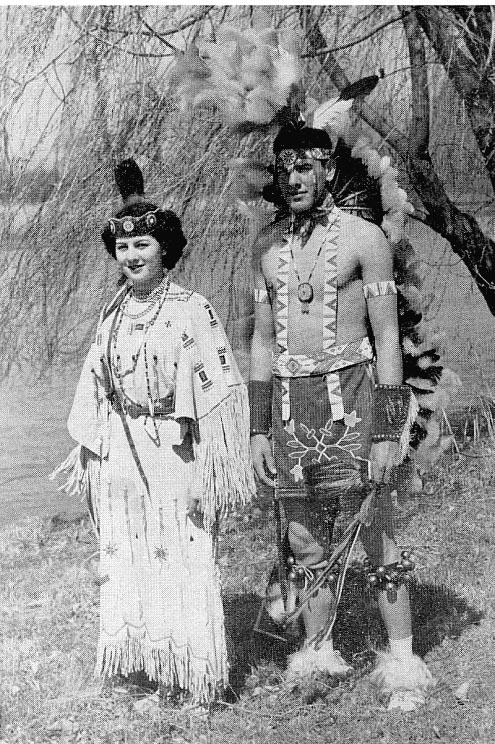
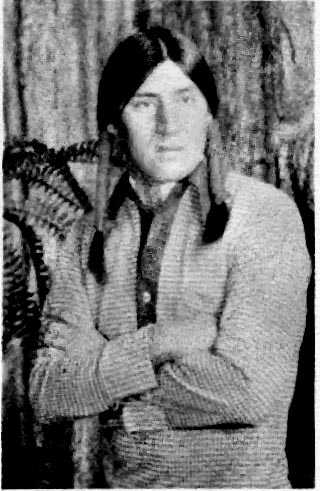
any school, honors were given to students who were willing to live
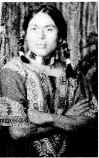
by the rules and work toward their own achievements. The Princess and
Brave honor was given to someone who had been active in the Indian Club.
They were supervised by learned people as to the particular tribe and the
appropriate costume of that tribe. Today, many people are mixing
regalia. However, at this time, 1952 there was still an adherence to the
conservative nature of the American Indian. This boys costume is marked on
his breechcloth with the symbols of the woodland, flowers and herbs which
tells he is of the woodland plains tribes. He wears a fancy dancer
regalia. Symbols on the beadwork around his neck is of the mountain
design, also telling of a coming out of the mountains (maybe) to the
plains area. He wears no roach which says he is not Osage or if he is, he
hasn't been named yet, which still could be a possibility because he holds
a whip in his hand saying he is a "whip man." This
person's duty is to "whip" the dancers who sit out too
long during the ceremonies. They don't literally whip anyone, just drag
the leather thongs over their legs to remind them they are sitting out too
long. Barely visible to the back of his legs is the broadcloth strip of
fabric. This company prides itself in the fact that the basic design, that
of dark navy blue woven wool trimmed in a narrow edge of color has not
changed in over 200 years. Like
any school, honors were given to students who were willing to live
by the rules and work toward their own achievements. The Princess and
Brave honor was given to someone who had been active in the Indian Club.
They were supervised by learned people as to the particular tribe and the
appropriate costume of that tribe. Today, many people are mixing
regalia. However, at this time, 1952 there was still an adherence to the
conservative nature of the American Indian. This boys costume is marked on
his breechcloth with the symbols of the woodland, flowers and herbs which
tells he is of the woodland plains tribes. He wears a fancy dancer
regalia. Symbols on the beadwork around his neck is of the mountain
design, also telling of a coming out of the mountains (maybe) to the
plains area. He wears no roach which says he is not Osage or if he is, he
hasn't been named yet, which still could be a possibility because he holds
a whip in his hand saying he is a "whip man." This
person's duty is to "whip" the dancers who sit out too
long during the ceremonies. They don't literally whip anyone, just drag
the leather thongs over their legs to remind them they are sitting out too
long. Barely visible to the back of his legs is the broadcloth strip of
fabric. This company prides itself in the fact that the basic design, that
of dark navy blue woven wool trimmed in a narrow edge of color has not
changed in over 200 years.
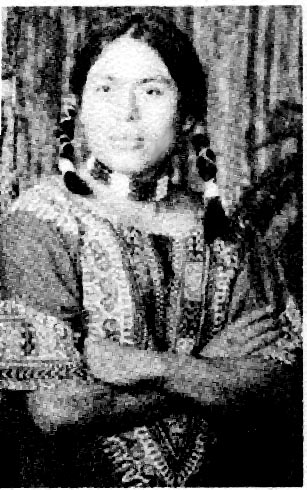
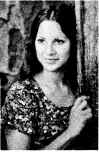
The girl is very fair and
probably doesn't know her traditions as well. She wears a northern
buckskin dress. However, the belt she wears looks to be store bought
rather than a finger woven wool fiber belt. She has an expensive beaded
head dress, but she wears an eagle feather instead of the tradition plume
of the plains maidens. At her neck should be a necklace telling whether
she is maiden, mother, or grandmother. Three medallions for a maiden, two
for a mother, one for a grandmother. She is not carrying the customary
shawl on her arm, neither does she hold a fan in her hand. One clan of the
Poncas has the right to wear the buckskin dress, and I'd be willing to
wager she is not of that clan.
 At this time, 1952, all these
traditions were strictly carried out. Today is different. There is a
blending and sometimes it is difficult to tell just what is tribe of
the person. The clan is even more obscure and is not marked with strength
on their dress. Probably, because our clans have become blended and are
not required to be followed as to their archaic laws and principles. At this time, 1952, all these
traditions were strictly carried out. Today is different. There is a
blending and sometimes it is difficult to tell just what is tribe of
the person. The clan is even more obscure and is not marked with strength
on their dress. Probably, because our clans have become blended and are
not required to be followed as to their archaic laws and principles.
There wasn't a campus anywhere
that was as beautiful as the Chilocco campus and as we strolled past the
fountain located in the center of the oval we were watching Mrs. Hayman as
she drove around that circle.
"She's your mom!" my friend told me and I had to smile,
because, indeed, I spent as much time with her as I would have spent with
my mother. It was just the way of the students to joke with one another
about their lives there at the boarding school known as Chilocco Indian
School.
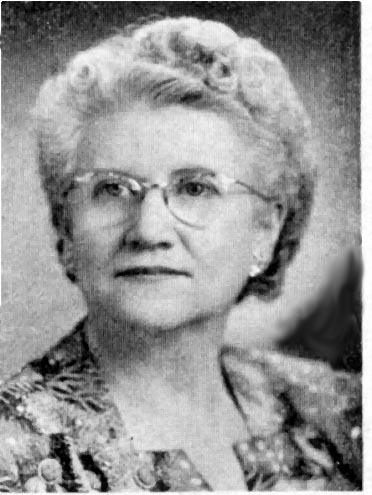
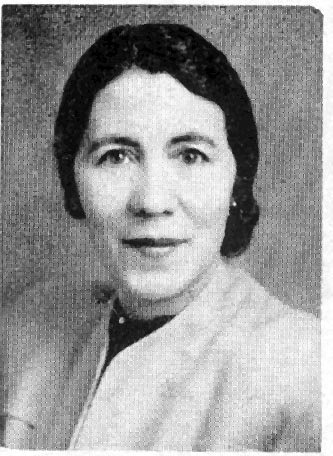
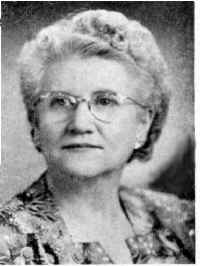 Miss
Vivian Hoage became Mrs. Claude Hayman, as she began teaching at Chilocco,
grew up teaching there and married Mr. Hayman when his first wife died.
Mrs. Hayman was the journalism teacher and as was the schedule I was
assigned to her as her "girl," to carry notes, sharpen pencils,
edit, write, proofread a big part of the school weekly newspaper, The
Indian School Journal and whatever other duties I performed in order
to be given my vocational training for one half a day. Mrs. Hayman's
classroom looked out over the lake where the green lawn just lay in a flat
almost non-existent slope toward the water. The white bobbing geese kept
their activities up and down the waters and were there for the pleasure of
the students to observe. Life was kind, easy, with nothing what so ever to
interrupt the peacefulness of it. Miss
Vivian Hoage became Mrs. Claude Hayman, as she began teaching at Chilocco,
grew up teaching there and married Mr. Hayman when his first wife died.
Mrs. Hayman was the journalism teacher and as was the schedule I was
assigned to her as her "girl," to carry notes, sharpen pencils,
edit, write, proofread a big part of the school weekly newspaper, The
Indian School Journal and whatever other duties I performed in order
to be given my vocational training for one half a day. Mrs. Hayman's
classroom looked out over the lake where the green lawn just lay in a flat
almost non-existent slope toward the water. The white bobbing geese kept
their activities up and down the waters and were there for the pleasure of
the students to observe. Life was kind, easy, with nothing what so ever to
interrupt the peacefulness of it.
"If Mrs. Hayman is
my Mom, Flodelle is yours!" and her friend had to laugh equally
as much as she had a moment earlier.
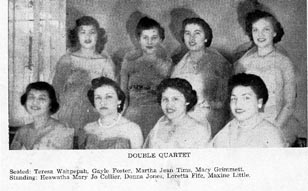
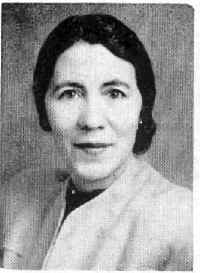 Flodelle
Dyer was the choir teacher. The children, away from her hearing,
quietly spoke of her as Flodelle. She was not a young woman but it was a
fact she would forever look like a youthful person with high clicking
heels, fashionable clothes, and, oh the music, to make anyone a dreamer.
She hammered out the scales and arpeggios early each morning at choir
practice, seven a.m. while in their youthful zest for life the music was
sheer magic. There was music from stage shows of Roger and
Hammerstein, Oklahoma, spirituals, light folk music, and whatever struck
the fancy of the quick, hard working lady. Flodelle
Dyer was the choir teacher. The children, away from her hearing,
quietly spoke of her as Flodelle. She was not a young woman but it was a
fact she would forever look like a youthful person with high clicking
heels, fashionable clothes, and, oh the music, to make anyone a dreamer.
She hammered out the scales and arpeggios early each morning at choir
practice, seven a.m. while in their youthful zest for life the music was
sheer magic. There was music from stage shows of Roger and
Hammerstein, Oklahoma, spirituals, light folk music, and whatever struck
the fancy of the quick, hard working lady.
To say she was partial to any student was not a fact. She equally spread
the music around to who so ever wished to participate. All one had to do
was have the willingness to take a solo, an octet, or an operetta and the
part was handed out. She created memories never to be forgotten. The
Spanish dancers in the operetta, the pageant while exercise clubs swung in
unison, painted with reflective light and spot lighted with black light to
The Merry Widow Waltz, or the haunting voice of a talented soprano as she
sang a popular love song, all were memories to be held in heart and mind,
forever.
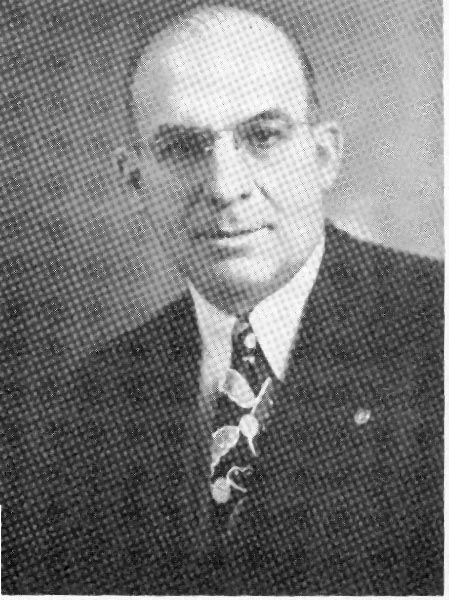
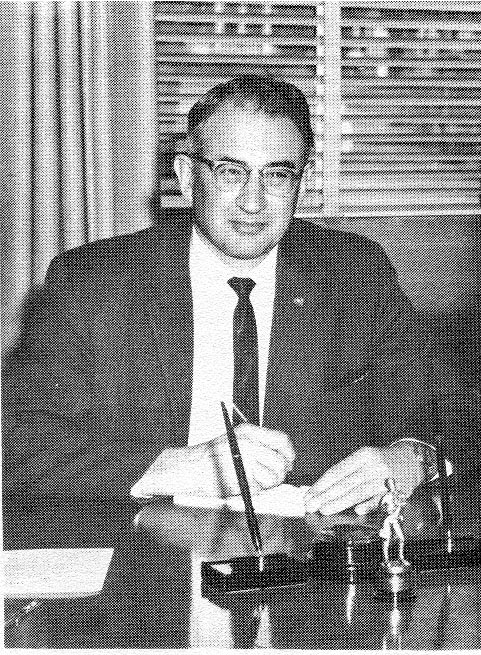
Dr. Leon Wall, was named
superintendent of the Chilocco Indian School August, 1962. In
acquiring this new position, he became the 13th superintendent at Chilocco
since the school opened in 1884. Prior to this time he served six and
one-half years as principal at Chilocco and also was a teacher,
educational specialist, and principal in the states of Nevada, Arizona and
North Dakota.
Dr. Wall brought to his new
position six years of teaching in state schools and twenty-three years of
service with the Bureau of Indian Affairs. He is a veteran of world War II
and served in the American, European and Asiatic theaters.
His formal education consists
of a bachelor's degree from the University of Oklahoma, a master's degree
from the University of Nevada, and a doctor of education degree from
Oklahoma State University.
One of Dr. Wall's
accomplishments, worthy of mention, is the fact that he was the author of
a 10,000 word Navajo language dictionary which is used extensively in the
field of education. He has also aided in developing techniques which may
be effectively used in teaching English to Navajo children.
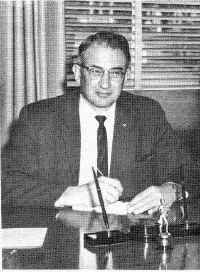 I
had the honor and privilege of serving as Dr. Wall's secretary for a short
appointment while his regular girl was on maternity leave. The year I
worked with him gave me a wealth and depth of understanding and
appreciation for these gentle educators who sacrificed everything to work
and give to the Native American children at Chilocco and in Dr. Wall's
position not only at Chilocco but other schools as well. I
had the honor and privilege of serving as Dr. Wall's secretary for a short
appointment while his regular girl was on maternity leave. The year I
worked with him gave me a wealth and depth of understanding and
appreciation for these gentle educators who sacrificed everything to work
and give to the Native American children at Chilocco and in Dr. Wall's
position not only at Chilocco but other schools as well.
He had a love for Navajo
people and the short association I had with one of them gave Dr. Wall and
I a mutual respect for the tribe. Dr. Wall who was patient and respectful
of the many folks he was serving and with whom he worked. He was a tall
giant of a man but his quiet and always pleasant ways made him
approachable. I feel I helped him through a transition period when he
first accepted his position at Chilocco since I was acquainted with the
staff and the system there. I was very young just out of a couple of years
of college and he gave me a very good feeling about myself as to my being
able to know names and procedures, up to a point, and with my lending this
knowledge to him. Such questions, "Mrs. so-and-so called me, now who
is she and what department is she over?" was just a minor problem but
it made for a smoother work day for him to have access to my being able to
provide these small details. To teach him how to operate the archaic
printing press type machine for the many bulletins which were part of the
paper work of the government was really not a small thing, since the
contraption had at least twenty steps to follow in precise order before it
would function. I had worked in the office during my school years there
and learned the temperamental machine's ways, and was one of the few
people who could operate it. He was not too lofty in his position to
humble himself to meekly learning its ways, and with trial and error, just
as everyone would have to do. It was a small joy to see him finally,
skillfully turning out the great amounts of copies necessary for this or
that report.
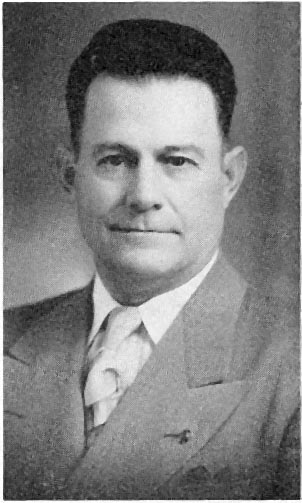
On the front pages of the 1952
yearbook the dedication of the book is given to the Superintendent, Mr.
Lawrence E. Correll and it says,
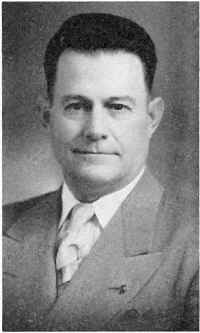 "To
our beloved superintendent and good friend, Mr. L.E. Correll we bestow
this very high honor. Mr. Correll has been at Chilocco since August 15,
1919. The next day after he received his Bachelor of Science degree at
A.& M College in Stillwater, Oklahoma, he was appointed to the
position of instructor of agriculture, a position he kept until he became
director of agriculture in 1924. "To
our beloved superintendent and good friend, Mr. L.E. Correll we bestow
this very high honor. Mr. Correll has been at Chilocco since August 15,
1919. The next day after he received his Bachelor of Science degree at
A.& M College in Stillwater, Oklahoma, he was appointed to the
position of instructor of agriculture, a position he kept until he became
director of agriculture in 1924.
It was the spring of 1925 when
Mr. Correll received his Master of Science degree at Oklahoma A&M .
From July 1, 1926 until this present time, 1952, he has been
superintendent at Chilocco.
His words: "During
the time you have been at Chilocco, the faculty of this school has given
you the essential vocational training to enable you to go out and earn a
respectable livelihood; in addition we have given you the traditional
academic training usually offered in a high school. Your little
class annual, The Chiloccoan, will give you a written as well as a
pictorial history of your work while a student at Chilocco. Be sure to
keep your present memories and acquaintances, active, and fresh in your
minds."
As the school was closed in
1980 there were many sorrowful, sad, and deep regrets, among the faculty
and the students as well. The school had served its purpose, it brought
the American Indian into the mainstream of society and with that there was
no longer a need for the institution. With Mr. Correll's retirement it
gradually began to disintegrate. He was a strong influence on its success
as long as he was in charge. He was an astute business man, a strong
leader in the total community and kept a good press for the school. While
he was there the school was self sufficient and was kept up largely
by the functioning of its own society. It was self contained requiring no
great drain on the government for moneys. The dairy provided, the
orchards, the livestock, chickens, beef, mutton. The labor for the upkeep
was provided by the students in whatever vocation they chose to follow.
Remember Mr. Correll had his degree in agriculture. Actually the school
operated like a minuscule country, totally encapsulated and with its own
peaceful government. It was probably true Mr. Correll could maybe have
been called the king. However, if that was so; he was a king with a
benevolent rule for his subjects, the children of the Native American
tribes. Even if there were 1000 students in a year he could call each one
of them by name if there happened to be a chance encounter on the lawn or
at some social occasion. He, like the other hand picked employees,
dedicated their lives to a cause, and it was this cause to set an example
of peace, obtained through that dedication and hard work to all who wished
to remain, obediently following the sharp military like rules, in
what could be remembered as a Utopia for the four years required to obtain
their high school education. Some picked up on that order and continued
living on there as employees also. The freedom from teachers uneducated in
dealing with the racial prejudice, poverty, fear of failure, uncertain
living circumstances, unbalanced diets gave the children a great reward
for their complying with the sometimes heavy strict rules with five thirty
in the morning rising and lights out by nine thirty at night. It was
common to see the students with their books on the floor studying through
a crack in the door where the hall light came through, if this didn't go
on too late and then was corrected by the ever present rounds of the hall
monitors.
The side effects of the
peaceful experiment was the blending of the great numbers of tribes as the
students became acquainted and later were actually united in marriages.
This had the greatest impact on the strong cultures of the tribes as
to a weakening of their definite customs through intermarriage.
Whether this was thought out by great minds or just happened will probably
never be known.
 Of
course, all rules are made to be broken and this in itself was a challenge
which is always joyfully recounted at the alumni meetings up until the
students are quite elderly remembering the fun of "getting away"
with some infraction. The breaking of a rule usually involved something as
innocent as avoiding the hall monitor so as not to necessarily
attend some social event in order to study or something else as
non-destructive. Of
course, all rules are made to be broken and this in itself was a challenge
which is always joyfully recounted at the alumni meetings up until the
students are quite elderly remembering the fun of "getting away"
with some infraction. The breaking of a rule usually involved something as
innocent as avoiding the hall monitor so as not to necessarily
attend some social event in order to study or something else as
non-destructive.
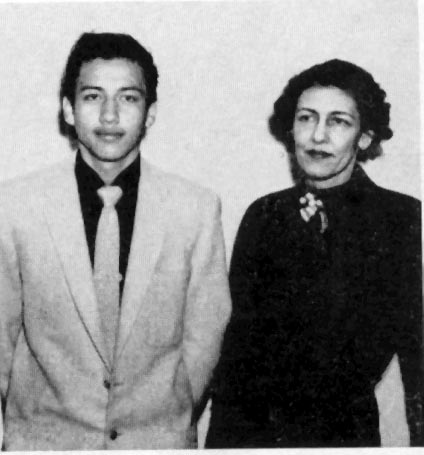
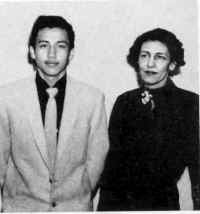
Dennis Michael Jones, brother
to Donna, was a student at the school in this year of 1952. He was the
president of the Silver Key Club. He is pictured here with Miss Kay
Ahrnken, English teacher.
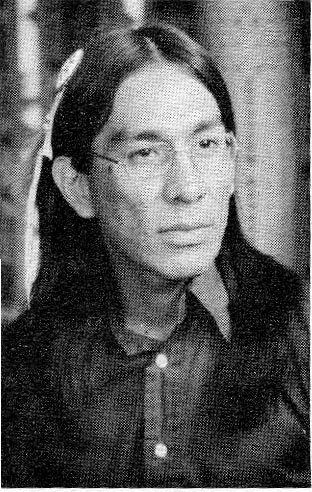
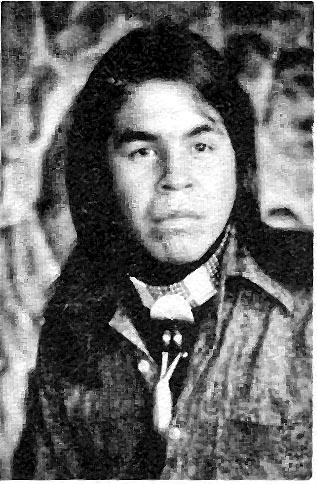
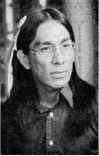
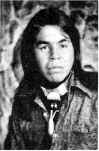
As a rough estimate these
photographs of students are maybe five percent of the total number of
tribes to attend Chilocco.
Introduction
Chilocco Indian School
Written by a Former Student, Class of 1955
In the interest of preserving the memory of a place that to me was truly
Camelot I am recording these things from material that has been handed to
me over the years from individuals who were passing it on with no
intention or goal of any sort in mind.
Please do not accept my
opinion as the ultimate truth, for every person who was involved has their
own story to tell, I'm sure. For myself the experience was
altogether pleasant, rewarding and beneficial. My grandmother,
Elizabeth Little Cook, Pensoneau, Hernandez was an early day student as
well as employee. My mother and uncle were students
there in the first annual we are exhibiting. My aunt Otilia Hernandez was
there in administration when the school closed, 1980, along with my uncle
Francis Hernandez, in the kitchen, and his wife Lucy Rousseau
Hernandez, with the canteen.
There were all manner of
discussions when the school was closed and one can find pro and con
statements if they look.
In my heart and my memory I
will always remember the beauty of the institution and this is how you
will see the school through my eyes. For the common person to walk among
castles, manicured lawns, orchards, a peaceful lake with geese bobbing
there, gentle kind instructors dedicated in their lives to teaching, for
those of us who came from simple backgrounds this was to me the grandest
and best time of my life.
For modern criticism as to
teaching subservience, disturbed students, archaic values, isolationism
and on and on, truthfully I cannot address these things. As a student and
later an employee all I knew was the answer of a call to duty to better
oneself, to an aspiration toward higher accomplishments, and the practice
of things learned.
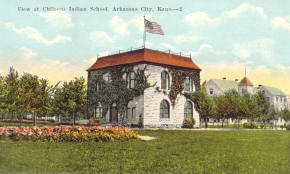
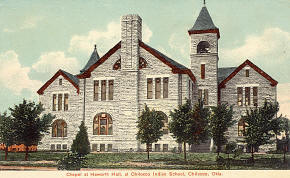
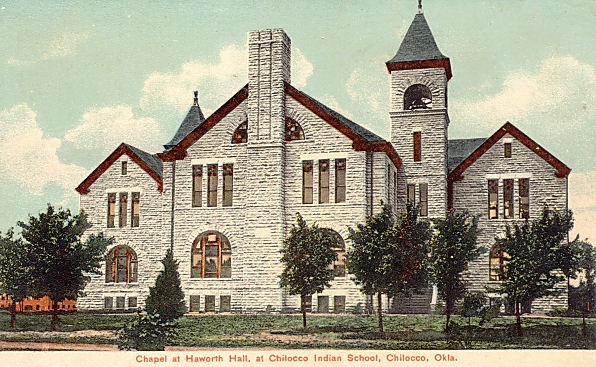
The right one of the last two pictures is
Haworth Hall:
The hall was named
after on of my husband's, Rodney Flood's ancestors, Maj. James
Mahlon Haworth.
Here are some
interesting facts on this man given to me by his grandson Thomas B.
McDavitt.
James Mahlon Haworth
was born in Wilmington, Ohio on November 19, 1831 and died
March 12, 1885 in Albuquerque, New Mexico. He and his family
relocated from Ohio to Olathe, Kansas in 1870 prior to the
July 2 date of the 1870 U.S. Census enumeration. His father,
George D. Haworth, was of English extraction and his mother,
Edith Hadley, was of Scottish extraction. the first
generation to emigrate was George Haworth of Rock Cliff near
Bacup, England, who came to America in 1699 with William
Penn and lived in Philadelphia a short time. George Haworth,
the grandson of George Haworth the immigrant, and the great
grandfather of James Mahlon Haworth, accompanied Daniel
Boone on one of his first expeditions into Kentucky.
Studied at Earlham School,
Richmond, Ind., 1848-50; farmer; merchant’ railroad ticket
agent; Treasurer, Clinton County, O.; Captain, 40th Regiment
Ohio United States Volunteers, 1861-63; Superintendent,
Kiowa Indian Agency, 1873-77; Special Indian Agent-at-Large,
1879-80; Indian Inspector, 1880-82; Inspector of Indian
Schools, 1882-83; Superintendent, Indian Schools, 1883-85.
b. Wilmington, O., November
19, 1831. d. Albuquerque, N.M., March 12, 1885. s. George D.
Haworth and Edith Hadley.
Haverford College Archives,
Haveford, PA
[From the History of
Kansas, Chicago: A.T. Andreas (Reproduction by Wadsworth
1975) WPL]
JAMES M. HAWORTH
was born in Clinton County, Ohio, November 19, 1831. Is
a member by birthright of the Society of Friends
(Quakers). Previous to the war, was engaged in farming
and merchandising. Was for many years connected with the
Clinton County Agricultural Society, filling the
position of president in 1861. Was elected County
Treasurer in 1856, and re-elected in 1858, holding the
office four years and three months, his term closing in
September, 1861, when he recruited a company of which he
was elected Captain, and going to Camp Chase was
assigned to the Fortieth Ohio Infantry, which regiment
was ordered to Eastern Kentucky, and became a part of a
brigade under command of General James A. Garfield on
whose staff he served as A.A.A. General, until the
General was ordered to another part of the country. He
resigned his captaincy on February 7, 1863 on account of
increasing infirmities and returned to his home for
restoration. In 1865, he removed to Cincinnati and
engaged in the wholesale drygoods business, until 1870,
when broken health, requiring a change of climate, he
removed to Olathe, Kas., from where, in the fall of
1872, he was appointed United States Indian Agent and
placed in charge of the Kiowa and Comanche Indians, near
Fort Sill, Indian Territory, remaining there until April
1878. He was one of a commission for locating the Sioux,
in the summer of 1878, soon after which he was appointed
a special Indian Agent at large, and on February, 1879,
was appointed United States Indian Inspector, which
position he held until July, 1882, when he was appointed
Inspector of Indian Schools, an office created by the
session of Congress which had just closed, the duties
being of a supervising care of all the Indian schools in
the United States, excepting the five nations in the
Indian Territory.
JAMES M. HAWORTH.--Superintendent
of Indian Schools, died suddenly in Albuquerque, New
Mexico, March 12th, 1885, in his 53rd year.
Funeral services were
held at the M. E. Church, Olathe, Kansas, March 16,
at 1 o'clock P.M., under the direction of the
I.O.O.F. and A.F. & A.M., and were largely attended.
The deceased was one of the most highly esteemed men
in Johnson county, and his sudden taking off is
mourned by all.
Arkansas City
Traveler, March 18, 1885.
This city was
startled Friday with intelligence of the death
of Maj. J. M. Haworth, which occurred at
Albuquerque, New Mexico, Thursday, March 12,
1885. Maj. Haworth has been long and favorably
known by many of our citizens. He was a man of
exceptionally great ideas, pure motives, and
earnestness in the work he was engaged in. He
threw his whole soul into it, and made it the
sleeping and waking thought and study of his
life. Major Haworth has been in the Indian
service since 1873, and in that time, no breath
of suspicion has ever been raised in regard to
his honesty of purpose or administration. In
1873, he was recommended by the Quakers, of
which body he is a member, to the Government and
was appointed agent of the Kiowas and Commanches,
then just located in the Territory, and in a
very wild and savage state, not having been
subjected in the least to civilizing influences.
He remained in charge of them for six or seven
years, meeting with most gratifying success in
their control. No agent since has been enabled
to do so much for them. At the end of the year
1879, he offered his resignation, and was
appointed Inspector of the Agencies in the
Territory, and in 1882 to General Superintendent
of all the Indian Schools in the U. S. In this
position, he has labored faithfully and well. It
was at his suggestion and influence that the
Chilocco Schools were placed where they are, and
it was by his untiring and ceaseless labors that
so many Indian children are now enabled to
receive the benefits of perfect training
schools, learning the arts of civilization and
the benefits of peace.
Major Haworth was
contemplating a removal to our city upon his
release from his present position, and expected
to engage in business. His loss will be greatly
felt in this community, whose true friend he had
proved himself; and we venture to say that he
had more friends here than any other man not a
resident.
We print below
the resolution adopted by the Presbyterian
Church of this city and the citizens generally,
as they voice our feelings and sentiments.
WHEREAS, God in
his inscrutable providence, has called to
Himself, in the flower of manhood, Maj. J. M.
Haworth, general government inspector of Indian
Schools in the U. S., and
WHEREAS, The
citizens of Arkansas City, who have known him
more or less intimately, have learned to look
upon him as one among the few who are worthy of
entire and implied confidence so often
manifested in his daily dealings and acts among
us; and
WHEREAS, Our city
owes so much of her prosperity to his generous
and just recognition; and
WHEREAS, That
while placed in many and severe trials and
difficulties, he has so nobly and uprightly
conducted himself, both as a government official
and a private citizen, that those of us who knew
him most intimately, desire to record our
appreciation of his kind, generous, christian
spirit manifested in motives and deeds that
betokened the abiding presence of the almighty
with him, and reveals a great, generous heart,
whose noblest impulses were enlisted for the
elevation and salvation of the Indian race, in
whose interests he labored so assiduously.
Therefore be it
resolved,
1st. That we,
citizens of Arkansas City, Kansas, and members
of the Presbyterian Church, in congregation
assembled, while bowing in humble submission to
the orderings of His will, who Adoeth all things
well,@ record with greatful memory, the life and
labors and eminent christian spirit of our
departed friend.
2nd. That we are
assured this great change means to him nothing
less than the fulfillment of a life-long desire
to hear the Awill done@ of the master, for which
his life, public and private, in business or in
social converse, has so eminently filled him.
3rd. That we
express our grief and sorrow at the great loss
sustained by the government service, and his
family, and that we hereby extend to the
stricken wife and children, our most heartfelt
sympathies in this their great bereavement.
4th. That a copy
of these resolutions be forwarded to the
President of the U. S.--to the Indian Industrial
School at Chilocco--to the family of our
brother, and that they be published in the
papers of this city.
Signed by
Committee. J. C. TOPLIFF, S. B. FLEMING. March
15, 1885.
Rev. Fleming held
memorial services at the Chilocco schools Monday
last in honor of Maj. J. M. Haworth.
Do
sign Donna's Guest Book if you get a chance!
Short Stories about Chilocco
Chilocco
Annual Year Books
1931
| 1939 | 1946
At the National Archives
Southwest you can find a complete record of Chilocco according to year:
Archives National Southwest
P.O. Box 6216
Ft. Worth, Texas z. 76115
Telephone: 1-817-334-5525
The Oklahoma History Center has a
database on CD, of all students who enrolled at Chilocco but did not
necessarily graduate.
Here is the part about
Chilocco from Muskogee:
Bureau of Indian Affairs, 101 N. Fifth Street, Muskogee, Ok.
PRELIMINARY INVENTORY OF THE RECORDS OF THE CHILOCCO INDIAN SCHOOL
Cabinet: C68 Drawer: D01 Roll: - ID: -
Format: FICHE Coverage: NATIVE AMER. Total: - Dates: 1884-1980
Dates: 1884-1980 Record Type: ETHNIC
Boarding schools:
1.Chilocco, Oklahoma
2. Concho, North of El Reno, Ok.
3. Riverside, at Anadarko, Ok.
4. Sequoyah, at Tahlequah, Ok.
5. Carter, Catholic school for Indians at Ardmore, Ok.
6. Pawnee, at Pawnee, Ok.
7. Jones Academy at Hartshorn, Ok.
8. Haskell, at Lawrence, Kansas
For a different out look on
what a government school was for the Native American visit
http://www.members.aol.com/tawodi/carlisle/intro.html
Material from the
collection of Vivian Hogg Hayman was a gift from her and delivered to me
by her family after her death. I was deeply touched by their thinking
of me and intrusting Mrs. Hayman's collection to me. I felt she had
reached out from the past and was once again transported to the
wonderful years at Chilocco. She was my mentor when I was assigned to
her detail, a girl Friday type job.
|