|
Our car sped along the hot
dusty Oklahoma roads leaving a great trail of dust behind. The flying dust
looked like the rooster tail of a speedboat in the water. This was Ponca
country in Kay county, and we were on the reservation. It was a world tied
to them. Our family lived in Osage county and today it was a treat to be
visitors here in Kay county.
As children, we were ever
alert to our American Indian mother's love for adventure. Our Scot- Irish
father indulged her wishes. He trusted her motives and this loyalty was
never misplaced.
Photography by Faye Heffington of the Hunter line
He drove the car through the gate which was tied together by two
lengths of barb wire fence. The family was immediately inside the yard and
in new surroundings.
A short distance from the front gate was a house so small it almost looked
like a children's playhouse. It had two rooms with a very small porch -
maybe six feet by eight feet across. It seemed like it had never been
painted. The boards of the house were weathered to a natural patina of
gray.
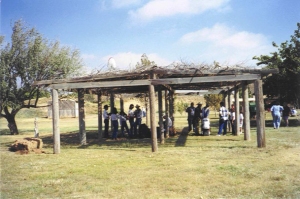
To the right stood the ever present brush arbor. The Indian homes all
held these more or less permanent structures. Winter time saw the arbors
standing stripped of the overhead branches as though depleted of the
finery-- at least until the next summer. Such arbors became the center of
the Indian people's activity in the summer. They were saddled with the
white man's wish to house them in tight, safe abodes and this was a quiet
way to wrest back the outdoors as much as possible. In the arbors was a
bed, a stand with water bucket and a wash basin. A place to hang a towel
was usually simply a nail hammered on the side of the table. Sometimes,
there was a refrigerator. A small wood cooking stove served them, too.
This was actually a summer house, one with no walls. Its feeling of a
house was intriguing to the children.
The yard was scraped free of any vegetation. As a matter of fact, it
often was swept with a broom as one would sweep a floor in order to keep
ay clutter from lingering there. There were no frivolous touches such as
flower beds. For generations the hated “Wais' ahs,” (snakes) were
controlled in this way and the custom was simply continued.
We tumbled out of the car and Dad ambled off toward the brush arbor where
an elderly man was sitting in the shade.
Grandmother Grace Little Warrior did not keep them waiting long on the
little front porch before she opened the door. She welcome them. The
children were instantly looking all about them. Their eyes were taking in
each object. Admittedly, there wasn't much to observe. Everything was
severely plain in agreement with the Native teaching of self discipline.
A rough table covered with an oil cloth which stood in the middle of the
room. The table was flanked by benches rather than chairs. Some homes
did not have benches to always stand at the table. The chairs were as
mobile as the people themselves, and would be placed wherever they
happened to be needed at the moment, including the front porch.
There was a water bucket and wash basin on a rough built small table
inside this house much like the one at the arbor. In one corner of the
room stood an ancient wood cooking stove. Everything was in immaculate
order. There was not one thing out of place. The surfaces of the
utilitarian objects in the room served as furnishings and had a scrubbed,
re-scrubbed look about them. The windows had no curtains in agreement with
their nomadic life style of but a few decades before. Everything here was
expendable and could be left with no sentimental or any other value
attached to it.
"Where does she keep all her things?" the children .wondered aloud. They
were met with her sh- sh- sh- as their mother shushed them.
Grandmother ushered them into the second room which held two small beds.
This is where they were instructed to sit and sit still. Their mother bent
over and gently told them they must be quiet. It was necessary to be
respectful because this room held the ancient sacred peace pipe. She
didn't have to speak to the children twice. They were in total stunned
awe, not for the peace pipe. It was wrapped up in what appeared to be a
heavy canvas fabric and was not visible to them. These new and different
surroundings were what held their attention.
"Now children," their grandmother was teaching them, "this peace pipe is
considered rare and sacred. It is the last one the Ponca's have.
Originally there were twelve, one for each clan and its chief.
“All who come into the presence of the peace pipe must behave with
self-control. You are not to be rowdy and noisy, tumbling, roughhousing,
or anything else disrespectful of its presence. To receive a name in the
presence of the pipe is an honor."
The girl, who was only eight, couldn't know of the value of such an
object. It would be years later that she learned Gramma Grace was the
daughter of a chief. It was her assigned duty to care for this, the last
peace pipe. Throughout her life she had maintained a clean, moral,
dignified way of living and she was respected now as an elder. Since she
carried this status it was desirable to have her name an elder daughter.
For sons, a male of high regard would be chosen for the naming. Forever
after that, when a public gathering was attended the name giver should be
gifted and honored by the person named.
As years flow from one to another, with trials and tribulation strong, one
has to wonder about the ways of the old ones. How were these traditional
laws tied to the moral fiber of their heart and life? It wasn't the
wealth of gold they left to their heirs. The strength bestowed upon that
person held a far greater power over their will. Whether it came from
something of greater heights under the shadow of the peace pipe or only
from the lips of the aging daughter of a chief would never be known.
"Jen-nee, her name is Jen-Nee. Water woman. This name is passed down to
her. It was Chief Standing Bear's Mother's name.”
|



