|
IT has been generally
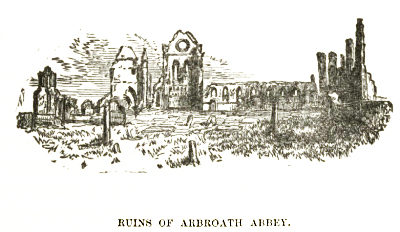
supposed that the erection of the buildings of the Abbey of Arbroath was
only commenced in the year 1178, but it is probable that the commencement
was one or two years earlier. King William, the founder, returned from his
eighteen months' captivity in England on 8th December 1174. Thomas a,
Becket, an early friend of William's, was killed on 29th December 1170, and
was canonized in 1173; and we find that by 1178 a church was built at
Aberbrothock, which, in that year, was dedicated to his memory ; and a
company of Tyronensian Monks of the rule of St Benedict, with an Abbot, were
brought from Kelso, and solemnly installed in the Abbey, in presence of the
King, the Bishop of Aberdeen (the bishopric of St Andrews being vacant),
with the Archdeacon of St Andrews,—"to bless the Abbey"—the Bishop elect of
Brechin, the Prior of Restennet, and many other grandees. All this could not
have taken place in the year 1178, as is stated in the Abbey writs, unless
the eastern part of the great church, and certain houses for the dwellings
of the Abbot and Monks, had been previously erected. Wynton, the Prior of
Lochleven, in his "Cronykil," says that the Abbey was founded by King
William, on the 9th day of August, although he is otherwise mistaken by
placing the event nineteen years too late. His words are:—
Of August that yhere the nynde
day,
Of Abbyrbrothoke the Abbay,
The Kyng Willame, in Angus,
Fowndyt to be relygyws.
In the honoure of Saynt Thomas,
That Abbay that tyme fowndyt was,
And dowyt alsua rychely,
Thare Monkis to be perpetually.
By this time the King had
conferred on this Abbey of his favourite Saint (whose aid he was in the
habit of invoking in the time of his captivity) the village of Arbroath,
with the lands now forming the parishes of Arbroath and St Vigeans and the
Parish Church. It is probable also that the church and parish of Ethie (Athyn)
were granted about the same period. The best idea of the progressive gifts
to the Abbey is to be obtained from the papal bulls granted in 1182, 1200,
and subsequent years. (Chartulary, vol. I. pp. 151-160.) We also learn from
Hollinshed and others that the greatest nobleman of the district—Gilchrist,
Earl of Angus—having, under the influence of jealousy, strangled his wife,
who was the sister of King William, was proclaimed traitor by the King, and
deprived of his great possessions, a considerable part of which was soon
afterwards conferred on the Abbey. These gifts probably consisted more or
less of the territory of Athenglas (near Kinblethmont), and the estates or
shires (now the parishes) of Dunnichen and Kingoldrum, and which, with the
parishes of Aberbrothock and Ethie, continued to form the principal part of
the Abbey possessions during all its history; for the numerous grants of
lands, churches, teinds, fishings, saltworks, tenements in burghs, &c.,
subsequently made by King William and his nobles, and by kings and subjects
in the three succeeding reigns, although very valuable, were not equal to
these tracts of fertile lands given by him at the time of the foundation.
year, during the reign of
Alexander II., it was again dedicated. It may be remarked that the
neighbouring cathedral of St Andrews was in course of construction during no
less than one hundred and sixty years, having been begun about the year
1158, and not finished till the year 1318. A comparison of the remains of
the Cathedral with the great Church of Arbroath affords a curious
confirmation of these dates, and would almost by itself demonstrate, to one
versant in Gothic architecture, that the church of St Andrews was commenced
at least twenty years previous to the church of Arbroath, and continued a
considerable way according to the earlier style, and that its western part
was constructed long after the magnificent western front of Arbroath church
had been finished. The substitution of what is termed early English for
Norman architecture, including as a principal feature the substitution of
tall lancet-headed windows (without stone mullions) for round-headed
windows, took place during the last quarter of the twelfth century ; and
these twenty-five years are accordingly termed in England the transition
period. This period witnessed the erection of very many splendid
ecclesiastical fabrics, and a great improvement in the style of masonry.
Thus the eastern part of St Andrews Cathedral, being planned and commenced
before this period, had only round-headed windows (nine of which were in the
east gable), according to its obvious original construction, while Arbroath
Abbey, not being commenced till the change began, has narrow lancet-headed
windows without mullions, intermixed occasionally with the older
round-headed arch, from the east gable even to the great west door; shewing
that the transition period of intermixture of the two styles had been
continued in Scotland later than in England, and during the early part of
the thirteenth century. The cathedral of St Andrews exhibits three separate
styles in succession—first, the latest Norman, then the early English, and
lastly what is termed the decorated style. The style of the Abbey Church of
Arbroath, on the other hand, is wholly of the "transition period" betwixt
the first two styles here mentioned, and consists of the remains of the
Norman style, with the early English prevailing. The church also exhibits a
marked improvement in the quality of the masonry during the fifty-five years
which elapsed between the erection of the chancel and the western towers, as
may be observed on examination of the beautiful masonry of the great
buttresses in the court behind the Abbot's house.
At the time of the erection
of Arbroath Abbey, Gothic architecture was in the full vigour of its early
manhood, The early English style is specially marked by grandeur, dignity,
and simplicity in its general design. Its decorations were limited in
number, and severe and chaste in character ; and it was not hurt by an
overload of meretricious and useless ornaments which have often marred the
beauty of expensive Gothic churches constructed in later periods. The Abbey
Church of Arbroath possessed most of the grand features which may yet be
seen in many of the Abbey and Cathedral churches in England, of which a
noble specimen is exhibited in Westminster Abbey, an erection begun in the
reign of Henry III.
The small fragment of what had evidently been the Chapter House (vulgarly
called the pint stoup) spews that it was erected in a style similar to that
of the church, and at the same time. And it is to be supposed that other
indispensable buildings, had they remained—such as the refectory and
fraters' hall—would have exhibited further specimens of the same style. But
every vestige of these buildings has been swept away.
The Abbey Church was finished
some time previous to the introduction of what has been termed the third or
decorated style of Gothic architecture, of which a modern specimen is
supplied to Arbroath in the new Episcopal Chapel. But the remains of the
great gate called the Pend, exhibit in several features an approximation to
that style, and show that this building was erected some time after the
completion of the Church. The vestry (commonly called the Chapter House) was
built by Abbot Walter Paniter, betwixt 1411 and 1433, and its south window
is in the decorated style, with mullions; and can easily be distinguished
from all the windows of the original Church. By this time the fourth or
perpendicular style of Gothic architecture had been adopted in England,
where many beautiful specimens of it may be seen. But its introduction into
Scotland was retarded by the poverty and misery into which the country had
been plunged by the wars of independence, which almost put an entire stop to
the erection of great and costly churches similar to those founded in
earlier and happier tunes,
|



