THE following pages have been
published chiefly for those who take an interest in the locality of the
ancient and now flourishing town of Arbroath, and also with the view of
removing the obscurity which has hitherto involved the history of its once
magnificent monastery. Among other sources of information the Chartulary of
the Abbey is entitled to stand first in rank. The most interesting portions
of these monastic writings have been digested and arranged in this volume.
An endeavour has thus been made to bring out the points in which they, along
with other authentic documents, tend to illustrate the history of the
district.
In alluding to the history of
past times, our ancestors have been allowed as far as possible to appear in
their own dress, and speak in their own words. This will account for the
number of quotations in the antique style, which may probably render the
perusal of some portions of the book a little difficult to readers otherwise
well educated. But if months or years are spent in the endeavour to acquire
a knowledge of dead languages two or three thousand years old, some trouble
ought to be taken with the view of being able to read with facility our own
living mother tongue, in the garb which it wore two or three centuries ago,
so that it may not be unintelligible unless expressed according to our
present conventional orthography. Many details, which to general readers not
acquainted with the locality may appear sufficiently minute, are inserted in
the text, instead of being placed in foot-notes, as it was considered
desirable to avoid that distraction of attention which numerous notes
invariably occasion. For the same reason references to the pages of the
Arbroath Chartulary have not been made, as these, if introduced, would have
become innumerable and cumbersome. They would, at the same time, have been
of no use to those who do not possess that collection of writings ; and
those, on the other hand, who may wish to verify any statement founded on
it, will be at once able to do so, by the names and dates referred to, with
the help of the tables of contents and indices of the published Chartulary.
It was omitted to be stated
in the tenth chapter that the lands of Aldbar have been ranked among the
possessions of the Abbey on the authority of an entry in the "Charge of the
Temporalitie," 1592, which is not altogether conclusive in the absence of
corroborative evidence; and that although Cotside and others near Barry have
been generally ranked among the Abbey lands, the authority for placing these
lands in the catalogue is not very satisfactory, as they do not appear in
the proper monastic writings under their modern names.
While these sheets were in
course of preparation the Author made every effort to procure definite
information on the subject of the alleged pillage and conflagration of the
Abbey Church about the time of the Reformation. He has not, however,
succeeded in being able to fix the exact manner in which that building was
unroofed and laid desolate. But a careful study of every contemporary record
within his reach has tended to confirm him as to the correctness of the
statements made in the text, that whatever might have been threatened or
attempted, no general pillage or burning of this majestic edifice had taken
place at the period in question; and that its state of ruin can be easily
accounted for on other grounds, by a simple reference to the churches of the
Abbeys of St Andrews, Lindores, Coupar-Angus, and others, where the
demolition is much more complete than at the Church of Arbroath, and where
the agency of fire has never been stated to have been applied.
It need scarcely be explained
that the notices of the town of Arbroath have been in general limited to the
period when the monastic establishment existed in its neighbourhood. The
history of Arbroath during the last hundred and fifty years, including the
extension of its population, buildings, manufactures, and commerce, within
that period, could not have been added without swelling the volume far
beyond the limits originally contemplated; and is a subject which, along
with the traditionary history of the burgh and its vicinity, yet remains to
be taken up by one who can devote to it the necessary amount of time and
research.
The Author does not flatter
himself that what is now given to the public can escape what every book of
the kind is peculiarly liable to, namely, the detection of errors and
omissions. He has endeavoured, however, to make no definite statement,
unless upon good authority: without being deterred from offering this
contribution to the history of the district by that over-scrupulous dread of
mistake which has prevented many persons well read in the affairs of
Scotland from giving to the world the benefit of their researches. There
could not be found a more striking instance of this than in the case of the
late Reverend Principal Lee, who has allowed much of his vast stores of
information to die with him; and who, under the influence of this
sensitiveness, most kindly dissuaded the author several years ago from
engaging in an undertaking of a nature somewhat antiquarian, by referring to
another friend who had devoted much time and labour to the early history of
a northern county, which, when published, "after all contained some
mistakes, and there were several things omitted."
In the preface of a book
devoted to the detail of facts regarding Arbroath, an allusion to a work of
fiction supposed to bear reference to the same place may be allowed. An
attentive reader of Scott's inimitable novel, "The Antiquary," acquainted
with the vicinity of Arbroath, will have little doubt that it contains the
scenery of that story. The allusions to the battery, the common, the Grecian
porch of the new Council-house, the great interest taken in merchandise and
linen manufactures, and the doings of the postmistress, are, among other
marks, quite sufficient to identify the town of Arbroath forty or fifty
years ago with the Fairport of the novel. Auchmithie and Ethie-haven are
described with Scott's usual power in his pictures of the fishing hamlets,
and contain fisherwomen who might sit any day as the originals of Maggie
MIucklebackit. Ethie Rouse is the only mansion in the neighbourhood that
suits the description of Knockwinnock. But the claims of identity with
Monkbarns are divided betwixt Seaton and Anniston, while the description
does not exactly suit either. The high rocky coast between Arbroath Ness and
Redhead will supply Halketheads and Bally-burgh Ness Points in abundance. A
poet's license is taken in placing "the root o' an aik tree" among the
cliffs, and in making the sun set over the waves of the German Ocean during
the storm ; and also in removing the ruins of St Ruth (described as Arbroath
and Melrose Abbeys intermixed) from the bustling vicinity of a large town
into one of the dells of the district, such as the den of Arbirlot. These
liberties were obviously used for greater effect, and probably to involve
the narrative in some degree of disguise. The veil becomes, however, very
transparent when the writer makes Edie Ochiltree meditate on his appearance
in the eyes of the villagers while he was "coming down the edge of
Kinblythemont"—a phrase which will suggest to every inhabitant of the
neighbourhood the bluegown's return toward Arbroath, along the old Brechin
road leading by Chapelton and the policies of Kinblethmont.
The Author takes this
opportunity of returning his thanks to those gentlemen whose subscriptions
have led to the present publication; and also to those who have facilitated
his researches by affording information or access to original documents.
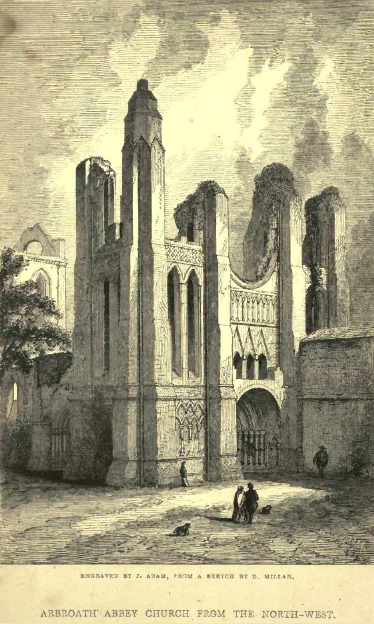
The frontispiece, engraved by
Mr J. Adam, Edinburgh, a native of Arbroath, is from a drawing which the
author made in order to shew the front of the Abbey Church as it now exists.
and would appear to passengers were the view not obstructed by modern
buildings which have been erected within a yard or two of its walls.
ARBROATH,
1st November 1859.
Contents
General Introduction
The Monastic Writings of Arbroath : Historical subjects on which they
supply information: Introduction of surnames: Topographical naives, and
variations, changes and translations of same : Anglo-Norman and other
settlers in Angus: Royal residences from 1178 to 1249: Introduction of
Shires and Sheriffs: Formation of Parishes: Adoption of Tutelar Saints :
Nature of Abthaneries: The Culdees and their Abbes: Culdees of Abernethy
and Brechin: Causes of the fall of their order: Indications of Culdees
at Monifieth and Arbirlot.
Chapter I - The Town
of Arbroath and its Dependencies
1. Origin and Condition till the foundation of the Abbey. 2. The
Harbour. 3. Formation of Older portion of the Burgh. 4. Formation of
Newer portion of the Burgh in the Almory. 5. Local Terms in the Town and
neighbourhood.
Chapter II -
Constitution and Rank of Burgh
Arbroath at first a Burgh of Barony and Regality: Made a Free Burgh by
special grants: Temporarily represented in Parliament A.D. 1579: Made a
proper Royal Burgh in 1599.
Chapter III - Social
State of Angus in the Twelve Century
Condition of Rural and Urban Population at the time of the foundation of
Arbroath Abbey: Slavery of the Rural Population: Power of the Barons:
Burghs as Fountains of Liberty and Progress: Emblems of Burghal Freedom
in Arbroath and other Burghs: Early state of Urban Inhabitants.
Chapter IV - Arbroath
from 1440 to 1640
Depression of Scotland in the Fifteenth Century: Civil broils:
Chamberlain Aires: Subjects of Investigation: Condition of Craftsmen:
Arbroath at the Reformation, and after its Erection into a Royal Burgh.
Chapter V - Erection
and Style of the Abbey Buildings
Date of commencement: Mixture of Norman and Early English Architecture:
Stages in the progress of building: Succeeding styles of Architecture
shewn in the buildings.
Chapter VI - History
of the Abbey Buildings
Accidents to Great Church during the Romish Period: Contract for roofing
the Choir: Damage done at the Reformation: Greater destruction since
that Period: Other Conventual Buildings, Ecclesiastical, and Civil:
Precinct walls and towers: Ruin of the Buildings.
Chapter VII -
Subsidiary Alters in Abbey Church
1. Altar of St Catherine. 2. Altar of St Peter. 3. Altar of St Lawrence.
4. Altar of St Nicholas. 5. Altar of St Mary the Virgin. 6. Altar of St
James. Appearance of Church on Festivals.
Chapter VIII -
District Chapels in Arbroath and Neighbourhood
1. Chapel of St Vigian at Conon. 2. Chapel of St John Baptist at
Hospitalfield. 3. Chapel of St Michael in the Almory. 4. Chapel of St
Ninian at Seaton Den. 5. Lady Chapel of Arbroath, with the Altars of St
Nicholas and St Dupthacus. 6. Chapel of St Lawrence at Kinblethmont. 7.
Chapel at Whitefield of Boysack. 8. Chapel at Boath, Panbride Parish. 9.
Chapel at Panmure Castle. 10. Chapel at Kelly Castle. 11. Chapel of St
Lawrence at Backboath. 12. Chapel of St Mary at Carmylie.
Chapter IX - Church of
St. Vigeans
1. Fabric of Church and Old Monuments. 2. Altars of St Vigian and St
Sebastian. 3. Priests and Ministers of St Vigeans since A.D. 1200.
Chapter X -
Possessions of the Abbey
1. Lands, Baronies, Villages, &c.—In Angus, Mearns, Perthshire,
Fifeshire, Lanarkshire, Aberdeenshire, Banffshire, Inverness-shire. 2.
Tenements in Burghs. 3. Fishings. 4. Ferryboats. 5. Woods and Forests.
6. Saltworks. 7. Churches, Tithes, &c. 8. Original Annual Rents. 9.
Burghs. 10. Rents at Dissolution of the Abbey.
Chapter XI -
Subordinate Officers of the Abbey
1. Sub-Prior. 2. Steward. 3. Chamberlain. 4. Terrarius or Land-Steward.
5. Sacristan. 6. Granitor. 7. Cellarer. 8. Master of Works. 9. Judge or
Deemster. 10. Justiciar or Bailie. 11. Mair and Coroner.
Chapter XII - The
Abbots of Arbroath
1. Influence and incidental Advantages of Monasteries in early times. 2.
Scottish Ecclesiastics at and previous to the foundation of the Abbey.
3. Biographical Sketch of the Abbots of Arbroath, from 1178 to 1606. 4.
Causes of the Dissolution of the Abbey.
Chapter XIII -
Description of the Conventual Buildings
Form of the Church, Towers, Divisions, Columns, Roofs, Doors, Windows:
Dimensions of Buildings: External and Internal Appearance of Church:
Remaining Statues: Conventual Seals: Bell Rock.
APPENDIX.
No. I.—Note
On the Decay of Feudal Power and Emancipation of the Rural Inhabitants
of Scotland.
No. II.—Sketch
Of the Life and Times of JAMES MELVILLE, Minister St Vigeans, during the
period from 1560 to 1600, being a supplement to the Sketch of the Abbots
of Arbroath.
No. III.—Selections
From the Records of the Magistrates and Council of Arbroath,
illustrative of the Manners and Customs of the Inhabitants about the
time of the Reformation.
History of Arbroath to the Present Time By George Hay (1876)
MY reason for writing the following pages is to be found in
the conviction that a better acquaintance with the history of the burgh of
Arbroath was an object at once desirable and attainable. The Chartulary of
the Abbey, published by the Bannatyne Club, is a mine of information with
regard to the Monastery; and Mr Miller, in his book on ‘Arbroath and its
Abbey' has brought much of this information before a popular body of
readers. But still little was known of Arbroath history except that which
belonged to the times of the Abbey; as to more recent history, almost the
only fact which stood out with any prominence from amidst dim tradition was
the bombardment of the town by a French cruiser in the year 1781.
Notwithstanding the defective condition of the early records
of the burgh, there were grounds for believing that material might yet be
found from which something like a connected history of the town could be
built up, and I some years ago began an investigation with that object in
view. The Chartulary of Arbroath Abbey, and other works tending to
illustrate the history of that great religious establishment, were examined.
I then made an examination of the early Court-Books of the burgh; and
fortunately, while I was so engaged, there were found some leaves of a burgh
record which had been kept in the first half of the sixteenth century, and
which afford glimpses into the civil and ecclesiastical condition of the
town in that hitherto rather dark period of its history. The whole of the
minutes of the Town Council, extending from February 1727 to the present
time, have also been gone over by me. I have likewise made an investigation
of the records of the Arbroath Guildry Incorporation, of the Seven
Incorporated Trades of the town, and of the ecclesiastical records of the
district, these consisting of the registers of the Presbytery of Arbroath
and the Kirk-Sessions of Arbroath and St Yigeans. The fruit of these
investigations, long continued, and of a somewhat laborious character, is
contained in the pages which follow, in the preparation of which I have also
availed myself of any other sources of information with regard to local
history which came in my way. Speaking only of the material of this History,
and not of course regarding the quality of the workmanship displayed in the
putting of it together, I may venture to say that some of that larger
portion of it which has been got at by researches into hitherto unpublished
records, is of value not merely from a local point of view, but as being
illustrative of civil and ecclesiastical affairs at critical periods of the
history of the nation.
With respect to the plan of the work, it was evident that to
follow, as in more general histories, a strictly chronological ~ order,
would result in a mere disjointed chronicle of events. The work has
accordingly been divided into Parts, in each of which one subject or
department of local history is taken up and exhausted. In the matters
treated of in the several Parts, as well as in the order in which the Parts
are given, the historical sequence has been observed. Among other
advantages, it is believed that the arrangement adopted will facilitate
reference to the book, for which purpose also an Index has been appended.
With regard to the pictorial illustrations, more of them
might have been introduced but for the consideration that the consequently
enhanced price of the book might have placed it beyond the reach of a large
portion of the public. Still it has been attempted to make the illustrations
as complete as was possible in the circumstances. The four pages of those of
the Sculptured Stones of St Vigeans which were discovered when the Parish
Church was restored in the year 1871, have been printed here by arrangement
with the Society of Antiquaries of Scotland, in the ninth volume of
whose 1Proceedings’ they have already been published. The Drosten Cross,
which is figured in the late Mr Chalmers’ 'Ancient Monuments of the County
of Angus' and in Dr Stuart’s 'Sculptured Stones of Scotland,’ is given for
the first time in a form as complete as is now possible. The fragment,
measuring 25 by 21 inches, which was found in 1871 has been placed in its
proper relation to the rest of the Cross, and a representation of the whole
is now given from a photograph by Mr Milne, Arbroath, who also photographed
the other sculptured stones of St Vigeans. I am indebted to Mr Miller for
his sketch of the Abbey Church from the north-west. The sketch was engraved
by Mr John Adam, of Edinburgh, a native of Arbroath, who has attained to
distinction in his art. The view does not show the front of the Abbey
precisely as it is to be seen at present, but as it would be seen were the
modem erections that are clustered about the ruins removed. The ruins of the
Abbey are Crown property, and some years ago the Department of the
Government which takes charge of them was memorialized to co-operate with
the local authorities in getting that portion of the Church which extends
northwards from the west gate opened up to view; but as yet this has not
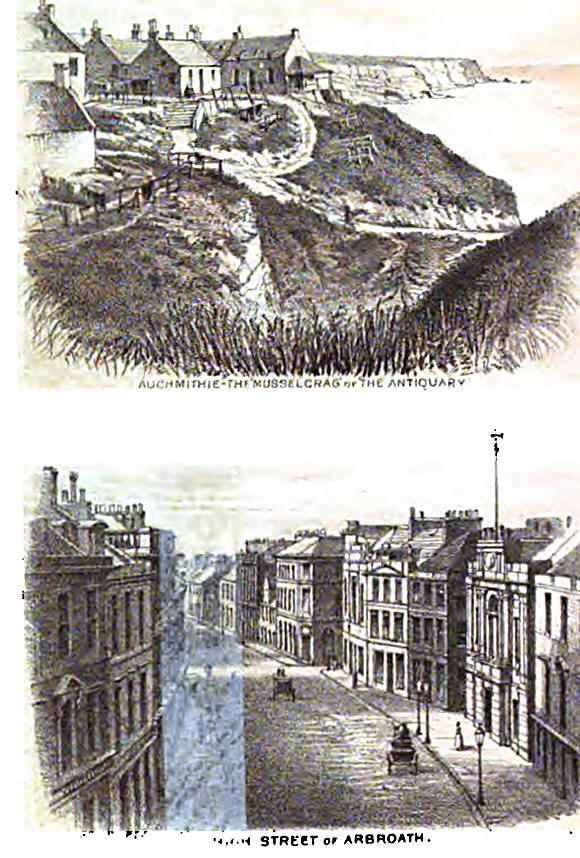
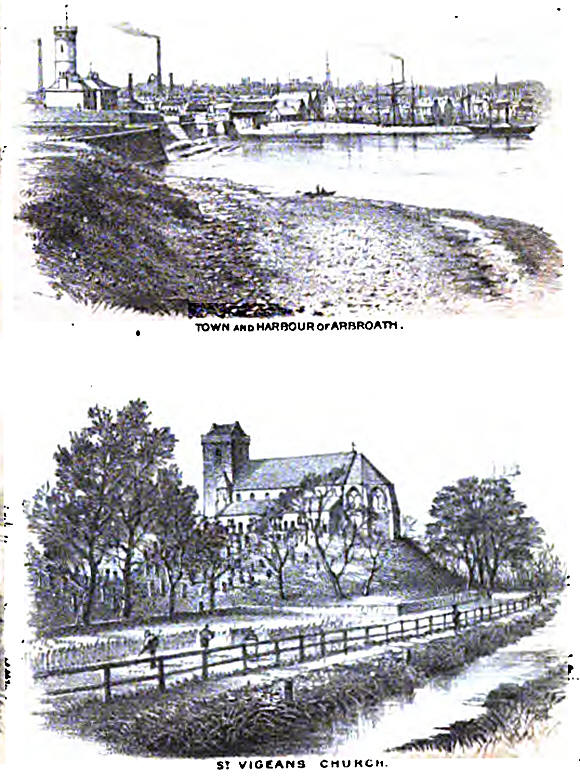
been done. The other page of views of the Abbey has been drawn from
photographs by Mr Milne, as have also the views of Auchmithie and the Church
of St Vigeans. The views of the Town and Harbour, and of the High Street,
are from photographs by Mr Geddes, Arbroath. My thanks are due to those
gentlemen for the use of their photographs. With the exception of the wood
engraving of the Abbey, the full-page illustrations have been lithographed
by Messrs George Waterston & Son, Edinburgh. The seal of the Corporation of
Arbroath, printed on the title-page, and the view of the Bell Hock
Lighthouse, on page 442, the latter reduced from a photograph by Mr Geddes,
have been engraved for this volume by Mr Adam. The seal is a copy of the one
now in use. Until about twenty-five years ago, when the helmed head was
added, the Corporation seal consisted only of the portcullis.
It now only remains to express thanks for assistance which I
have received in the preparation and execution of this work. I am indebted
to the members of the Municipality and the Town-Clerk; to the Guildry
Incorporation and its Clerk; to the officials of the Incorporated Trades; to
the Presbytery of Arbroath, and the Rev. James Hay, the Presbytery Clerk;
and to the Kirk-Sessions of Arbroath and St Vigeans, for the readiness with
which I obtained liberty to examine the records of those bodies, and for the
facilities which were afforded me for that purpose. My thanks are likewise
due to the Rev. Robert Grant, Clerk of the Presbytery of Brechin, for
extracts from the register of the formerly united Presbyteries of Fordoun,
Brechin, and Arbroath. I am indebted to the Curators of the Advocates’
Library, Edinburgh, for permission to consult their collection of
manuscripts and printed books; and to T. Hill Jamieson, Esq., the Keeper of
the Library, for many favours. I have also consulted books in the Signet
library, Edinburgh, in the Public Libraries of Dundee and Arbroath, and in
the Forfar Library; and in so doing have been favoured with the ready help
of the officials.
It is with deep sorrow for his recent lamented death that I
mention here the name of the late Dr Forbes, Bishop of Brechin. Bishop
Forbes communicated to me the interesting extracts from Theiner’s "Vetera
Monumenta" occurring in Part II., and made suggestions of much value with
regard to the earlier portions of the book generally. I shall always
remember with gratitude the kindly interest which that eminent scholar took
in the progress of this work, as well as the favourable opinion which he was
pleased to express, in a letter to me written only a few weeks before his
death, in reference to those parts of it which had come under his
observation.
I am indebted to John Stuart, Esq., LL.D., Edinburgh, author
of ‘The Sculptured Stones of Scotland,’ and other most interesting and
valuable works, for his kindness in directing me to some sources of
information. I am further under obligation to the Rev. William Duke, F.S.A
Scot., St Vigeans; Patrick Chalmers, Esq. of Aldbar (for a loan of
‘Miscellanea Aldbarensia’); Alexander Gardyne, Esq., London; Alexander
Brown, Esq., LL.D., Arbroath; Mr Buncle (who has assisted me in the work of
transcription), and other gentlemen. Ben. N. Peach, Esq., of H.M. Geological
Survey of Scotland, favoured me, at my request, with a monograph on the
geology of the district of Arbroath, an epitome of which is given in the
first three pages of the last chapter of the book; and I am indebted to a
friend, to whom I do not feel free to do more than allude, for the
preparation of the Index and the revision of the proof-sheets.
G. H.
Arbroath, November 1875.
LIST OF AUTHORITIES
Manuscripts.
Acts and Records of the Seven Incorporated Trades of Arbroath.
Acts and Records of the Guildry Incorporation of Arbroath.
Arbroath Burgh Court-Books—Is* (fragment), dates,
1491-1530 ; 2d, 1563-1575 ; 3d, 1605-1647;
4th, 1681-1704.
Arbroath Town Council Minutes, 1727 to the present time.
Arbroath Burgh Register pf Sasines.
Arbroath Burgh Charter, 1599.
Hay’s, Aug., Scotia Sacra. (In Advocates’ library.)
Hutton’s Collections. (In Advocates* Library.)
Memoranda of the Abbey and Town of Arbroath. 23 pp. 1816.
Miscellanea Aldbarensia. (At Aldbar.)
Mudie’s, D. (Town-Clerk), Account of Arbroath, 1742.
Precept in favour of the Magistrates of Arbroath by Esmd Stuart, Duke of
Lennox. (In Parliament House, Edinburgh.)
Registers of the Presbytery of Arbroath, dates, 1659-1687; 1794 to the
present time.
Register of the United Presbyteries of Forden, Brichen, and Aberbrothock.
Register of the Kirk-Session of Arbroath, consulted from 1669 (with blanks)
to a recent date.
Register of the Kirk-Session of St Vigeans, consulted from 1665 to about the
middle of the eighteenth century.
Schedule of Land Customs of the Burgh, 1775.
Printed Books
Acts of the General Assembly of the Church of Scotland.
1698-99.
Acts of the Lords Auditors of Causes and Complaints. 1839.
Acts of the Lords of Council in Civil Causes. 1839.
Acts of the Parliaments of Scotland. 11 vols. 1814-44.
Arbroath Guide Newspaper.
Arbroath, list of Electors of, showing the Votes in 1833.
Arbroath Magazine. Arbroath 1800.
Balfour's, A, Characters and Tales.
Bannatyne Miscellany. (Bannatyne Club.) 3 vols. Edin. 1827-55.
Black’s, D. D., History of Brechin. Edin. 1867.
Boece’s, EL, History and Chronicles of Scotland. 2 vols. Edin. 1821.
Bremner’s, D., Industries of Scotland. Edin. 1869.
Buchanan’s History of Scotland.
Buckle’s, H. T., History of Civilisation in England. 3d edit. Lond. 1860.
Burke’s, Sir B., Peerage and Baronetage of the British Empire. Lond. 1860.
Burnet’s History of his own Time. 2 vols. Lond. 1724-34.
Burton’s History of Scotland. 2d edit. 8 vols. Edin. 1874.
Calderwood’s History of the Kirk of Scotland. 7 vols. (Wodrow Society.) Edin. 1842-45.
Chalmers’, P., Sculptured Monuments of Angus. Edin. 1848.
Chambers’s, Dr R., History of the Rebellion of 1745-46. Edin. 1858.
Charters and Documents relating to the Burgh of Peebles. (Scot. Burgh
Records Soc.) Edin. 1872.
Chronioon de Laneroost. (Bannatyne and Maitland Clubs.) Edin. 1838.
Deer, The Book of. (Spalding Club.) Edin. 1869.
Dempster’s, T., Historica Ecdesiastica Gentis Scotorum. 2 tom. (Bannatyne
Chib.) Edin. 1829.
Edward’s, R., Description of the County of Angus (1678). Dundee 1793.
Forbes', Dr A. P. (Bishop of Brechin), Kalendars of Scottish Saints. Edin.
1872.
Foxdun’s, J., Scotichronioon. 2 tom. Edin. 1759.
Fraser’s, W., History of the Camegies, Earls of Southesk, and of their
Kindred. 2 vols. 1867.
Gordon’s, Dr, Catholic Church in Scotland. Aberdeen 1874.
Grahame’s, C. Stirling, Mystifications. Edin. 1865.
Hailes’, Lord, Annals of Scotland. S vols. Edin. 1797.
Headrick’s, Rev. J., Agriculture of the County of Angus. Edin. 1813.
Helyot’s Histoire des Ordres Monastiques. Paris 1718.
Historical Manuscripts, First and Second Reports of the Royal Commission on.
Lond. 1870-71.
Holinshed’s, R., Soottish Chronicle. 2 vols. Arbroath 1805.
Hook’s, Dean, lives of the Arohbishops of Canterbury. 2d vol. 1862.
Hume’s, D., of Godscroft, History of the House of Douglas and Angus. 2 vols.
Edin. 1743.
Jervise’s, A., Land of the Lindsays. Edin. 1853.
Memorials of Angus and Mearns. Edin. 1861.
Epitaphs and Inscriptions. Edin. 1875.
Johnson’s, Dr., Journey to the Western Islands. Edin. 1795.
Keith’s Scottish Bishops, Spottiswoode’s Aocount of the Religious Houses in
Scotland at end of. Edin. 1824.
Knox’s, J., History of the Reformation in Scotland. 2 vols. (Wodrow
Society.) Edin. 1846-48.
Letters from the Minister of St Vigeans to the Heritors, dates, 1823-28.
life of John Metcalf. Knaresborough.
Lindsay of Pitscottie’s History of Scotland. Edin. 1778.
Lopes’, G. Domingo, Noticios Historicos de los Tres Florentissunas
Provincias del Celeste Orden de la SS. Trinidad in Inglaterra, Escocia, y
Hibernia. Madrid 1714.
Lyndsay’s, Sir David, Poetical Works. 2 vols. Edin. 1871.
Macaulay’s, Lord, History of England. 3d vol. Lond. 1855.
Mackelvie’s, Dr W., Annals and Statistics of the United Presbyterian Church
Edin. 1873.
Mackenrie’s, Sir George, of Rosehaugh, Works. Edin. 1716.
M'Crie’s, Dr, Life of Andrew Melvill. 2 vols. Edin. 1819.
Maitland Miscellany. 4th vol. Glasgow 1847.
Mealmaker's Moral and Political Catechism of Man. Edin. 1797.
Melros', Thomas, Earl of, State Papers and Correspondence. (Abbotsford
Club.) 2 vols. Edin. 1837.
Miller’s, D. Arbroath and its Abbey. Edin. 1860.
Miller’s, Hugh, Old Bed Sandstone. Edin. 1869.
Municipal History of the Boyal Burgh of Dundee. Dundee 1873.
Hobbie’b, W., Dundee Celebrities. Dundee 1873.
Obdebicu8 Vitalis’ Ecclesiastical History of England and Normandy. 3 vols.
Lond. 1854.
Papers in Cases: Bakers' Incorporation v. Robert Lindsay of Almerieclose;
Johnstone, Armstrong, A Co. v. Jolly and Sturrock, the Magistrates of
Arbroath, and the Incorporated Trades ; William Ritchie the Magistrates.
Pennant's Tour in Scotland. 3 vols. Lond. 1776.
Person's, D., Varieties. Lond. 1635.
Petrie’s, G., Round Towers of Ireland. Dublin 1845.
Pitcairn's, R., Criminal Trials in Scotland. 3 vols. Edin. 1833.
Proceedings of the Society of Antiquaries of Scotland. 4th, 9th, and 10th
vols.
Proceedings in Arbroath for Obtaining a Reform of Parliament. Arbroath 1817.
Records of the Convention of the Royal Burghs of Scotland. 2 vols. Edin. 1866-70.
Registrum Episcopatus Brechinensis. 2 tom. (Bannatyne Club.) Aberdeen 1856.
Registrum Episcopatus Moraviensis. (Bannatyne Club.) Edin. 1837.
Registrum de Panmure. 2 vols. Edin. 1874.
Registrum Prioratus S. Andree. (Bannatyne Club.) Edin. 1841.
Registrum Vetus de Aberbrothoc. (Bannatyne Club.) Edin. 1848.
Registrum Nigrum de Aberbrothoo. (Bannatyne Club.) Edin. 1856.
Report by Committee of the House of Commons on the Royal Burghs of Scotland.
1793.
Rotuli Scotia. 1814-19.
Row’s, John, History of the Kirk of Scotland. (Wodrow Society.) Edin. 1842.
Rymer’s, T., Foedera. 4 vols. 1816-30.
Sadler's State Papers. 3 vols. Edin. 1809.
Sands', J. Sim, Poems. Arbroath 1833.
Scotland, Statistical Account of (Old). 7th and 12th vols. Edin. 1791-99.
Scotland, New Statistical Account of,—Forfarshire. Edin. 1843.
Scott’s, Dr Hugh, Fasti EcdesUe Scoticana. 3d vol. Edin. 1871.
Sleser’s, Captain John, Theatrum Scotia. Lond. 1693 and Edin. 1874.
Spalding's, John, Memorialls of the Trubles in Scotland and in England.
(Spalding Club.) 2 vols. Aberdeen 1850-51.
Spottiswoode Miscellany. (Spottiswoode Society.) Edin. 1844.
Strachan’s, P., Map of the little World. Edin. 1693.
Stuart's, Dr J., Sculptured Stones of Scotland. 2 vols. Edin. 1867.
Thuher’s, Aug., Vetera Monumenta Hibemorum et Scotorum Historiam
illustrantia. Roma 1864.
Tytler’s, P. F., History of Scotland. 9 vols. Edin. 1828-40.
Warden's, A. J., linen Trade. Lond. 1867.
Wesley's, Rev. J., Journal. 4 vols. Lond. 1864.
Works of Authors mentioned in Part VH. Chap. IV.
Wyntoun’s Cronykil of Scotland. Edin. 1872.
ADDENDA ET CORRIGENDA.
Page 42.—I am indebted to Alex. J. Warden, Esq., author
of 1 The Linen Trade, Ancient and Modem,' and an interesting book on * The
Burgh Laws of Dundee,’ for showing me a lease, in his possession, of the
lands of Balfour, Kyrkton, Aacrawys (Upper and Lower), and the mill and mill
lands of Kingoldrum, granted by the Convent of Arbroath on 20th February
1539-40, five years prior to the date of the Collision charter. The lease is
signed by Cardinal Beaton, as Commendator of Arbroath, and twenty-four
monks. In 'Epitaphs and Inscriptions’ (p. 385), recently published, Mr
Jervise prints an abridgment of a charter of Balfour, granted on the same
day as the lease just referred to, and to it also there are appended the
signatures of the Cardinal and twenty-four other members of the Convent.
This charter, which is at Panmure, is in favour of James Ogilvie of
Cookstone, Marjorie Durie his spouse, and their heirs. The number of
signatures to these documents bears out the view expressed in the text, that
by the year 1544 the monastic brotherhood of Arbroath was much reduced in
number, compared with what it had been less than thirty years before.
The following changes have occurred since the pages referred
to were printed:—
Plage 202.—Dr Lumsden, Principal of the Free Church College,
Aberdeen, died there on the 17th October 1875.
Plage 257.- The Bev. John Macdonald resigned the pastorate of
the congregation assembling in the Baptist Chapel, Arbroath, in September
1875.
Page 813.—From the abstract of the Arbroath Guildry accounts
to Michaelmas 1875, it appears that the nett stock belonging to the
Incorporation eras at that date £2454, 13s. 2d.
Page 828b—The revenue of the Harbour of Arbroath for the year
ending 14th October 1875 was £4179, 18s. 7d., being £459, 18s. 6d. in excess
of the expenditure.
Page 396.—From the abstract state of the books of the burgh
of Arbroath for the year ending 10th October 1875, it appears that the
revenue eras £1578, 5s. 8JcL, which was £282, 2s. 3d. in excess of the
expenditure. The nett balance of stock at the same date was £21,883, 5s.
4½d.
Pages 12 and 13.—For Aitken read Aitkin.
Pages 94 and 95.—For Ferguson read Fergusson.
Page 147, note.—For Melrose read Melros
Page 271, line 6.—For at Lochlands read near Lochlands,
TABLE OF CONTENTS.
Part I
THE EARLY PERIOD—SCULPTURED MONUMENTS
Chapter I
Situations and Names - The Ancient Race
Chapter II
Sculptured Stones
Chapter III
St Vigian
Part II
THE ABBEY, FROM ITS FOUNDATION IN 1178 TO THE DISSOLUTION OF
THE ABBACY IN 1606, TOGETHER WITH THE SUBSEQUENT HISTORY OF THE MONASTIC
BUILDINGS.
Chapter I
St Thomas - The Royal Founder of the Abbey - Earl Gilchrist - The
Tyronensian Order of Monks
Chapter II
The Chartulary of the Abbey
Chapter III
The Abbey Buildings - Alters and Chapels
Chapter IV
The Monastic Establishment - Privileges and Possessions
Chapter V
The Uses of the Abbey
Chapter VI
Civil History of the Abbey - The War of Independence - Convention of the
Estates at the Abbey - Battle of Arbroath
Chapter VII
The Abbots
Chapter VIII
The Abbey in Ruins
Part III
HISTORY OF THE BURGH TO THE EIGHTEENTH CENTURY.
Chapter I
Early History of the Burgh
Chapter II
The Burgh Records
Chapter III
Burgh Laws in the First Half of the Sixteenth Century
Chapter IV
The Magistrates and the Pre-Reformation Church
Chapter V
Burgh Laws in the Second Half of the Sixteenth Century
Chapter VI
The Burgh Charter - Old Set of the Burgh
Chapter VII
Convention of Burghs at Arbroath
Chapter VIII
Burgh Affairs in the First Half of the Seventtenth Century
Chapter IX
Representatives in Parliament - The Civil War - Arbroath Soldiers at
Aberdeen - The Abbey and the Prelates - The Bishop of Moray - War Taxes -
The Marquis of Montrose at Arbroath - Cromwell's Ships and Carmichael's Guns
- The Restoration - The Earl of Panmure and the Town - The Ward Mill -
Appearance of the Town in 1685 - Neighbouring Estates
Chapter X
Burgh Administration, 1683 to 1704 - Provost Steven and the 'Association' -
Slezer's Picture - Viscount Dundee's Standard Bearer
Chapter XI
The Union - Provost Hutchison's Vote - The Presbytery and the Union - The
Rebellion in 1715 - Exactions of the Rebels - The Earls of Panmure and
southesk - The Presbytery and the Rebellion - Appointment of Magistrates by
the Duke of Argyll - The Episoplain Clergy - The Rebellion in 1745 -
secretary Edgar - The Rebels in Arbroath - Bishop Edgar - Forfeiture
Part IV
THE CHURCH, ITS MINISTERS AND DISCIPLINE, FROM THE REFORMATION TO THE
PRESENT TIME — SCHOOL — THE POOR
Chapter I
Local Ecclesiastical Records - Walter Miln - Readers in the Reformed Church
- The Reformation in Arbroath - Deposition of a Schoolmaster - Ministers of
Arbroath from the Reformation to the Present Time
Chapter II
The Old Church
Chapter III
Ministers of 'Quoad Sacra' Parishes in Arbroath
Chapter IV
Ministers of Parish Churches in the District of Arbroath
Chapter V
Discipline of the Restoration Church
Chapter VI
Discipline of the Presbyterian Church
Chapter VII
The Episcopal Church - Presbyterian Dissent - The Free Church - Wesleyan,
Old Scotch Independent, Congregationalist, Evangical Union, Baptist, Roman
Catholic, and catholic Apostolic Churches
Chapter VIII
Schools and Schoolmasters
Chapter IX
The Poor's Funds
Chapter X
Administration of the Poor Law
Part V
THE INCORPORATED TRADES — THE GUILDRY — THE HARBOUR
Chapter I
The Incorporated Trades
Chapter II
The Crafts in their Trade Relations
Chapter III
The Trades in their Relation to Religion and Morals
Chapter IV
The Guildry Incorporation
Chapter V
The Abbot's Harbour
Chapter VI
The Old and New Habours
Part VI
HISTORY OF THE BURGH FROM 1727 TO THE PRESENT TIME.
Chapter I
Municipal Matters from 1727 to 1765 - Smuggling - A Story of Wrecking
Chapter II
Financial Difficulties of the Corporation
Chapter III
Burgh Administration, 1766 - 1780 - The Town House - The American War - Meal
Mobs - A Troublesome Quartermasters
Chapter IV
Bombardment of the Town by Captain Fall
Chapter V
Sedition - Mealmaker and Bands - The War - The Volunteers - Capture by the
Enemy at Sea
Chapter VI
Burgh Administration, 1781 - 1815 - Village of Friockheim - Riots - Public
Houses - The Corn Laws - The Town Council and Trade - The Town House - The
Bell Rock Lighthouse - Election Dinners - Burgh Reform
Chapter VII
Burgh Administration, 1816 - 1833 - The Prison - Police - Projected Canal -
Mail and stage Coaches - Fishermen - Parliamentary and Burgh Reform
Chapter VIII
State of the Population - Markets - High Street - Amusements - A Romance of
the Peerage (1750-1840)
Chapter IX
Burgh Administration, 1834 - 1875 - Population - Improvements - Railways -
Water Schemes - Purification of the Brothock - The New Cemetery - Public
Affairs - A Village Patriach - Volunteers - The Public Hall
Part VII
INSTITUTIONS AND SOCIETIES—TRADE-NAMES OF STREETS—LITERATURE, SCIENCE, AND
ART—THE CLIFFS AND CAVES.
Chapter I
Charitable and Other Public Funds and Institutions - The Library and Museum
- Co-Operative and friendly societies
Chapter II
The Trade of the Town
Chapter III
Names of Streets and Places
Chapter IV
Literature, Science and Art
Chapter V
The Cliffs and Caves
Memories of Arbroath
This video is produced by the members of Arbroath Round Table. It was done
as an entertainment piece for residents of Arbroath care and residential
homes, to help those with dementia recall times gone by in the town they
grew up in. The feedback on this video was so overwhelmingly positive that
we were asked for copies, more than we can actually produce, so the easiest
thing is for anyone to enjoy it and here it is on YouTube. With thanks to
the Arbroath Herald for access to their picture archive and Anvil Ceilidh
Band for public use of their music.
This comment system
requires you to be logged in through either a Disqus account
or an account you already have with Google, X, Facebook or
Yahoo. In the event you don't have an account with any of
these companies then you can create an account with Disqus.
All comments are moderated so they won't display until the
moderator has approved your comment.