Canada's second prime minister Alexander
Mackenzie, was a nation builder of a literal sort. When he became Canada's
first Liberal prime minister in 1873, he brought with him both his
stonemason's skill and his democratic principles. Born in Perthshire,
Scotland, he emigrated to Canada in 1842 to follow his sweethart, Helen Neil.
Trained as a stonemason, he soon found work in the rapidly growing provinces
of Canada East and West. One of his first jobs was to build a bomb-proof stone
arch at Fort Henry in Kingston. His next task was working on the Beauharnois
Canal near Montreal. Many of the monuments raised by Mackenzie still stand in
Ontario; the Welland Canal, the Martello towers at Fort Henry, the Episcopal
Church and bank in Sarnia courthouses and jails in Chatham and Sandwich.
While cutting stone on Wolfe Island one winter, he crossed the ice every
Saturday night to visit Helen, who was living with her parents in Kingston.
One night, Mackenzie arrived half-frozen and soaking wet, haven fallen through
the ice in the darkness. But this narrow brush with drowning did not deter the
ardent Alexander. He continued his visits, but carried a pole to help him out
of the lake!
In order to support his family, Mackenzie had been forced to cut short his
formal education at the age of thirteen. But throughout his life he sought to
make up for the schooling he lacked by a program of self-education which
included the study of literature, history, science, philosophy and politics.
In Scotland, Mackenzie had been drawn to the Chartist movement, a political
group advocating democratic reform. He was naturally drawn to the Reform party
(forerunner of the Liberal party) in Canada. By 1852, Mackenzie was the editor
of the Reform newspaper, The Lambton Shield, and through it, became friends
with the party leader, George Brown. Mackenzie was first elected as a Reform
member to the Provincial Assembly in 1861. He was elected to federal
Parliament in 1867 and sat in the Ontario Assembly from 1871 to 1872, when
dual representation was abolished.
Mackenzie became leader of the Liberal (formerly Reform) party in 1873. That
same year, the Liberals uncovered and released to the press evidence of
bribery involving the Conservative party and the contractors engaged in
building the government's Pacific Railway. In the ensuing scandal, the
Conservatives under Sir John A. Macdonald were forced to resign, and Alexander
Mackenzie and the Liberals took over. A general election in January 1874 gave
Mackenzie the mandate to govern.
It was unusual for a man of Mackenzie's humble origins to attain such a
position in a age which generally offered such opportunity only to the
privileged. Lord Dufferin, the current Governor General, expressed early
misgivings about a stonemason taking over government. But on meeting
Mackenzie, Dufferin revised his opinions: "However narrow and inexperienced
Mackenzie may be, I imagine he is a thoroughly upright, well-principled, and
well-meaning man"
Mackenzie also served as a Minister of Public Works and oversaw the completion
of Parliament Buildings. While drawing up the plans, he included a circular
staircase leading directly to his office to the outside of the building. This
clever addition allowed him to escape the patronage-seekers waiting for him in
his ante-chamber. Proving Dufferin's reflections on his character to be true,
Mackenzie disliked intensely the patronage inherent in politics. Nevertheless,
he found it a necessary evil in order to maintain party unity and ensure the
loyalty of his fellow Liberals.
In keeping with his democratic ideals, Mackenzie refused the offer of a
knighthood three times. His pride in his working-class origins never left him.
Once, while touring Fort Henry as prime minister, he asked the soldier
accompanying him if he knew the thickness of the wall beside them. The
embarrassed escort confessed that he didn't and Mackenzie replied "I do. It's
five feet, ten inches. I know, because I built it myself!"
Under Mackenzie, the Liberal government established the Supreme Court of
Canada, reformed the electoral system and introduced the secret ballot, as
well as completing the Intercolonial Railway and starting the Pacific line.
Unfortunately, the country suffered an economic recession in the mid-1870s for
which Mackenzie's government was blamed and they lost the election in 1878.
Mackenzie gave up the leadership of the Liberals in 1880, but remained in
Parliament until hid death in 1892.
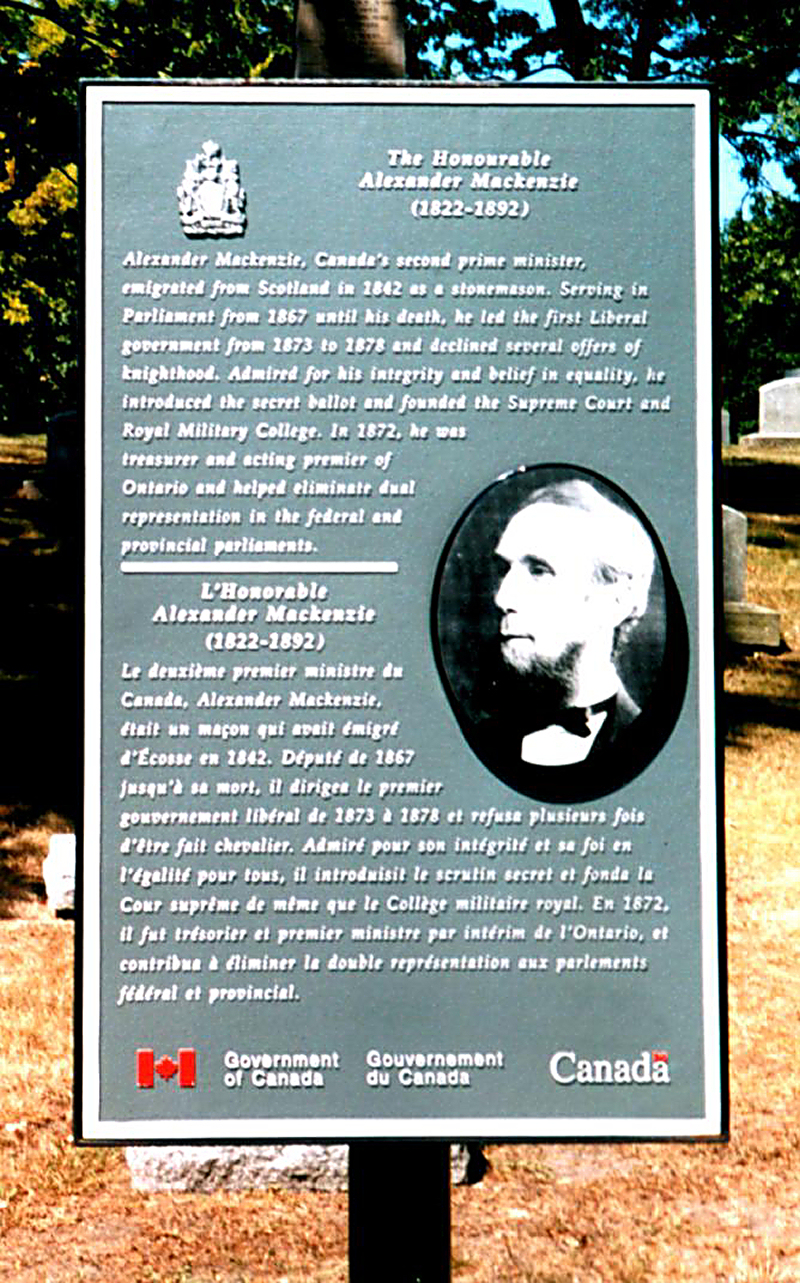
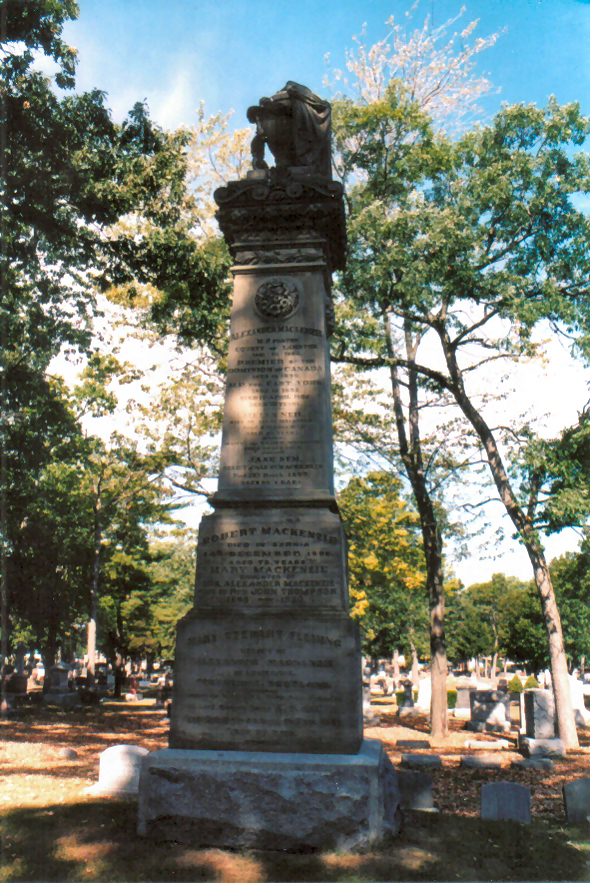
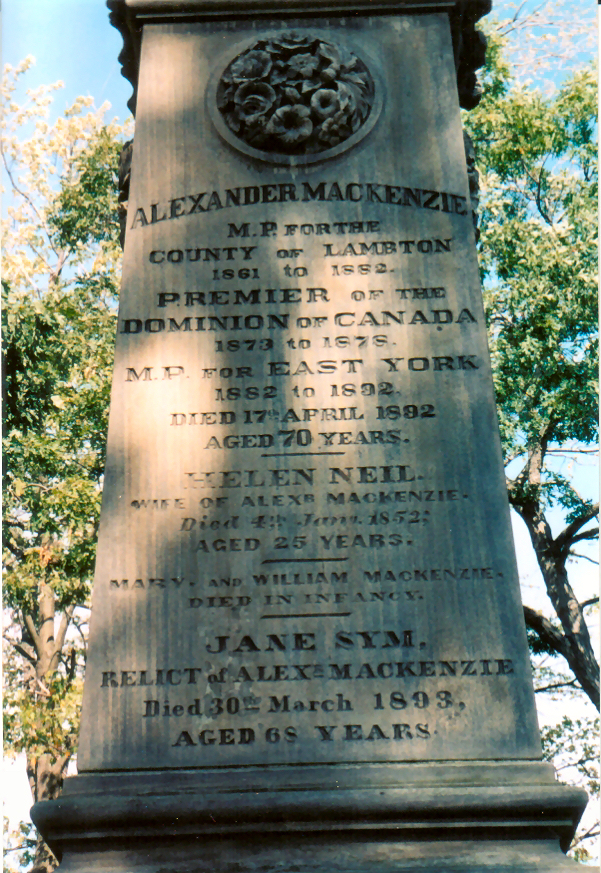
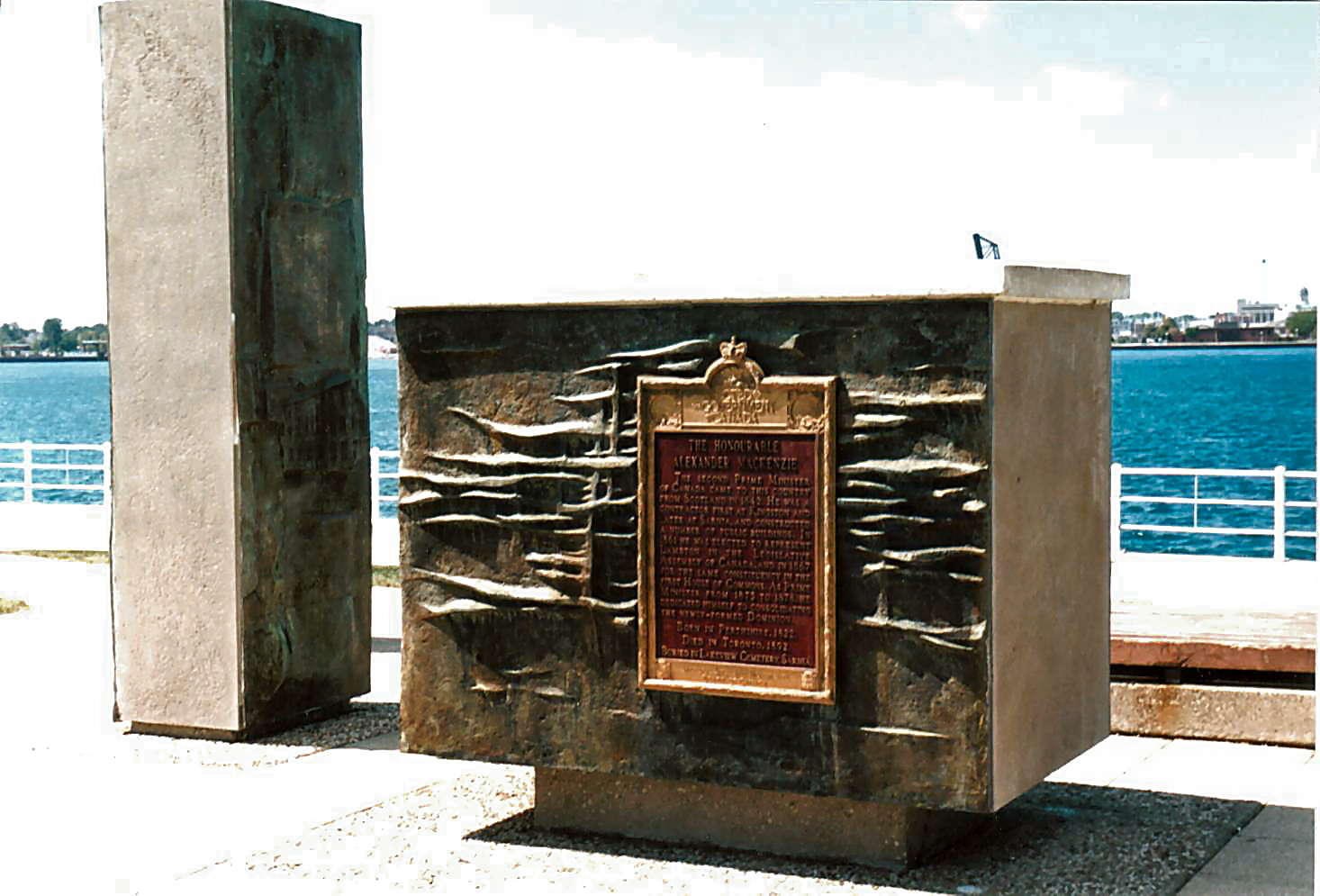
The above pictures are the grave and monuments to
Alexander MacKenzie in Sarnia, Ontario.
Our thanks to Hugh Sutherland for sending them in.
The Hon. Alexander Mackenzie
His Life and Times by William Buckingham, Private Secretary and Hon.
Geo. W. Ross, LL.D., Minister of Education, Ontario (Fifth Edition)
(1892) (pdf)
This comment system
requires you to be logged in through either a Disqus account
or an account you already have with Google, X, Facebook or
Yahoo. In the event you don't have an account with any of
these companies then you can create an account with Disqus.
All comments are moderated so they won't display until the
moderator has approved your comment.