Crofting
Agriculture
Its practice in the West Highlands
and Islands by F. Fraser Darling (1945)
AGRICULTURE in the crofts, the Islands, and West
Highlands presents special problems. In this book Dr Fraser Darling explains
the principles of putting land into good heart and of growing crops which
suit the difficult climate and conditions.
There is no one better qualified to do this than Dr
Fraser Darling, who has first-hand experience and a great sympathy with the
crofter's problem.
Some of Mr Robert Adams's beautiful photographs of
Highland scenery illustrate the book, and this selection shows that he does
not neglect to record the arts and crafts of Highland Life.
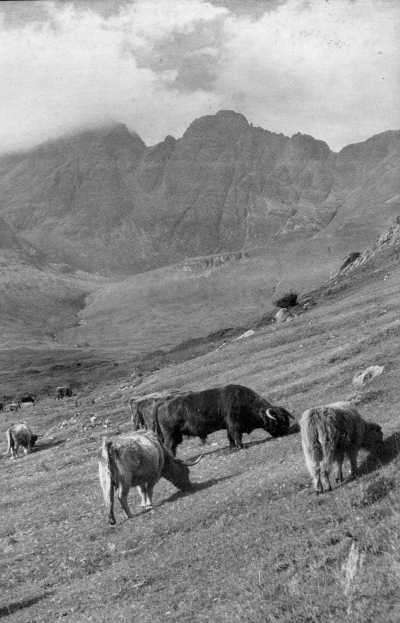
HIGHLANDERS AT TORRIN, BELOW BLAVEN, SKYE
The blood of the Highland breed is of great value in the
store stock exported from the Highlands, but unfortunately it is generally
felt that to maintain pure bred Highlanders does not pay. There cannot be a
continuation of cross-Highland cattle for the store markets unless someone
keeps pure Highlanders. A well-ordered cattle policy should ensure the
maintenance of sufficient pure Highland cattle, should attempt to keep the
Shorthorn-Highland cross heifers in the crofting districts, and, in allowing
these heifers to be crossed with an Aberdeen-Angus bull, should use
persuasion to prevent the black offspring being kept as breeding stock in
the West. These black-polled calves, which would be one-half A.A.,
one-quarter Shorthorn and one-quarter Highland, should be reared to be
six-quarter stirks and then sold out of the Highlands or grazed off as the
end-product.
The Highlanders in this photograph are grazing old
crofting lands which were once cultivated.
Crofting Boy in 1955
Crofters (1944)
The Corncrake and the Croft
A 1977 BBC Bristol production for The World About Us series captures a
vanished world of crofting in the Outer Hebrides. Written and narrated
by Finlay J. Macdonald, filmed and directed by Alan McGregor with help
from the RSPB Film Unit. Macdonald, a native Gaelic speaker, was from
the nearby island of Harris.
Living on a Croft (1986) A rough cut version of a 1986 documentary which was filmed for the
BBC children's series "Let's See". It looked at everyday life in the
community of Ness (Isle of Lewis, Scotland); the villages of Eoropie,
Fivepenny, Port of Ness, Lionel, Habost, Swainbost and North Dell are
shown.
Preface
This book is the result of an experiment in agricultural
journalism. When a series of articles first took shape in my mind as an
accompaniment to personal travels in the crofting areas, I knew that its
success would not be wholly dependent on such knowledge, and ability to
impart it, as I might possess. The fortunes of the weekly articles would
depend largely on the co-operation of the Highland newspaper editors: with
their paper supplies being cut and increasing official demands being made on
their space, would they be prepared to print an additional 600 to 700 words?
Every editor resident in the Highlands who was approached replied that he
would do his best, and that he has done. The weekly articles still could not
be called a success unless it was known that they were widely read. The
crofter's readiness to read them was just as important as my willingness to
write and the editor's kindness and public spirit in printing them.
I believed that the crofter would read matter which dealt
with the problems of his own husbandry. It did not matter to me whether he
agreed or not with what I had to say, but I believed he would preserve an
open mind and bring his critical sense to bear. The footnote each week
inviting correspondence on crofting agriculture was in some measure a
safeguard that I should not do all the talking!
The West Highlands are a country of difficult
communications and on a part-time appointment it would have been impossible
for me to see every crofter personally and have a crack with him—the more's
the pity, from my point of view. The weekly article helped me to say
something about basic principles of agriculture, and the crofter's response
in letters asking for advice is an expression of goodwill and a definite
sign that someone wants to know. The volume of letters from crofters has
steadily grown, and if the truth be known, these letters are the only ones I
sit down to answer with enthusiasm and enjoyment, instead of as an irksome
necessity.
I was criticized recently for saying that there was
defeatism in the Highlands, defeatism being the failure to believe that the
croft was worth working for a living or part of a living. Such an attitude
undoubtedly exists, but my remark should never have been represented as my
final opinion of the crofter. I have faith in him and in the crofting life
as the good life; the interest shown in these articles and the letters I
receive asking for particular information are proof that defeatism is not
general. While people can take the trouble to sit down with pen and paper
and ask for knowledge, they are not taking the line of least resistance,
which is the attitude of defeatism. These letters are a token of a positive
will to action and I miss no opportunity of telling that to the outside
world.
Many correspondents have asked if the articles might be
gathered together in book form. The idea seemed a good one, and I am glad to
present them in that form now in an expanded version, thanks to the
co-operation of the Publishers.
I am also grateful for the opportunity of having Mr
Robert M. Adam's illustrations. His beautiful photographs of Highland
scenery are famous, but the selection given with this book shows that he
does not neglect to record the arts and crafts of Highland folk. These
photographs have enabled me to add a last few words to the book in such
fashion as the reader and I might talk if we were walking round the croft
together.
Kilcamb Lodge, Strontian
North Argyll, April 1945
Power to the Pococks: A Year in the Life of a Crofting Family
Crofters - A 1944 film
showing life on Scottish crofts in wartime
Eriskay - A Poem of Remote Lives
Made in 1934 by an amateur ethnographer and aristocratic German diplomat
who had abandoned his country to live in Scotland, this is one of the
earliest film portraits of the tiny island Eriskay, famous for Whiskey
Galore, the Eriskay Love Lilt, the Eriskay fisherman's jersey, and the
fact that Bonnie Prince Charlie first set foot on Scottish soil on this
island, when he returned from France to lead the rebellion.
Eriskay sits at the bottom of the long chain of the outer Hebrides,
running from Lewis in the North, through Harris, through North Uist,
Benbecula, South Uist, and nearby Barra...
Kissling filmed the 500 islanders at work, men and women, girls and
boys, setting off in their herring smacks, shearing, gathering peats,
collecting lichen for dying their tweed, spinning, carding, waulking,
and recorded their beautiful working songs...
The plans and dreams of a new generation from the land. They value their connections to the land; they want to work the land and make their homes there. But against them stands the market economy: unaffordable land and housing, and a lack of employment opportunities in the rural communities they love. A group gathers in the northern Highlands to organise for change.
There are many Crofting
pages on Facebook and while this selection is correct at time of listing
these I can't guarantee they will still be there when you try them.
The Last Crofter in Laxay
Film of my father in-law. Malcolm Macleod of Laxay, Isle of Lewis. His
nickname "Chaidh Ardie" is a childhood abbreviation of his name in
Gaelic - Malcolm son of Angus son of Alasdair. The film was made by John
Murdo Macdonald.
The Scottish Crofters
Machair Life
Machair is the Gaelic name for a rare and distinct type of coastal
grassland that supports a huge diversity of wildlife in the Hebrides of
Scotland. This is the story of crofting on the machair in the 21st
century and a partnership project to support this unique landscape.
Lumnah Acres
A Guide to Modern Homesteading Self-Sufficiency and FREEDOM. We love
Homesteading and the control it offers with growing our own food,
raising our own animals and of Course the FREEDOM it provides! I was
born and raised 20 minutes from Boston, MA. At the age of 17, I was
diagnosed with Anxiety. My personal experience with the prescribed
medication was NOT POSITIVE. So I decided to find a better way. I didn't
know it at the time but, that was the BEGINNING for me! I have been
“FINDING A BETTER WAY” in all areas of my life ever since. Better ways
of how to create a modern homestead affordably, and a better way to
provide my family with healthy foods, and so….. much MORE!
At Lumnah Acres we hope our experiences can help guide you to find YOUR
BETTER WAY! Please join us in sharing our journey with you, let us be a
guide to Modern Homesteading, Self-Sufficiency, and FREEDOM for you!
The Farmhouse
After 5 months at the very awesome Cloquet River Campground we have
bought a house and it is time to move. House number 2 was the choice. 37
acres, an old farmhouse that needs some work... Perfect... Welcome to
"The House"
The
Scottish Isle
During the summer of 2023, we moved to a remote Scottish island to be
its only two residents along with our two pet sheep and pair of cats.
Join us in our journey as we renovate our ancient stone cottage, build
up our homestead, and tune-in to the rhythms of island life
Simple Living Alaska
After 4 years of building a sustainable life at our previous homestead
in Oregon, we decided to take a BIG leap and uplift our family to head
2,500 miles North to Alaska to do it all again. This time around we are
keeping things simple. Follow us as we hunt and gather, explore the
rugged terrain, and recreate our homestead at our off grid cabin here in
Southcentral Alaska. We are thrilled to share our Simple Living
experience in the Alaskan Wilderness with you!
My Self Reliance
Log Cabin Building, Woodworking, Bushcraft, Survival Skills, Cooking,
Canadian Wilderness exploration, Hunting, Fishing, Off Grid Living in
the forest with my golden retriever Cali.
Hi, I'm Shawn James. I am a passionate outdoorsman living the life of my
dreams in a log cabin that I built by myself in the Canadian wilderness.
Join me and my golden retriever, Cali and listen to the sounds of the
forest in this relaxing wilderness setting. I prefer to keep my talking
to a minimum and let the natural sounds of nature make you feel as
though you are there with me. New videos EVERY FRIDAY & randomly
throughout the week.
Hickory Ridge Homestead
Working hard to fulfill a dream. Building a home with logs from my own
land in the Ozark Mountains of Arkansas debt free and developing a
sustainable homestead. Leaving the corporate world behind. Follow us on
our journey!!
Country View Acres
We purchased 41 acres in the southern Illinois and are preparing the
land to be our future homestead. We just built our log home on the
property, and now we are working towards raising more animals. We like
to hunt, fish, garden, and have our own shooting range. We already raise
chickens and rabbits and are planning for goats and pigs. Follow us as
we continue to develop our property into a working homestead. I will do
my best to post at least two to three videos a week.
An
introduction to off grid living in the UK
A quick tour of where I live and a chat about how I do it! I cover solar
power, heating, cooking, growing food, using rain water and more. I've
made a whole series of follow up videos, see the off grid living
playlist on my channel!
If you've enjoyed this video - feel free to buy me a beer via paypal :-)
This has over 1 million views and having
watched a couple of those videos I can see why.
Kris Harbour Natural Building
My goal is to buy some woodland in Wales in the UK and build a house
with natural and re-cycled materials.
I spend most of my time at the moment making things that will be
beneficial for the future projects such as a water wheel/turbine a wind
turbine, woodworking benches and holding tools.
i would rather make something with my hands than to buy it. there is
nothing more rewarding to me than to make something and see it working.
its a real privilege that I can spend my time doing what I enjoy.
Tap o' Noth Farm
CSA market garden and permaculture demonstration farm in
NE Scotland. Vlogging about life on our small ecological farm with
milking goats, hens, market garden and all the rest.
Just a
Few Acres Farm
Our videos focus on small farm life, and are targeted toward people
interested in understanding more about small farming, sustainable
farming methods, or who wish to vicariously live the farm life! Just a
Few Acres is a 45 acre seventh generation family farm in Lansing, NY, in
operation since 1804. We are a diversified livestock farm, providing
high quality, healthy meats directly to consumers in our community. All
our livestock is grown using a grass-based diet, and we focus on a
low-stress life for our animals. We operate our farm using sustainable
practices, building healthier soil every year through innovative grazing
methods. We believe a small family farm can still be a viable business
in today’s “bigger is better” world, and that small farms supplying
locally grown food to their communities can create a more resilient,
healthy, and meaningful agricultural system.
Red
Poppy Ranch
This is our journey from the big city of the southwest to the little
town of the north west. I have dreamed this dream of living life on my
terms for my entire lifetime. We recently took major steps to make this
a reality.
The EASIEST and CHEAPEST way to COOK! No
electric or gas
People of the croft: Visualising land, heritage and identity
This short photographic essay emerges from the recognition that
identity,
landscapes, and heritage landscapes in particular, are rarely configured
and conceptualised wholly linguistically.(pdf)
This comment system
requires you to be logged in through either a Disqus account
or an account you already have with Google, X, Facebook or
Yahoo. In the event you don't have an account with any of
these companies then you can create an account with Disqus.
All comments are moderated so they won't display until the
moderator has approved your comment.