It is he, who is credited with the excavation of the
ornamental pond, which follows the contour along the north-east flank of
the knoll on which the castle sits. While it is described as "The
Moat" in contemporary writings and maps, it could never have served
any defensive purpose due to its shallow depth and distance from the
actual castle building. The Old Statistical Account describes several
mineral springs in the grounds and it is one of those which is the water
source for the moat.
As well as building the high stone wall surrounding
the estate, he planted a substantial amount of timber, not only for
decoration, but by way of an investment. A 1743 survey records 8557 growing
trees on the estate, and remarks on the quality of sweet chestnut trees
which were much sought after by ships’ carpenters. A feature of his
planting which can still be observed from a high vantage point, was the
tree-lined avenue, known as the Grand Avenue, 30 feet wide and almost 1
mile long, running in a straight line north-west, from the castle to
what was then the main road at a point opposite the farm of Snabs. At
that time the road from Dundee to Perth was further north than it now is
and bypassed the village, the present road not being constructed till
1790. In the time of Earl Patrick there was no road leading to the
village as there is today.
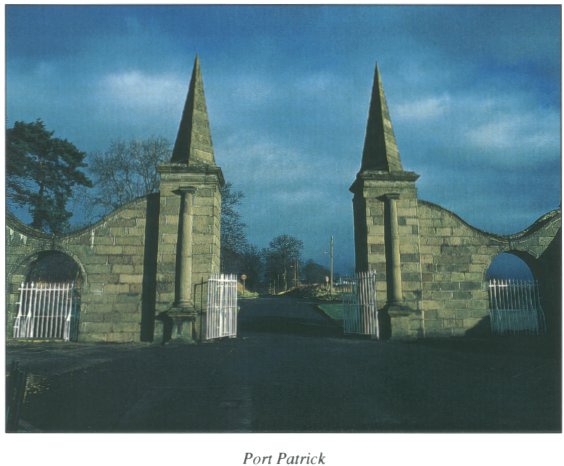
The Grand Avenue originally had six gates, five of
which no trace remains. The outer, or first gate was dismantled sometime
around 1790 and re-erected at the present entrance. It is built of a
similar sandstone to that of the castle and consists of a central
gateway 16 feet wide with two side arches of 7 feet. Two piers are
decorated with ornamented semi-circular Tuscan pilasters and all are
surmounted with elongated pyramids aligned to the cardinal points of the
compass. The gate was known as Port Patrick but became corrupted to Port
Patience.
The next gate along the Grand Avenue was the Rustic
Gate, said to be a noble arch with a little postern on each side. To the
right of this gate was the deer park and to the left, the nursery
ground.
The third gate was the Iron Gate and had two strong
pillars with rich capitals, all the pillars being of well cut stone, set
for hanging an iron gate. The enclosure to the north contained the farm
steading and to the south, the family offices and the gardener’s
house. It was between the farm steading and the avenue where the fabled
Glamis Tree stood.
The fourth gate was the Coach House Gate.
This was formed of two large plain pillars with capitals and bases. The
fifth gate was at the foot of the incline up to the castle and known as
the Ionic Gate. This was decorated in the ionic style with four columns
and capitals.
The last gate in the series was the Castle
Gate, with two plain hewn pillars and capitals, and a globe of stone on
each pillar. To the left of this gate was a postern where the Grand Avenue
terminated. Beyond the postern was Ye Beggars Seat, a stone seat,
said to be capable of holding 30 people.
On either side of the avenue was the Bow
Butts, grassed walkways, 5 yards wide and 80 yards long. At each
end was built a stone wall, faced with turf. These were for archery
practice with the right side reserved for nobility and the left for the
commoners.
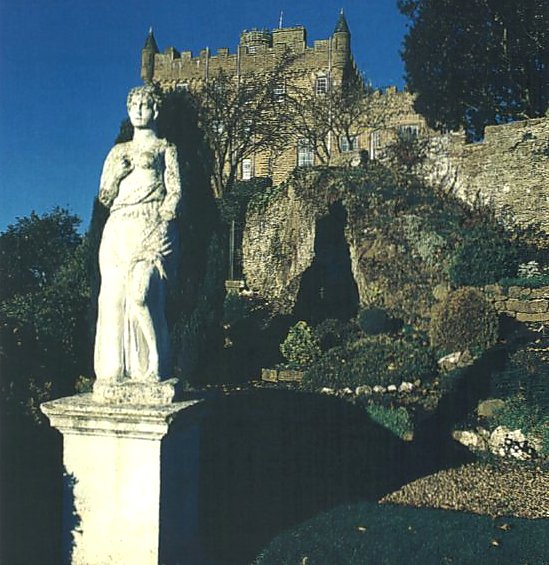
The most striking piece of civil
engineering was that of the terraced gardens, which were formed by the
force of quarry mells and peiks. This garden today bears the
name of the Italian Gardens, and is said to be made up of carried soil
which was imported from Italy as ballast for ships discharging at
Kingoodie.
Horticulture played an important
part in the life of the estate. 300 feet was under glass with a steam
heated melon pit, 20 feet by 12 feet. Much of the area under glass was
heated by copper pipes some of which were contained within the walling.
Grapes and peaches grew with notable success possibly due to the
innovative steam dew, a by-product of the melon pit, which was said to, "preserve
the trees from suffering by various insects ".
When in London, the first
Earl Patrick was much taken up with the many noble buildings then being
erected and furnished there. He was evidently determined to bring up to
date his old Castle, the name of which he changed from Huntly to Lyon
which latter name continued to be used until 1776 when a new owner
restored the old name. He bought a good deal of fine furniture and
furnishings for the improvement of his Castle and shipped his purchases
from London to Dundee. As there were no bricks made in Scotland until long
after his day he probably brought bricks for his ice-house in the same
manner. The Earl also brought statuary for the embellishment of his
gardens and introduced many new ideas such as sash windows.
For a period around 1780 the estate
was to enjoy an income from the sale of shell marl (an aggregate used in
the construction of walls and outer rendering of buildings). Records
indicate sales of 60,000 bolls (a cube of two feet) at 8d or 9d per boll.
George Paterson’s
influence on the estate saw some changes in the layout. Old trees were
removed and new ones planted but many of the fine specimen trees were to
remain so as to preserve the unity of style between the policies and the
castle.
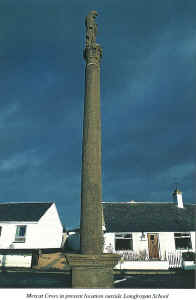
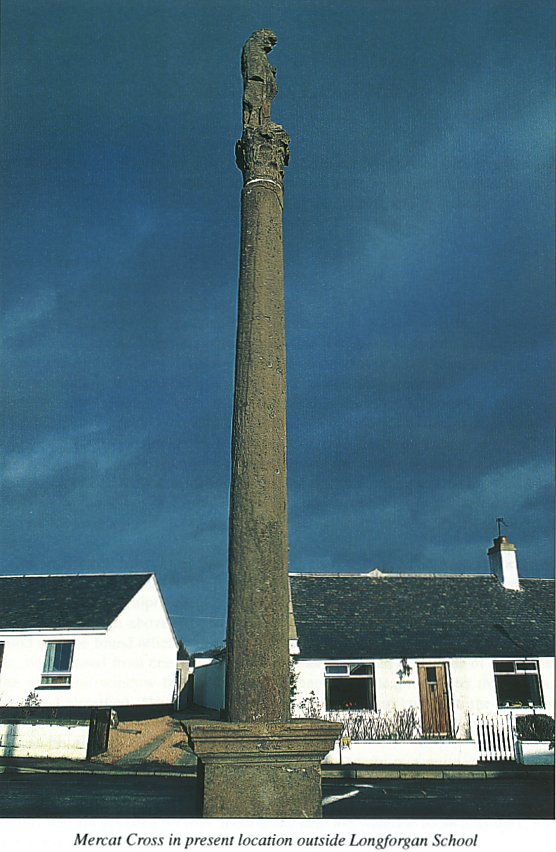
A mercat cross consisting of an
eleven foot high stone pillar surmounted by a lion had been erected in the
village of Longforgan in the 17th Century. Some years later it was removed
and re-erected within the policies on a grassy mound, known locally as
Cromwell’s Knowe. It remained there until as recently as 1989 when, at
the request of the Community Council it was reinstated to the village to
stand outside the primary school.