Castle Huntly, like many
other noble buildings has its share of tales to tell, some of which are
founded in fact, some of which have become so distorted through time as to
be barely recognisable, all are enjoyable to hear and to recount.
The White Lady
The most commonly known
legend is that of the White Lady. One version is of a dowager Countess of
Strathmore who entered into a second ill fated marriage. The account of
her bitter experience impelled Thackery to write his romance of sordid
life entitled Barry Lyndown. In some editions of that romance, a note by
the author explains its foundation in history. The unhappy woman wrote
about her wretched experience, the letter being described as the most
damning indictment of a husband ever written by a wife. As well as being
reported to having been seen in one of the rooms of the castle, her ghost,
it is said, has been known to haunt the grounds. Long before Queen
Victoria ascended the throne, many in Longforgan village expressed their
confident belief in the apparition that was said to haunt the chamber in
the tower of Castle Huntly and the parks. Even in the last decade of Queen
Victoria’s reign many Carse folk did not care to pass the Bogle Brig at
night.
When Lady Armistead was
tenant of Castle Huntly two young local ladies determined to sleep in the
haunted room; but after midnight for reasons not recorded but can be
imagined, they were compelled to seek other quarters. The maid at Castle
Huntly had always been nervous about going near the Waterloo room after
dark, and it was known that English maids had been scared out of their
wits.
The legend of the White
Lady of Castle Huntly has no connection whatever with the fate of the
foolish Dowager Countess of Strathmore, who married a degenerate Irishman.
She died long after Castle Huntly had become a Paterson possession. While
she was still alive, the eerie story of Castle Huntly’s ghost terrified
Carse folk.
 The
Glamis Tree
The
Glamis Tree
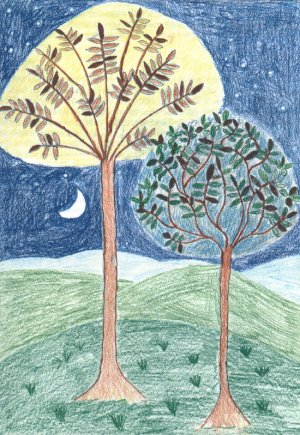
There was said to be a most
remarkable tree called the Glamis Tree, an ash, which grew to a height of
over 50 feet high and 27 feet in circumference. The tale is that an Earl
of Kinghorne, or perhaps Patrick, first Earl of Kinghorne and Strathmore
who made Glamis Castle splendid as it is now, ordered the family fool to
take a message to Castle Lyon, as Castle Huntly was then called. The
luckless jester, dressed in the uniform preserved at Glamis, remarked that
he had no horse for the long journey to the Carse; and as the legend
asserts, the Earl took a sapling and told him to ride thither on it. The
fool arrived at Castle Lyon affecting to ride the sapling as a horse and
either himself or someone in authority planted the sapling so as to
commemorate the strange means of travel. Like all legends, this one of the
ash at Castle Huntly must have originated in some practical happening.
Longforgan folk believed the story associated with the splendid ash tree
at Castle Huntly gateway and when the noble feature was lowered to the
ground much concern was expressed.
Associations
Castle Huntly is a place
around which cluster interesting historical associations. In 1650 Charles
II paid a visit though not a willing one. He escaped from the Covenanters
at Perth on Friday the 4th of October 1650, and being overtaken in Glen
Clova he was taken back. He was conducted on Saturday to Castle Huntly
where he stayed over night and from there on Sunday he was escorted to
Perth.
A tradition is told that
when General Monk besieged Dundee, his soldiers occupied Castle Huntly as
a Cavalry station and the church of Fowlis as a stable.
During the short lived insurrection
of the Earl of Glencairn against the Commonwealth a party of the Athol men
it is said "came to Huntly to jointure house of Lady Glamis in
February 1654 and fired a stack or two but
promptly repenting of the mischief staid and extinguished them".
During the possession of
Charles, fourth Earl of Kinghorne the Castle, then Castle Lyon was visited
by the Pretender. On the way from Peterhead to the camp at Perth the
Chevalier halted at Glamis on 4th January 1716 and on his way from Dundee
on Saturday the 7th January, he honoured Castle Lyon by staying to dine
within its walls and in the evening passed on to Fingask.
Castle Lyon too saw the
retreat of the Chevalier and his forces and their pursuit by the army of
Argyll. The table at which both Charles II and James the Pretender were
served remained in the castle for some years but is now sadly unaccounted
for.
Castle Huntly
Tradition would have it
that Lord Grey named the castle after his wife, a daughter of the Earl of
Huntly, but since the lineage can be traced back to Browfield or the
estates at Broxmouth on the east coast not far from Dunbar, it is more
likely that the name was taken from the village of Huntly in the parish of
Gordon, which formed part of the Broxmouth estate. Another theory is that
before the castle was built there was a field known as Huntly, and a burn
which ran through the lands was of the same name.
The Tunnel
For many years there has
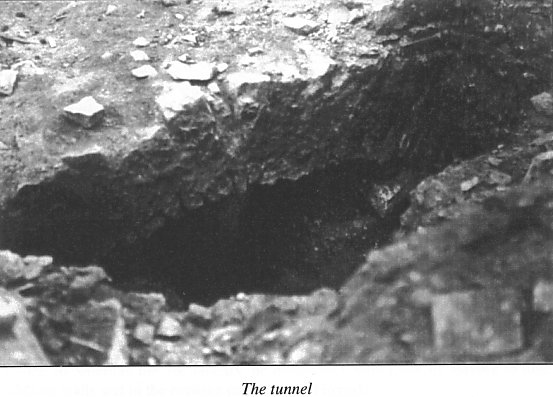
been speculation about a tunnel between Castle Huntly and Glamis, a
distance of about 15 miles. In 1939 press speculation revived this legend,
when some old plans were found by Colonel A. G. Paterson on his
rediscovering the dungeon. To date there has been no evidence to support
this legend, and indeed even a
modest understanding of the topography makes the practicalities of such an
endeavour questionable. Another tale of the links between Glamis and
Castle Huntly surrounds the first Earl of Strathmore. It was said that it
was his intention to build an avenue of trees between the two castles
despite the 15 mile distance.
Wallace’s Stone
The tale of Wallace’s
stone is somewhat more plausible. The Statistical Account of 1795 describes
this stone as the bear stone, relating the tale that this stone was the
property of a Longforgan weaver named Smith. When not in use as a quern or
hand mill for removing the husk from the barley or bear, he kept the stone
at the side of his cottage door as a seat. It was on this stone that
Wallace rested on his way to Dundee, when he fled after killing the
Governor’s son. The last descendant of the Smith family presented the
stone to George Paterson for safe keeping. The stone lay for many years
unremarked in Castle Huntly but is now in the Steeple Museum in Dundee.
Construction
Tradition has it that the
stone for Castle Huntly was brought from Kingoodie by boat. There is
certainly large deposits of river sand to the south-west of the rock which
shows signs of exposure to water erosion. This may have been the reason
for the curtain wall which by the Statistical Account was built between
1660 and 1670 and the massive buttressing at the base of the south-west
elevation.


