|
Dr. Stewart’s Last Message
to the Missionaries—His Private Statement about the Native College—The
Present Position of the College.
‘It is better to
Christianise the Africans than to crush them. It is better to educate than
to exterminate them. And the day is coming, whether we live to see it or
not, when even the Dark Continent shall have its Native Universities.
‘—Dr. Stewart in 1878.
A
FEW weeks before his death Dr. Stewart
dictated this message to the missionaries of all the Churches:—
‘DEAR SIR,—The
recommendation of the recent Inter-Colonial Native Affairs Commission with regard to the establishment of a
central Native College aided by the various States for training native
teachers, and in order to afford opportunities for higher education to
native students, has, no doubt, occupied your thoughts. As the proposal is
being discussed by natives all over the country, and in view of any action
the Governments may take to give
practical effect to the recommendation, it seems well that expression
should be given to the opinion of missionaries and especially of those
directly connected with the education of the more advanced native
students.
‘I therefore write to you, and to
other European missionaries, to ask you to assist in carrying out this
scheme for the advancement of native education throughout South Africa,
that we, by co-operation with one another, and co-operation with the
Governments, may ensure the missionary and inter-denominational character
of the proposed College.
‘Owing to my ill-health, I fear very
much I could not attend any meeting which might be convened for the
purpose of discussing the matter and of uniting in some one line of
policy, but my views on the subject can be condensed into a short written
statement, and a member of my staff would represent me. - Believe me to
be, yours sincerely,
‘JAMES STEWART.’
From his death-bed he sent the
following statement to his Committee in Edinburgh. It will be appreciated
by all who are interested in Native Education
‘PERSONAL STATEMENT - PRIVATE
‘The Report of the recent
Inter-Colonial Native Affairs Commission contains the recommendation that
a Central College should be established to provide higher education for
the natives. Further, it has been officially recommended by the Education
Advisor to the High Commissioner that the claims of Lovedale to become
this College should be considered; and the lines on which this College
should be constituted with regard to finance, control, and curriculum,
have also been outlined by Mr. E. B. Sargant in his Report to Lord Milner.
‘In view of the possibility of
conflicting opinions being expressed by missionaries during the discussion
of these proposals both in this country and in Scotland, I would not like
any doubt to exist as to my attitude towards the question and my earnest
hope for the future development of Lovedale, and so have thought fit to
express these in a written statement. This is all the more necessary as my
ill-health prevents me from taking as active a share as I would have liked
in furthering the proposals.
‘The statement following may
therefore be considered as my own personal judgment based on experience,
and gradually arrived at after many years.
‘Before the year 1880 I recognised
that if the desire for education on the part of the natives continued to
grow at the existing rate, sooner or later it would be necessary to
provide them with higher training than was then available; and to meet
what was coming I endeavoured so to shape the policy of Lovedale that the
expansion of its work would follow naturally, both as regards numbers and
scope, on the need being felt. In brief, I had formed the idea, expressed
at the London Missionary Conference in 1882, that Love-dale should become
the future Native Christian University of South Africa. And with this end
always kept in view we have not confined ourselves to any one department
of instruction or to any one native tribe, or to any one religious
denomination.
‘It is necessary to mention here
that another ideal for the future of Lovedale has been and is held by
some. It may be described as the official view of the Cape Education
Department, which would like to see Lovedale become a large institution
exclusively devoted to training Cape Colony youths as teachers for the
schools of Cape Colony. The wide distinction between these two ideas will
be recognised at once, and remembered.
‘It is therefore hardly necessary to say that the
recommendations of the Native Affairs Commission, and the further proposal
of Mr. E. B. Sargent that a native College should be established which
would embrace all British South Africa and invite the co-operation of all
Protestant Christian denominations, not only meets my whole-hearted
approval, but is to my mind the natural result of a careful study of
educational progress among the natives, combined with the statesmanlike
recognition of their desires and potential capabilities. it would be a
realisation of my hopes for Lovedale, and I cannot but see in its
inception the possible workings of Providence.
‘Without committing myself with
unqualified approval to all the details of the scheme suggested by Mr.
Sargent and those working with him, I will indicate broadly what I
consider would be essential to the success of such a College as has been
proposed.
‘CONTROL
‘With regard to control or
administration, the three parties most interested in the matter, the
Governments, missionaries, and natives, should be represented on any
councils or boards, constituted to guide the policy and conduct the
management of the College. The denominational house system, by which all
the Protestant Churches working among natives would have the boarding and
care of their respective students, would ensure the missionary and
pan-denominational character of the College, and, provided men of moderate
views were in charge of the various hostels, should not prove unworkable.
Means should also be taken to ensure the appointment to teaching posts of
men of high character and religious earnestness.
‘FINANCE
‘The natives and their friends should be prepared to
raise in part or in whole the sum necessary for the purchase of Lovedale,
and the Governments should guarantee in perpetuity towards the maintenance
of the College an annual sum of not less than £10,000.
The various Churches should establish
and maintain their own hostels, college fees covering the cost of the
boarding of students. Representation should bear some proportion to the
amounts contributed by each of the several states and by the churches and
natives respectively.
‘SCOPE OF WORK
‘In the present stage of native
education it is impossible to lay down definitely, or in detail, the lines
on which the curriculum should be finally drawn up; that must be left to
educational experts, whose views will probably be modified by experience.
At the same time, opportunity should be given natives of being trained as
ministers, teachers, hospital assistants, and law interpreters. One thing
may be said with certainty, that unless a course is framed capable of
development to a standard equivalent to a degree course in a British
University, and in time justifying the conferring on the students of a
degree, this College will not fulfil the expectations of the natives, nor
check the exodus to America. Minor points may safely be left to the
decision of a Council representative of the Governments, and the
missionaries themselves.
‘JAMES STEWART.
‘LOVEDALE,
‘Oct. 30, 1905.’
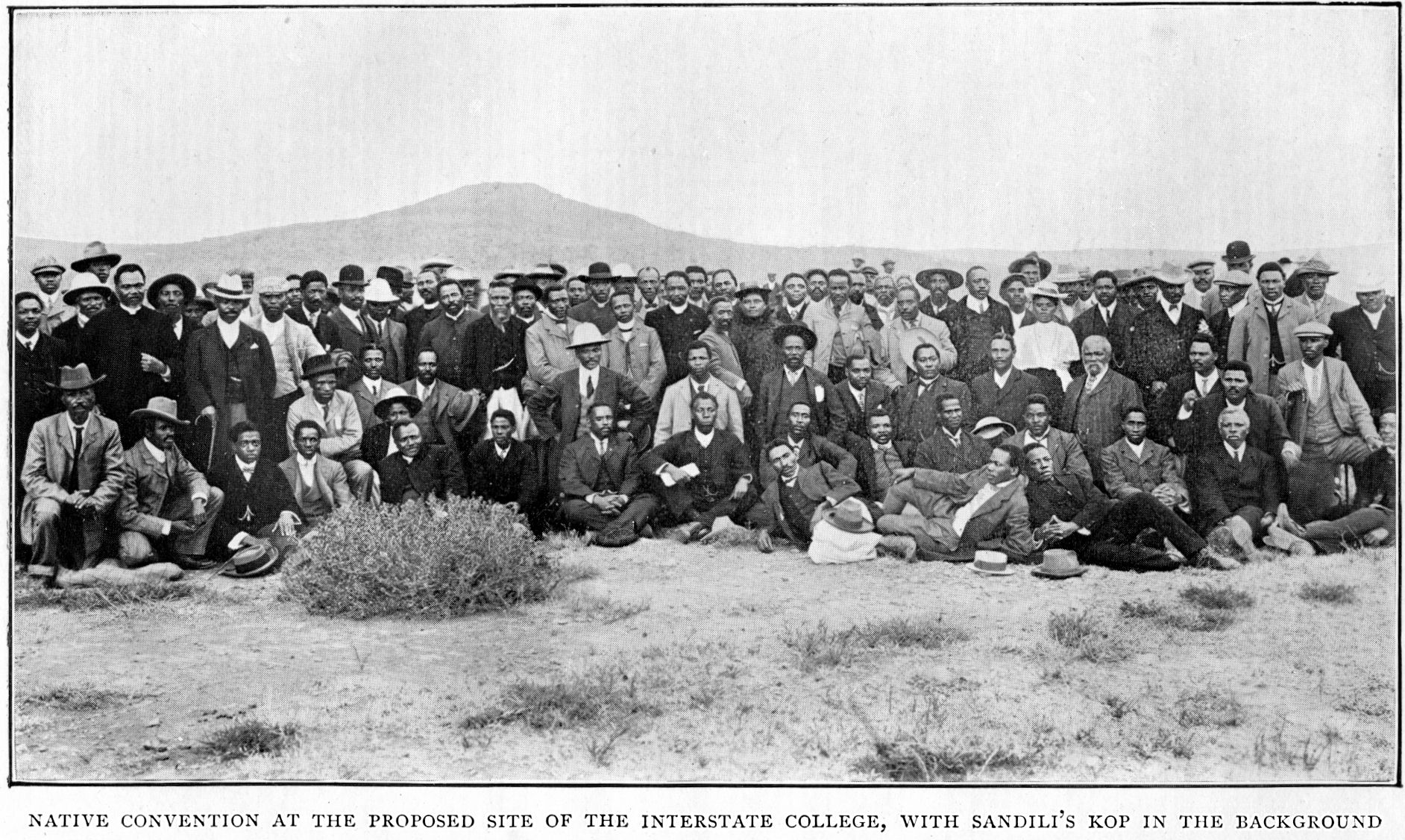
The scheme for the Native College
seems to be making satisfactory progress. The site is to be at Fort Hare,
on the mission lands, on the east side of the Tyumie, and about a mile
from Lovedale.
Several of the tribes are redeeming
their promises by raising large sums of money. Religious training will be
secured for all the students through hostels presided over by ordained men
specially chosen for the work. The pupils are to receive industrial
training at every stage in their course. |