CRAWFORD,
CRAUFURD, or CRAUFORD,
a surname derived from the barony of Crawford in Lanarkshire, of
which the origin is unknown.
The family
of Crawford is of undoubted Norman origin. The site of the ruins of
Crawford castle is still called Norman Gill, and the early names of
this family are all pure Norman. The account of their descent from
an Anglo-Danish chief, as given by George Crawfurd, and adopted by
Robertson in his Ayrshire Families, is altogether erroneous. Burke,
[History of the Commoners, vols. ii. and iii.,] conjectures
that they are descended from that old and distinguished race, the
earlier earls of Richmond, with whose armorial bearings theirs
nearly correspond, being Gules, a fesse ermine in the
former, and a bend on the latter. According to his
hypothesis, Reginald, youngest son of Alan, fourth earl of Richmond,
who died in 1146, and great grandson of Galfridus, duke of Brittany,
who died in 1008, obtained large grants of land from King David the
First in Clydesdale, being one of the thousand Norman knights whom
he established in his dominions. These grants may have originated in
his (Reginald’s) connection with the royal family of Scotland, as
his brother Conan le Petit, fifth earl of Richmond, married a
grand-daughter of David, namely, Margaret, daughter of Prince Henry,
and sister of King William. In connection with this relationship and
settlement of Reginald in Scotland, Theobaldus the Fleming, the
reputed ancestor of the Douglases, who held lands in Yorkshire under
the earls of Richmond, appears to have followed his fortunes into
that kingdom, as also Baldwin of Biggar, formerly of Multon in
Yorkshire, under that family, who afterwards married the widow of
Reginald. He is presumed to be the party who assumed the surname of
Crawford, according to the practice of that age, from his barony of
Crawford in Clydesdale. He is alluded to, in a charter of William de
Lindsey, afterward confirmed by King William, early in that prince’s
reign, wherein mention is made of Johannis de Craufurd, filius
Reginaldi. In 1127 there were two brothers of this name, knights,
sons must probably of this Reginald, namely, Sir John Crawford and
Sir Gregan Crawford, both in the service of King David the First. On
the foundation of the abbey of Holyrood by that monarch, Sir
Gregan’s arms were placed therein, as he was instrumental in saving
his majesty’s life from a stag that had unhorsed him whilst hunting
on that spot on Holyrood day, in 1127. [Nisbet’s System of
Heraldry, vol. i. p. 334.] The old stones on which his arms were
emblazoned, taken from the ruins of Holyrood Abbey, were built over
the lintels of the Canongate church porch; this church having been a
dependency of the Abbey. He carried in his armorial bearings,
argent, a stag’s head erazed, with a cross crosslet, between his
attires, gules, laying aside his paternal bearing; gules, a fesse
ermine, carried by some branches of the Crawfords. On the abbey of
Holyrood are the arms of Archibald Crawford, treasurer to James IV.,
and brother of Crawford of Henning, as shown in the subjoined cut,
viz., a fesse ermine with a star in chief, and the shield adorned on
the top with a mitre. Sir Gregan had a grant of lands from King
David in Galloway, called after him, Dalmagregan. This appellation
is most probably a corruption of “De la Mag Gregan,” and implies
“the lands of the chief Gregan,” and is an instance of the adoption
of the prefix Mac in connection with the Romanesque Dal, as well as
in reference to a Norman knight.
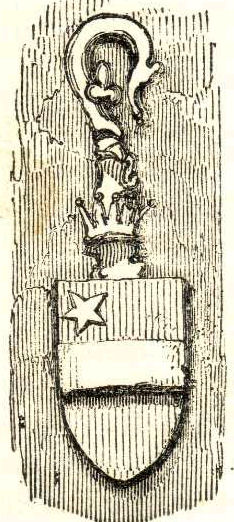
[arms of Archibald Crawford]
Galfridus, styled Dominus Galfridus de Crawford, frequently
occurs among the magnates Scotiae, as a witness to the
charters of King William inter 1170 et 1190. He married the sister
of John le Scot, earl of Chester, and niece of the king. She was the
daughter of David earl of Huntingdon, second son of David the First
of Scotland by his queen Maud. He is termed kinsman by John le Scot
earl of Chester, nephew of the king, in a charter quoted by George
Crawford, along with John le Scot’s two natural brothers,
where they are all styled fratribus, in accordance with the
practice of that age in the use of this term.
Reginald de Crawford, probably the son of Galfridus above
mentioned, is witness in 1228, to a charter of Richard le Bard (the
original of the name of Baird) to the monastery of Kelso. Reginald
was succeeded by his second son, Sir John de Crawford, designed
dominus de eodem, miles, in several donations to the monasteries of
Kelso and Newbottle. He died, without male issue, in 1248, and was
buried in Melrose Abbey. He is said to have had two daughters, the
elder of whom, Margaret, married Archibald de Douglas, ancestor of
the dukes of Douglas, and the younger became, about 1230, the wife
of David de Lindsay of Wauchopedale, ancestor of the earls of
Crawford. There is, however, no proof of this latter marriage, and
William de Lindsay of Ercildun possessed the barony of Crawford long
before the date assigned to it. (See LINDSAY, name of.) The
Lindsays held it till the year 1488, when David duke of Montrose was
deprived of it, and it was given to Archibald Bell the Cat, earl of
Angus. Others say that the duke exchanged it with Earl Archibald for
lands in Forfarshire.
Contemporary with the above Galfridus de Crawford was
Gualterus de Crawford, witness to a charter of Roger, bishop of St.
Andrews, sometime between 1189 and 1202. From him came Sir Reginald
de Crawford, who, about 1200, married Margaret de Loudoun, the
heiress of the extensive barony of Loudoun in Ayrshire. He was the
first vice-comes or high sheriff of the county of Ayr, an office
hereditary in his family. In consequence of this marriage he
quartered the arms of Loudoun with his own. He witnessed a donation
of David de Lindsay to the monastery of Newbottle, confirmed by
Alexander the Second in 1220. It was under this Sir Reginald, as
hereditary sheriff principal of Ayrshire, that the three bailiwicks
of Carrick, Kyle, and Cunningham were first formed into a county, in
1221. [See Chalmers’ Caledonia, vol. iii. p. 452.]
His son, Hugh Crawford of Loudoun, sheriff of yr, in a charter
of Walter, son of Alan, high steward of Scotland, of a donation to
the monastery of Paisley, of the lands of Dalmullin (De la Mouline)
in 1226, is designed Hugo, filius Reginaldi. By a grant of Allan,
son of Roland of Galloway, he had, pro homagio et servitio suo,
the lands of Monoch, which is ratified by a charter of King
Alexander the Second at Cadihou (Cadzow) the last day of March,
1226. He had another charter from the great constable his superior,
de tota terra de Crosby, afterwards enjoyed by his
descendants the Crawfords of Auchinames. He was one of the
magnates et barones Scotiae, who put themselves into the
protection of the king of England, in the commotions that happened
in 1255. He died in the end of the reign of Alexander the Second.
His son Sir Hugh Crawford, sheriff of Ayr, had a letter of
safe-conduct to go to England in the year last mentioned. He settled
a contest with the abbot of Kelso, cum consensu Alicie spousae
suae. He had two sons and a daughter; the latter, Margaret,
married Sir Malcolm Wallace, of Elderslie, knight, and became the
mother of Sir William Wallace, the hero of Scotland. As old Wintoun
says:
“His father was a manly knight,
His mother was a lady bright.”
Sir Hugh was succeeded by his son, Sir Reginald Crawford of Loudoun,
sheriff of Ayr, who, in 1288, witnessed a charter of donation of
James, high steward of Scotland, to the monastery of Paisley. In
1292, he was one of the nominees on the part of Robert Bruce in his
competition for the crown of Scotland with Baliol; and in 1296, with
many others, he swore fealty to King Edward the First of England,
when he overrun Scotland with his armies. In the Ragman Roll occurs
the name of Radolphus de Crawforde (Nisbet’s Heraldry, App.
vol. ii. p. 10. ed. 1742), on which Nisbet remarks, “This is the
same person with Reginaldus de Crawford, in the same record entitled
vice-comes de Air.” Believing that the oath to Edward, as it had
been exacted by force, was not binding on him, he joined with the
first of the Scottish patriots who rose in arms against Edward. He,
with other Scottish knights, is described by Blind Harry as having
lost his life at the mysterious transaction called the conference of
Ayr in 1297, a deed avenged shortly afterward by his nephew Sir
William Wallace. By Cecilia his wife, he had a son, Sir Reginald or
Raynauld (otherwise Ronald) Crawford, of Loudoun, sheriff of yr, who
was among the first of the Scottish barons to join Wallace his
cousin, and was with h im in all his struggles and dangers. He was
also among the first to join Robert the Bruce. In 1306, he
accompanied Thomas and Alexander, the brothers of Bruce, in their
descent on Galloway, with seven hundred men; when, being attacked on
their landing at Loch Ryan by Duncan M’Dowal, or MacDougall (Magnus
du Gall, or chief of the Gall or Wallense), a powerful chieftain,
their little army was totally defeated, 9th February
1306-7, and the two brothers, with Sir Reginald Crawford, were
grievously wounded and made prisoners. M’Dowall carried them to the
English king at Carlisle, where they were ordered to instant
execution, their heads being placed on the castle and gates of that
town. He left an only child, Susanna Crawford of Loudoun, his sole
heiress, who married Sir Duncan Campbell of Lochawe, ancestor of the
earls of Loudoun (See LOUDOUN, earl of).
In the Ragman Roll the surname of Crawford occurs no less than
eight times as that of Scottish barons who swore fealty to Edward
the First in 1292, 1296, 1297, &c. Nisbet remarks that this surname
was then so frequent that it is difficult to distinguish them from
one another.
_____
The Crawfords of Kerse in the district of Kyle, Ayrshire, a
branch of the Crawfords of Loudoun, ultimately became the
representatives of the Dalmagregan Crawfords, and, in consequence,
carried in their armorial bearings a stag’s head, as did also the
Crawfords of Drumsoy and the Crawfords of Comlarg. The first of the
Kerse family was Reginald, son of Hugh Crawford of Loudoun, He got a
grant of the lands from his brother Hugh in the reign of King
Alexander the Third. Notices of various individuals of this family
occur in the reigns of James the First and Fourth, Esplin being at
that period a favourite Christian name with them. In 1508, David
Crawford of Kerse, David his son, John Crawford, ‘proctour,’ Esplane
Crawford, and seven others, came in the king’s will, for hindering
the sitting of the bailliary court of Carrick, when the laird of
Kerse was americated in five pounds, and each of the others in forth
shillings. This case arose out of one of the numerous feuds for
which the district of Carrick was at one time notorious. On October
5th, 1527, Bartholomew Crawford of Kerse; David and
Duncan his brothers; George Crawford of Lochnorris, and William his
brother; John Crawford of Drougan, John and William his sons, with a
great number of others, found caution to underlie the law for
assisting Hugh Campbell of Loudoun, sheriff of Ayr, in the cruel
slaughter of Gilbert earl of Cassillis. The grandson of this
Bartholomew, David Crawford of Kerse, in consequence of having only
female issue, entailed the estate in 1585, and on his death in 1600,
he was succeeded by Alexander Crawford of Balgregan in Galloway, the
next remaining heir male, descended from a son of David, the brother
of Bartholomew, and designed of Culnorris and Balgregan. The
original lands of Kerse appear subsequently to have gone to the next
heir of entail, who seems to have been of the Comlarg family. IN
1680, Alexander Crawford of Kerse is infeft in the lands of Nether
Skeldon, as heir of his father Alexander Crawford of Kerse. This
Alexander Crawford appears to have been the last male proprietor of
Kerse of the name of Crawford. His only daughter, Christian Crawford
of Kerse, married Mr. Moodie of Meicester, and having no succession,
she disponed the lands of Kerse to William Ross of Shandwick, writer
in Edinburgh, who was, soon after, drowned on his passage to Orkney,
when the estate of Kerse devolved on his heirs; who afterwards sold
it to Mr. Oswald of Auchencruive, in whose family it still remains.
The Crawfords of Kerse were famed for their feuds with the
Kennedies, and a characteristic poem, called ‘Skeldon Haughs, or the
Sow is Flitted,’ by the late Sir Alexander Boswell of Auchinleck,
baronet, one of whose ancestors married a daughter of the laird of
Kerse, founded on a traditional story current in Carrick, and the
date of which Sir Alexander assigns to the fifteenth century, was
printed at the celebrated Auchinleck press, and will be found in the
appendix to the Account of the Kennedies. Edin. 1830, 4to.
_____
The Craufurdland branch of the Craufurds, one of the oldest of
the name, descend from Sir Reginald de Crawford, sheriff of Ayr, who
married the heiress of Loudoun. His third don, John, obtained from
him several lands in Clydesdale, and in right of his wife, Alicia de
Dalsalloch, became chief proprietor of that barony. This John
conferred Ardoch, to which he gave the name of Craufurdland, in
Ayrshire, upon his second son, John Craufurd, who lived in the time
of Alexander the Second. His grandson, James Craufurd of
Craufurdland, fought under his cousin, Sir William Wallace, and a
descendant of his, John Craufurd of Giffordland, living in 1480, was
ancestor of the Crawfords of Birkheid.
Sir William Craufurd of Craufurdland, of this family, one of
the bravest warriors of his day, was knighted by James the First. He
was one of the Scottish auxiliaries in the service of Charles the
Seventh of France, and in 1423 he received a severe wound at the
siege of Crevelt in Burgundy, where a bloody battle was fought
between the French and Scots and the English, when the Scots, under
James Stewart, Lord Darnley, being basely deserted by the French,
were defeated, with a loss of three thousand killed, and two
thousand taken prisoners. Douglas (in his Baronage, p. 432) states
that Craufurd was among the slain, but this is a mistake, as in the
following year, he was amongst the prisoners released, with James
the First.
Robert Craufurd, the youngest son of Robert Craufurd of
Auchencairn, a son of the laird of Craufurdland, died in 1487, of a
wound received at the Wylielee in Ayrshire, in defending James Boyd,
earl of Arran, when that nobleman was attacked and slain by the earl
of Eglinton, with whom he was at feud. His father, Archibald
Craufurd of Craufurdland, had two other sons, namely, Thomas,
ancestor of the Craufurds of Classlogie and Powmill in
Kinross-shire, and William, secretary to the earl of Morton, and
progenitor of the Craufurds who settled in Tweeddale. Betwixt the
lairds of Craufurdland and the lairds of Rowallan, the superiors of
the lands of Ardoch, there had been a long feud, in the course of
which the title deeds of both families were destroyed. In 1476, in a
justice-eyre, holden at Ayr, by John Lord Carlyle, chief justice of
Scotland, on the south side of the Forth, Robert Muir of Rowallan
and John Muir his son, and diverse others their accomplices, were
indicted for breaking the king’s peace against Archibald Craufurd of
Craufurdland. By means of the sister of the second wife of the
latter, dame Margaret Boyd, who had been mistress to King James the
Fourth, and married Muir of Rowallan, this feud was at length
extinguished, and a new charter, upon resignation, granted to the
lair of Craufurdland of the lands of Ardoch.
His grandson, John Craufurd of Craufurdland, by his prudent
conduct, reconciled the Boyds and Montgomeries, and obtained in
marriage Janet Montgomery, daughter of the laird of Giffin, and with
a daughter, Renee, had two sons, John his successor, and Archibald,
born after his father’s death.
This Archibald Craufurd was bred to the church, and became
parson of Eaglesham, in the shire of Renfrew, and as such had a
manse in the Drygate of Glasgow, which he conveyed, in free
property, to his chief the laird of Craufurdland. He was secretary
and almoner to Queen Mary of Guise, regent of Scotland, with whose
corpse he was sent to France in 1560, to see it deposited in the
Benedictine monastery of St. Peter at Rheims, where his own sister
Renee was then abbess. When in France, he got a commission from the
unfortunate Mary queen of Scots, renewing to him his office of
secretary and almoner, and expressive of her obligations for his
great services rendered to her late mother, which commission was
dated at Joinville in France, 17th April 1561. After
Mary’s return to Scotland, in consequence of the attacks that were
sometimes made on the chapel of Holyroodhouse, where the popish
worship was allowed to be performed for the queen’s household, and
the danger of its being pillaged at any time when she might be
absent from Edinburgh, the queen, on January 11, 1561-2, directed
Sir James Paterson, the sacristan or keeper of the sacred utensils,
to deliver to her valet de chambre, Servais de Conde, the furniture
of her chapel to be kept by her almoner, Mr. Archibald Craufurd, in
the wardrobe of her palace at Edinburgh, from whence it could easily
be conveyed as often as was necessary. On the restoration of the
jurisdiction of the archbishop of St. Andrews in 1563, Mr. Archibald
Craufurd was one of the judges deputed by that prelate to exercise
it. In March of that year, he was cited before the justice court,
for celebrating mass, but the result is not stated. [Pitcairn’s
Criminal Trials, vol. i. p. 29.] He was appointed by Queen Mary,
a lord of session on the spiritual side, on the death of the bishop
of Brechin, and took his seat on 26th April 1566. After
the queen had been sent a prisoner to Lochleven, in June 1567, an
inventory was taken of all her plate, jewels, &c., at Holyroodhouse,
and the specie thereof was, by the confederated lords, melted and
converted into coin. It appears, however, that her majesty found
means to put into the hands of Mr. Archibald Craufurd, her almoner,
certain pieces of plate, for the service of her table, which he
faithfully kept in his possession till the following November, at
which time they were demanded from him by the treasurer, Mr. Robert
Richardson, and, on the 13th of that money, were
delivered by the said treasurer to the regent Murray, who granted
his acquittance for the same to Mr. Archibald Craufurd. On June 2d,
1568, his place on the bench of the court of session was given to
the prior of Coldinghame, “as being vacand through his inhabilitie,
and divers offences committed be him, quhilk merit his deprivatioun.”
His attachment to the queen was most likely his principal offence.
Among other public acts, he erected the west church of Glasgow, and
built the bridge of Eaglesham.
His elder brother, John Craufurd of Craufurdland, accompanied
James the Fourth to the fatal field of Flodden, where he fell in the
flower of his age. The eldest son of the said John, also John
Craufurd of Craufurdland, in his father’s lifetime, got from Mary
queen of Scots, a gift of the ward of the lands of Redhall in
Annandale. The deed of gift, having the queen’s signature, is dated
at Edinburgh 26th December 1561. Hugh, his second son,
portioner of Rutherglen, had several sons, who all went to Germany,
and settled there. John Craufurd of Craufurdland, who died in 1686,
had several sons. Of these, John, the eldest, who succeeded him, was
imprisoned in 1684, on suspicion of being concerned in the rising of
Bothwell Bridge; Alexander, the second son, was designed of
Fergushill; and William, the third, a merchant and burgess of
Glasgow, was the father of Matthew Craufurd, designed of Scotstoun,
author of the Ecclesiastical History deposited in the Advocates’
Library, Edinburgh, in manuscript. The grandson of John, also named
John Craufurd of Craufurdland, succeeded, on his father’s death in
1744. He was twice married, and in right of his first wife, a
daughter and heiress of John Walkinshaw of Walkinshaw, assumed the
additional surname and arms of that family.
His son, John Craufurd of Craufurdland, entered the army at an
early age, and attained the rank of lieutenant-colonel. He was
present at the victory of Dettingen, and distinguished himself in
the hard-fought field of Fontenoy. He was the intimate and faithful
friend of the ill-fated earl of Kilmarnock, who was beheaded on
Towerhill for his share in the rebellion of 1745, and attended that
unhappy nobleman to the scaffold; for which act of trying friendship
his name, it is said, was placed at the bottom of the army list.
Nevertheless, in 1761 he was appointed falconer to the king for
Scotland. Colonel Craufurd died at Edinburgh, unmarried, in February
1793, aged seventy-two. He settled his estate, by deed made on his
deathbed, on Thomas Coutts, Esq., the eminent London banker. This
deed was, however, disputed by his aunt and next heir, Elizabeth
Craufurd, and after a protracted litigation, carried on by herself
and her successor, it was eventually reduced by a decree of the
House of Lords in 1806, and the ancient estates came back to the
rightful heir. This Elizabeth Craufurd was twice married; first to
William Fairlie of that ilk, by whom she had one daughter, who died
in infancy; and, secondly, on 3d June, 1744, to John Howison, Esq.
of Braehead, in the parish of Cramond, Mid Lothian. She died in
1802, aged ninety-seven, and was succeeded by her only surviving
child, Elizabeth Howison-Craufurd of Braehead and Craufurdland. This
lady married, in 1777, the Rev. James Moodie, who assumed the
additional surnames of Howison and Craufurd. He died in 1831. On the
death of his wife, 1st April 1823, she was succeeded by
her only surviving son, William Howison-Craufurd of Craufurdland and
Braehead, born 29th November 1781, married 14th
June 1808, Jane Esther, only daughter of James Whyte, Esq. of
Newmains, by his wife, Esther Craufurd, with issue.
The Howisons possessed Braehead in Mid Lothian since the reign
of James the First. According to a tradition, which is embodied in
the popular drama of ‘Cramond Brig,’ part of the estate was
conferred by James the Second or Third, as a reward to one of their
ancestors for having gone to the rescue of the king, then wandering
about in disguise, when attacked by a gang of gipsies, and with no
other weapon than his flail, with which he had been thrashing corn
in his barn, delivering him from his assailants. The tenure by which
this land is held, is the presenting of a basin of water and a
napkin to the king of Scotland, to wash his hands, King James, on
entering Howison’s cottage, before partaking of refreshment, having
asked for water and a cloth to wipe the marks of the scuffle from
his clothes. This service was performed by Mr. Howison-Crawfurd,
then younger of Crawfurdland, in right of the lairdship of Braehead,
to King George the Fourth, at the banquet given to his majesty by
the city of Edinburgh, 24th August, 1822, when he was
attended by masters Charles and Walter Scott, the one a son, the
other a nephew of the author of Waverley, as pages, attired in
splendid dresses of scarlet and white satin. The rose-water then
used has ever since been hermetically sealed up, and the towel which
dried the hands of his majesty on that occasion has never been used
for any other purpose. All the documents mentioned as granted to the
above-named Archibald Craufurd, almoner to Queen Mary, are likewise
carefully preserved by the Craufurdland family.
_____
The Crawfords of Drumsoy, in Ayrshire, are descended from
Duncan Crawford of Comlarg, who lived in the reign of James the
Fourth, and was the third son of David Crawford of Kerse. His
daughter, Margaret, married John Crawford of Drongan, and their
youngest son, William, became the founder of this branch of the
family. John Crawford of Comlarg having a feud with the Kennedys,
was, on the last day of July 1564, attacked in the sheriff-court of
Ayr, while the court was sitting, by Barnard Fergusson of Kilkerran,
and fifty-three others, of the Kennedy faction, and defended by this
William Crawford of ‘Drummishoy,’ David his brother, David Crawford
of Kerse, and several others. For this offence both parties were
subsequently tried. [See Pitcairn’s Criminal Trials, under
date December 12, 14, and 15, 1564.] His grandson, Sir Robert
Crawford, in his father’s lifetime, married Agnes, only daughter of
David Fairlie of that ilk, and in consequence assumed the additional
surname of Fairlie. His eldest daughter Agnes, heiress of Drumsoy,
married her cousin, Robert Crawford, a descendant of whom, in the
fourth generation, was David Crawford of Drumsoy, historiographer to
Queen Anne, a biographical notice of whom is given below in its
place. On his death in 1710, he left an only daughter, Emilia
Crawford of Drumsoy, who died, unmarried, in 1731. At her instance
the estate was sold, when it was purchased by her grand-uncle,
Patrick Crawford, merchant in Edinburgh, third son of David
Crawford, sixth laird of Drumsoy. He had previously become the
proprietor of the estate of Auchinames at a judicial sale, 25th
February, 1715. This Patrick Crawford was twice married; first to a
daughter of Gordon of Turnberry, by whom he had two sons. Thomas,
the elder, after being secretary to the embassy of the earl of Stair
to the French court, became himself envoy extraordinary to the same
court, and died in Paris in 1724.
Robert, the poet, usually but erroneously designed of
Auchinames, was the younger. He is also sometimes called William
instead of Robert. He was author of the beautiful pastoral ballad of
‘Tweedside,’ ‘The Bush aboon Traquair,’ and other popular Scottish
songs, first contributed to Ramsay’s ‘Tea-Table Miscellany.’ He
resided long in France. He died, or according to the information
obtained by Burns was drowned on his return to Scotland in 1733. A
notice in a manuscript obituary kept by Charles Mackie, professor of
civil history in the university of Edinburgh, states the time of his
death to have been in May 1733, in which month and year his father
also died. Robert’s body appears to have been recovered, and brought
to Scotland for interment. He was never married. According to Sir
Walter Scott, the lady celebrated in Crawford’s song of ‘Tweedside’
was a Miss Mary Lillias Scott, one of the daughters of Walter Scott,
Esq. of Harden, an estate delightfully situated on the north side of
the Tweed, about four miles below Melrose. She was the descendant of
another celebrated beauty, Mary Scott, daughter of Mr. Scott of
Dryhope, in Selkirkshire, known by the name of ‘The Flower of
Yarrow.’
By his second wife, Jean, daughter of Archibald Crawford of
Auchinames in Renfrewshire, Patrick Crawford had as his eldest son,
Patrick, who succeeded his mother on her death in 1740, in the
estate of Auchinames. He was M.P. for Ayrshire from 1741 till 1754,
and for Renfrewshire from 1761 till 1768. He died 10th
January 1778. The second son, George, was lieutenant-colonel of the
53d regiment, and died in 1758.
Patrick Crawford, M.P., above mentioned, had two sons; John,
his heir, and James, colonel in the guards, one of the equeries to
Queen Charlotte, and governor of Bermuda, who died in 1811. The
elder son, John Crawford of Drumsoy, Auchinames, &c., was the
associate and friend of Charles James Fox; member for Old Sarum in
the parliament of 1768, and afterwards for the county of Renfrew. He
died, unmarried, in 1814, when he was succeeded by his cousin, John
Crawford, grandson of Colonel Crawford, third son of the above
mentioned Patrick Crawford, who purchased the estates of Drumsoy and
Auchinames. He is designed of Auchinames and Crosby. Born 4th
January 1780, he married, 16th August 1814, Sophia
Marianna, daughter of Major-general Horace Churchill, and
great-granddaughter of Sir Robert Walpole.
The laird of Auchinames is the sole representative of the
family of Drumsoy, and therefore the designation of Drumsoy is still
retained, as is also that of Kerse, the original property. He is
also considered the sole representative of the Dalmagregan Crawfords,
as those of Comlarg, Balgregan, Drongan, &c., all merged in the
house of Drumsoy. The estate of Ardneil (or Arnele) is of modern
acquisition, having been purchased in 1746 by Patrick Craufurd of
Auchinames from the Boyds of Kilmarnock, to whom it was granted by
King Robert the Bruce. Many royal charters are dated from Ardneil.
_____
The Crawfurds of Auchinames were descended from Hugh Crawfurd,
second son of Sir Reginald Crawford of Loudoun, sheriff of Ayr in
1296. This Hugh appears to have inherited the lands of Monoch or
Manoch, and also Crosby near Kilbride in Ayrshire. His son, Reginald
Crawfurd of Crosby, in 1320 obtained a grant of the lands of
Auchinames in Renfrewshire for his services to Robert the Bruce, as
well as an augmentation to his arms, of two lances in saltire,
commemorative of his exploits at the battle of Bannockburn.
Auchinames, being the larger possession, became the designation of
the family, though in a different county and a less ancient estate.
His grandson, Thomas Crawford of Auchinames, mortified several lands
to the church of Kilbarchan, in 1401, for a monk to say mass for the
salvation of his soul, and his wife’s, and his father’s and
mother’s, and for the soul of Reginald Crawford his grandfather. His
son Archibald had two sons; the younger, Thomas, was ancestor of the
Crawfords of Thridpart, while the elder, Robert Crawford of
Auchinames, must have been a person of some consideration in his
day, as he had for his first wife Isabel Douglas, youngest daughter
of George master of Angus, sister of Archibald, sixth earl of Angus,
who married the widowed queen of James the Fourth. His son, who was
also Robert Crawford of Auchinames, was slain at Flodden in 1513. A
subsequent laird, John Crawford of Auchinames, fell at the battle of
Pinkie in 1547. His grandniece Jane, on whom were settled the lands
of Crosby, married, about 1606, Patrick Crawfurd, the then laird of
Auchinames, and thus the ancient estates of the family were again
united. Their grandson, Archibald Crawford, the sixteenth baron of
this family, was the last laird of Auchinames in a direct male line.
Robert Crawfurd of Nethermains, Ayrshire, third son of Patrick
Crawfurd of Auchinames and his spouse Jane Crawford of Crosby,
continued the representation of the original family of Auchinames
(See Crawfords of Drumsoy), and was the progenitor of the Crawfords
of Newfield. His eldest son, Robert Crawfurd, M.D. of Nethermains,
married a daughter of the Rev. George Crawford, minister of West
Kilbride about 1640, of whom the following characteristic anecdote
is preserved in Crawfurd’s ‘Genealogical Collections,’ in the
Advocates’ Library: “Mr. George Crawfurd, a son of Thirdpart, was
minister at Kilbride. He was deposed in the strict times of the
Covenant for warldly-mindedness and selling a horse on the Sabbath
day, as old Portincross (Robert Boyd of Portincross, who dyed very
aged, near 100 years of age, in 1721) told me, who knew him minister
of Kilbryde, and was a witness against him at the presbytery.”
Dr. Crawfurd’s next brother, Patrick Crawfurd of Nethermains,
had an only daughter, Agnes, who sold that estate. On the death of
her father without male issue, the representation devolved on his
younger brother, Moses Crawfurd, who died in 1723. His grandson,
Moses Crawfurd, went to India about 1765, and there attained the
rank of major in the military service of the East India Company. He
was second in command at the capture of Beechigar, a strong hill
fort on the Ganges, and was left in command of that place with a
garrison of two thousand men. He returned home in 1783, and
purchased the estate of Newfield in Ayrshire. He died in 1794, and
was succeeded by his eldest son, Robert Crawfurd, Esq. of Newfield,
formerly a captain in the 7th Hussars, with which
regiment he served in the Peninsula. A second son, John, major of
the 44th foot, was present at the battles of Salamanca
and Orthes, and was wounded and taken prisoner in the latter
engagement. Robert Crawfurd, Esq. of Newfield, an officer in the
Rifle Brigade, the son of the last-mentioned Robert, succeeded in
1843, and is the representative of the original Crawfords of
Crawford.
_____
The firs Craufurd mentioned as laird of Fergushill is
Alexander Craufurd, whose name appears in the rolls of the
Convention parliament among those of the commissioners for ordering
out the militia of Ayrshire. He was a commissioner of supply for
that county in 1695, and lastly in 1704. His eldest son, John
Crawford, married Anna, the younger sister of Major Daniel Ker of
Kersland, a celebrated covenanter, who was killed in 1692, at the
battle of Steinkirk, where nearly the whole of his regiment, the
Cameronians (now the 26th), was cut to pieces; and by an
arrangement with his wife’s eldest sister, Jean, he became
proprietor of Kersland, and assumed the name of Ker. He was the
well-known John Ker of Kersland, who wrote the ‘Memoirs, containing
his secret transactions and negotiations in Scotland, England, the
courts of Vienna, Hanover, &c.” (London, 1726, 8vo); and was
otherwise remarkable for his political tergiversations in the reigns
of King William and Queen Anne. The property of Fergushill was
alienated from the Craufurd family in 1728.
_____
Of the Giffordland Crawfords, the third laird was killed at
the battle of Flodden, and the fifth fell at Pinkie. They were both
named John Crawford. The latter had three daughters, the youngest of
whom, Margaret, married Thomas Craufurd, a younger son of the laird
of Craufurdland, to whom she had two daughters, Grizel and Isabel.
The elder married John Blair of Windyedge, and Giffordland became
inherited by their descendants, under the name of Blair.
_____
The Craufuirds of Baidland, now of Ardmillan, in Ayrshire, are
lineally descended from a younger brother (whose name has not been
preserved) of Sir Reginald Craufurd, sheriff of Ayr in 1296. The
name in the ancient Titles is spelled sometimes Craufurd and
sometimes Craufuird. By the marriage of James Craufuird of Baidland,
not many years after the Restoration, with a daughter of Hugh
Kennedy of Ardmillan, he ultimately succeeded to that estate, which
from that time became the title of the family. This gentleman made a
conspicuous figure on the government or persecuting side, in the
civil and religious troubles towards the end of the reign of Charles
the Second. On the 20th March 1683, James Craufuird of
Ardmillan was, by the privy council, appointed commissioner for the
bailliary of Carrick, and on the 28th July, the same
year, he was included in the royal commission for the county of Ayr,
along with John Boyle of Kelburn, Colonel White, and Captain Inglis.
According to Wodrow (vol. ii. p. 225), in the transfer of heritable
jurisdiction from many of the leading nobility which took place in
those unsettled times, Graham of Claverhouse and he were the only
untitled persons on whom these honours were conferred, the regality
of Tongland and sheriffdom of Wigton being taken from the families
of Kenmuir and Lochnaw, and given to “the laird of Claverhouse,” and
the bailliary of Carrick and regality of Crossraguel from the earl
of Cassillis and given to “the laird of Ardmillan.” He had a large
family, some of whom settled in Ireland, where several branches
still remain. His daughter became the wife of David Crawford of
Drumsoy, and the mother of David Crawford, historiographer to Queen
Anne for Scotland. His eldest son, William Craufuird, was
distinguished for his defence of the fortress of the Bass, the
prison of the Covenanters, against King William’s government in
1691. He predeceased his father, who, in 1698, executed a settlement
in favour of a younger son, John, but it was set aside by the court
of session, and ultimately by the House of Lords, in 1712. This John
settled in England, and was the ancestor of the Crawfurds of Sussex.
Archibald Craufuird, eldest son of the above William Craufuird, in
consequence of the above decision, succeeded to Ardmillan, but the
original estate of Raidland had been sold to Hugh Macbride, merchant
in Glasgow. This Archibald Craufuird was a keen Jacobite, and after
the rebellion of 1745, was compelled to reside for some time under
surveillance in Edinburgh. He died in 1748. his elder son,
Archibald Craufuird of Ardmillan, who died in 1784, was deeply
involved in the unfortunate banking copartnery of Douglas, Heron,
and Co., in consequence of which the estate of Ardmillan was brought
to a judicial sale, during the minority of his son, Archibald
Craufuird, writer to the signet, and bought by his uncle, Thomas
Craufuird, who had been long in the army, and having for his
military services been rewarded with a lucrative office under
government at Bristol, he was thereby enabled to preserve the estate
fro going out of the family. He had a son,
Archibald-Clifford-Blackwell Craufurd, major in the army, and two
daughters, Margaret, married to her cousin, Archibald Craufurd,
writer to the signet, above mentioned, and Anne, the wife of
MacMiken of Grange. The said Archibald Craufurd, W.S., died 16th
May 1824, leaving, with other children, a son, Thomas MacMiken
Craufurd of Grange.
James Craufurd, a judge of the court of session by the title
of Lord Ardmillan, son of Major Archibald C.B. Craufurd of Ardmillan,
born at Havant, Hants, in 1805, was educated at the Ayr Academy, and
afterwards studied for the bar at Glasgow college and at the
university of Edinburgh. Passed advocate in 1829, in February 1849
he was appointed sheriff of Perthshire. In November 1853 he became
solicitor-general for Scotland. In January 1855 he was appointed a
lord of session, and in June of the same year a judge of the high
court of justiciary. Subjoined are the arms of the family.
The motto is, “Durum Patientia Frango.”
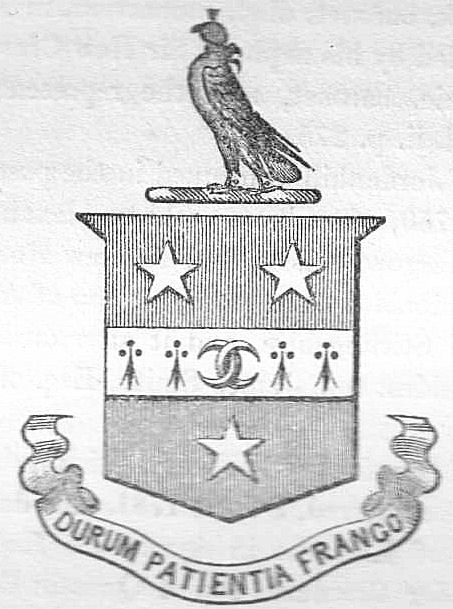
[arms of
Craufurd family]
A branch of the Baidland family possessed the estate of
Haining in Stirlingshire. Archibald Craufurd, lord high treasurer of
Scotland, a younger son of William Craufurd of Haining, was in 1457
nominated abbot of Holyrood, and appointed a lord of council in
1458. He was ambassador to England, and negotiated, with others, a
treaty of marriage betwixt James III. and Edward IV. in 1482, in
which it was contracted that James duke of Rothesay, afterwards
James IV., should marry the princess Cicely, second daughter of
Edward IV., and a great part of the portion was delivered, though
the marriage did not take place. He died in 1483, and his arms
were beautifully cut on the fly buttresses on the north side of the
nave of the abbey of Holyrood: – a fesse ermine, with a star
of five points in chief, Or, surmounted with an abbot’s mitre.
_____
The immediate ancestor of the Crawfurds of Jordanhill in
Renfrewshire, was Lawrence Craufurd of Kilbirnie in Ayrshire,
progenitor of the viscounts of Garnock (merged in the earldom of
Crawford in 1749, see CRAWFORD, earl of, below), and the eleventh
generation of that illustrious family in a direct male line. The
lands of Kilbirnie anciently belonged to a branch of the potent
family of Barclay. John Barclay of Kilbirnie, the last male heir of
that house, died in 1470, and his only daughter, Marjory, married
Malcolm Crawfurd of Easter Greenock (which barony he possessed in
right of his mother, a Galbraith), a descendant of the house of
Crawfurd of Loudoun. The above Lawrence Craufurd of Kilbirnie
flourished in the reign of James the Fifth. He exchanged the barony
of Crawfordjohn, the ancient inheritance of his ancestors, with Sir
James Hamilton of Fynnart for the lands of Drumry, in the county of
Dumbarton, for which he got a charter under the great seal, dated 5th
April 1529. About the year 1546, he endowed a chapel at Drumry, with
the lands of Jordanhill, for the support of a chaplain, and died 4th
June 1547. By his wife, Helen, daughter of Sir Hugh Campbell,
ancestor of the earls of Loudoun, he had six sons. From the eldest,
Hew, his successor, who fought on Queen Mary’s side at the battle of
Langside, was lineally descended Sir John Craufurd of Kilbirnie,
created a baronet by Charles the First in 1642, the grandfather of
John Craufurd of Kilbirnie, created by Queen Anne, in 1703, viscount
of Garnock (see GARNOCK, viscount of), the son of Margaret, second
daughter of the said Sir John Craufurd, and her husband, the Hon.
Patrick Lindsay, (second son of John, the fifteenth earl of Crawford
and first earl of Lindsay,) on whose heirs, male and female, he
entailed his estate of Kilbirnie, on their assuming the surname and
arms of Craufurd.
The sixth son of the above Lawrence Craufurd of Kilbirnie was
the celebrated Captain Thomas Craufurd of Jordanhill, whose daring
exploit of surprising and carrying by escalade, in April 1571, the
almost impregnable castle of Dumbarton, which had long held out for
Queen Mary, is familiar to every one acquainted with the history of
Scotland during the minority of James the Sixth. Of this bold
enterprize, an interesting account, written by himself to John Knox,
is inserted in Bannatyne’s Journal. He appears to have commenced his
military career at a very early age, as he was taken prisoner at the
disastrous battle of Pinkie in 1547, but after some time obtained
his liberty by paying ransom. In 1550 he retired to France, and
entered into the military service of Henry the Second, under the
command of James earl of Arran; and in 1561, he returned with Queen
Mary to Scotland. Previously to this, he had, with consent of his
eldest brother, Hew Craufuird of Kilbirnie, received from Sir
Bartholomew Montgomery, chaplain of Drumry, the lands of Jordanhill,
which had been bestowed by his father on that chaplainry, and the
grant was confirmed by a charter under the great seal, dated 8th
March, 1565-6. He was long attached to the Lennox family, and was
one of the gentlemen of Lord Darnley, the husband of the queen. On
her unexpected visit, in January 1567, to her sick husband at
Glasgow, Darnley sent Craufurd to meet her majesty, with a message
excusing himself from waiting on her in person, on account of his
illness. After Mary had left him, Darnley called Craufurd, and
informing him fully of all that had passed between the queen and
himself, bade him communicate it to his father the earl of Lennox.
He then asked what he thought of the queen’s proposal to remove him
to Craigmillar. “She treats your majesty,” replied Craufurd, “too
like a prisoner. Why should you not be taken to one of your own
houses in Edinburgh?” “It struck me,” said Darnley, “much in the
same way, and I have fears enough, but may God judge between us, I
have her promise only to trust to.” On the murder of Darnley, soon
after, he joined in the association with the earls of Argyle,
Morton, Athol, Glencairn, &c., for the defence of the young king’s
person, and the bringing the murderer to trial. He was examined on
oath before the commissioners at York, December 9, 1568, when he
produced a paper which he had written immediately after the
conversations between himself, and the queen and Darnley. His
deposition, indorsed by Cecil, is quoted by Tytler, in his History
of Scotland (vol. vii. p. 78). He afterwards accused Lethington of
participation in the king’s murder.
For his capture of the castle of Dumbarton, Captain Craufurd
obtained from James the Sixth, the lands of Blackstone, Barns,
Bishopsmeadow, and others, in the neighbourhood of Glasgow, with an
annuity of two hundred pounds Scots, during his life, payable out of
the priory of St. Andrews. He commanded in several expeditions
against the queen’s party, and was captain of the king’s forces all
the time of the calamitous civil war which raged during the
regencies of Lennox, Mar, and Morton. In September 1571, when a body
of Kirkaldy’s troops from the castle of Edinburgh, surprised the
town of Stirling, and the regent Lennox was killed, Captain Crawfurd,
with the assistance of a party from Stirling castle and some of the
citizens, chased the attacking faction out of the town. In the
following year, he had some skirmishes in the wood of Hamilton with
the Hamiltons. Previous to the surrender of the castle of Edinburgh,
in 1573, the regent Morton appointed him and Captain Hume to keep
the trenches, and at the head of their respective companies and a
band of English, on the morning of the 26th May, they
advanced to storm the Spur, an outwork of the castle of great
strength, in the form of a half-moon. A dull old ballad, entitled
the ‘Sege of the Castell,’ (Scots Poems of the Sixteenth Century,)
says:
“That Hume and Craford to the lave were gyde,
With certain sojours of the garysoune,
Four captains followit at their back to byde,
Semphill and Hector, Ramsay and Robesoune.”
The attempt proved successful. After a desperate conflict which
lasted for three hours, the ravelin was stormed, and the standard of
James the Sixth immediately displayed upon it. The surrender of
Edinburgh castle put an end to the civil war, and during his latter
years, Captain Crawfurd resided at Kersland, in the parish of Dalry,
Ayrshire, the heiress of which, Janet Ker, was his second wife. On
the 15th September 1575, the king wrote him the following
characteristic letter: “Captain Crawfurd, I have heard sic report of
your guid service done to me from the beginning of the warrs against
my onfriends, as I shall sum day remember the sam, God willing, to
your greit contentment; in the mean quhyle be of guid comfort, and
reserve you to that time with patince, being assured of my favour.
Fareweel. Your guid friend, James Rex.” He afterwards got a charter
under the great seal “acras terrarum ecclesiasticarum viccariae
pensionaris de Dalry.” &c., in Ayrshire, dated 20th
March 1578; and another charter to himself and Janet Ker his spouse,
of the lands of Blackstone &c., in the shire of Renfrew, dated 24th
October, 1581. The latest notice we have of him is in the same
year, when the king, by a gift, dated at Holyrood, grants him a
hundred pounds Scots, yearly, “out of the superflue of the third of
the benefices not assignat to the maintenance of the ministrie.” He
died 3d January 1603, and was buried in the old churchyard of
Kilbirnie. On his monument, which was erected in his lifetime, in
1594, to himself and his spouse, is inscribed “God schaw the Richt,”
a motto given him by Morton, in memory of his bravery in the fight
of the Gallowlee, between Leith and Edinburgh, in which, however, he
had been repulsed.
His eldest son, David, succeeded to his mother’s estate of
Kersland, and assumed the name of Ker, but his male line has long
been extinct. The second son, Hew, carried on the Jordanhill family.
This Hew had, with two daughters, five sons; namely, 1. Cornelius,
his heir, whose second son, Thomas, was progenitor of the Crawfurds
of Cartsburn; 2. Thomas, a colonel in the Russian service; 3. John,
rector of Halden in the county of Kent; 4. Laurence, a major-general
in the Scots army, in the reign of Charles the First, killed at the
siege of Hereford, in September 1645; and 5. Daniel, a
lieutenant-general in the army of the czar of Muscovy, at one time
governor of Smolensko, and at his death in 1674 governor of Moscow.
Hew Crawfurd of Jordanhill, the seventh laird, only son of
Hew, the sixth laird, was on 19th July, 1765, served heir
male to the above-mentioned Sir John Crawfurd of Kilbirnie, baronet,
ancestor of the families of Kilbirnie and Jordanhill. He married
Robina, only child of Captain John Pollok of Balgray, third son of
Sir Robert Pollok of Pollok, baronet, and in her right became Sir
Hew Crawfurd Pollok, baronet. He had a large family, several of whom
died when young. The eldest daughter, Mary, was married in 1775 to
General Fletcher of Saltoun (then Campbell of Boquhan), and
afterwards to Colonel John Hamilton of Bardowie in Stirlingshire;
and the third, Lucken, to General John Gordon Skene of Pitlurg,
Aberdeenshire, by whom she had ten children. Another of his
daughters, and one of his sons, Captain Hew Crawfurd, form the
subject of two caricatures by Kay, and some curious notices of them
will be found in Kay’s Edinburgh Portraits. The eldest son Sir
Robert Crawfurd Pollok, baronet, died, unmarried, in August 1845,
and was succeeded by his nephew, Sir Hew Crawfurd of Pollok and
Kilbirnie, baronet, now the representative of the family.
The estate of Jordanhill continued in the possession of the
Crawfurds till 1750, when it was sold to Alexander Houston, merchant
in Glasgow, whose son, Andrew Houston, sold it, in 1800, to
Archibald Smith, youngest son of Andrew Smith of Craigend, in
Stirlingshire, and it afterwards became the property of his eldest
son, James Smith, Esq. of Jordanhill.
_____
the family of Craufurd of Kilbirney, Stirlingshire, on whom a
baronetcy was conferred, 8 June 1781, are descended from the
Crawfurds of Kilbirnie in Ayrshire. The first baronet was Sir
Alexander Craufurd, son of Quentin Craufurd, Esq. of Newark, in
Ayrshire, one of his majesty’s justiciary baillies of the west seas
of Scotland. Sir Alexander had three sons, James, second baronet;
Sir charles, G.C.B., a lieutenant-general in the army, and colonel
of the second dragoon guards, and Robert, the celebrated General
Craufurd, who was killed at Ciudad Rodrigo in 1812, and of whom a
biographical notice is given below. Sir James, the second baronet,
born 20th October 1762, succeeded in 1801, and in 1812
assumed the additional name of Gregan. His eldest son, Thomas, was
killed at Waterloo. His second son, Alexander Charles,
lieutenant-colonel in the army, died 12th march 1838. On
his own death in 1839 he was succeeded by his third son, the Rev.
Sir George William Craufurd, of Kilbirney, Stirlingshire, and Burgh
Hall, Lincolnshire, third baronet. Twice married, issue, two sons by
first wife.
_____
The Crawfurds of Cartsburn, in Renfrewshire, are descended
from Thomas Crawfurd, second son, by his wife, Mary, daughter of Sir
James Lockhart of Lee, of Cornelius Crawfurd, who succeeded to the
estate of Jordanhill in 1624. Cartsburn was an ancient possession of
the Kilbirnie family. It was included in the barony of Easter
Creenock, which was acquired by Crawfurd of Kilbirnie through his
marriage with the heiress, about the end of the fourteenth century.
In the reign of Queen Mary, it became the patrimony of a younger
brother of the Kilbirnie family. this branch ended in the person of
David Crawfurd, in the reign of Charles the First. The lands of
Cartsburn next went to Malcolm Crawfurd of Newton, also a descendant
of the house of Kilbirnie, from whose heirs they were acquired by
Sir John Campbell of Kilbirnie in 1657. In 1669, Sir John’s daughter
and heiress, Margaret, wife of the Hon. Patrick Lindsay, conveyed
these lands to her cousin, the said Thomas Craufurd, second son of
Cornelius Crawfurd of Jordanhill. His eldest son succeeded to
Cartsburn. His second son was Hew Crawfurd of Woodside, a small but
pleasant property in the vicinity of Paisley, which continued in his
family till 1755, when it was sold. The third son, George, was the
genealogist and historian; author of the ‘Genealogical History of
the Royal and Illustrious Family of the Stewarts, from the year 1034
to the year 1710; to which are added, The Acts of Sederunt and
Articles of Regulation relating to them; to which is prefixed, A
General Description of the Shire of Renfrew,’ Edin. 1710, fol.; ‘The
Peerage of Scotland, containing an Historical and Genealogical
Account of the Nobility of that Kingdom,’ Edin. 1716, fol.; ‘Lives
and Character of the Crown Officers of Scotland, from the Reign of
King David I. to the Union of the two Kingdoms, with an Appendix of
original papers. 1st vol., all that was published; Edin.
1726, fol. He married Margaret, daughter of James Anderson, the
eminent antiquary, compiler of the ‘Diplomata Scotiae,’ whose life
is given in this work, by his wife, a daughter of John Ellis of
Ellisland, advocate in Edinburgh. Thomas Crawfurd, the first of
Cartsburn of this line, died in 1695. In 1669, the year in which he
acquired the property, he obtained a crown charter in confirmation
of one which had been granted by Charles the First in 1633, whereby
the lands of Cartsburn were erected into a free burgh of barony. The
village which arose, called Craufurdsdyke or Cartsdyke, from a dyke
or quay he built there, adjoins the town of Greenock, from which it
is separated by the Cart’s burn, and is included within the
parliamentary boundaries of that burgh.
Thomas Craufurd, the sixth laird of Cartsburn, died in 1791,
and was succeeded by his aunt, Christian Crawfurd,
great-granddaughter of the first Thomas. She married Mr. Robert
Arthur, and died in 1796. She had a son, Thomas, who predeceased
her, and a daughter, Christian Arthur Crawfurd, who succeeded her in
Cartsburn, and married Thomas Macknight of Ratho, son of Rev.
William Macknight, who died in 1750, minister of Irvine, and had a
son, and two daughters, The eldest daughter, Christian, married Rev.
Thomas Macknight, of Dalbeath, D.D., one of the ministers of
Edinburgh. The son, William Macknight, assumed the surname of
Crawfurd under an entail, on succeeding to Cartsburn. He married
Jean, daughter of James Crawford of Broadford.
_____
CRAWFORD,
earl of, a title in the peerage of Scotland, first conferred, in
1398, on Sir David Lindsay of Glenesk, whose ancestor, William de
Lindsay of Ercildun, in the reign of Malcolm the Fourth, was the
first of the family who possessed the barony of Crawford in
Clydesdale. That line terminated, in 1249, in an heiress, Alice de
Lindsay, the wife of Sir Henry Pinkeney, a great baron of
Northamptonshire, whose grandson, Sir Robert Pinkeney, claimed the
crown of Scotland at the competition in 1292, as descended from the
princess Marjory through his grandmother Alice de Lindsay. The
barony of Crawford was afterwards forfeited, and bestowed on Sir
Alexander Lindsay of Luffness, the ancestor of the more recent house
of Crawford [see ante, and LINDSAY, surname of].
Sir David Lindsay, the first earl of Crawford, is supposed to
h ave been born in 1366. He succeeded his father, Sir Alexander
Lindsay, in Glenesk (which had belonged to his mother, Catherine,
daughter of Sir John Stirling of Glenesk), in 1382, and his cousin
Sir James Lindsay of Crawford in 1397. Having married the princess
Catherine, fifth daughter of King Robert the Second, he received
with her the barony of Strathnairn in Inverness-shire. In his
twenty-fifth year, he proved the victor in the celebrated tournament
with John Lord Welles at London-bridge in May 1390. That nobleman
had been sent ambassador to Scotland by Richard the Second, and at a
banquet with the Scottish nobles, where the conversation turned on
deeds of arms, on Sir David Lindsay extolling the prowess of his
countrymen, Welles exclaimed, “Let words have no place; if you now
not the chivalry and valiant deeds of Englishmen, assail ye me, day
and place where ye list, and ye shall soon have experience.” Then
said Sir David, :I will assail ye!” Lord Welles naming London Bridge
for the place, Sir David appointed the festival of St. George for
the day of combat. For this tourney he obtained a safe-conduct for
himself and his retinue of twenty-eight persons, including two
knights, squires, valets, &c. He was received with high honour by
King Richard, and on the appointed day, in presence of the king and
court, and after the usual preliminary ceremonies, at the sound of
the trumpet the two champions encountered each other, upon their
barbed horses, with spears sharply ground. Both spears were broken,
but in this adventure the Scottish knight sat so strong that
although Lord Welles’ spear was shivered to pieces upon his helmet
and visor, he stirred not, and the spectators cried out that,
contrary to the law of arms, he was bound to the saddle; whereupon
he vaulted lightly off his horse, and leapt back again into his
seat, without touching the stirrup. In the third course he threw
Lord Welles out of his saddle to the ground. He then dismounted, and
a desperate foot combat with their daggers ensued, when Sir David,
fastening his dagger between the joints of his antagonist’s armour,
lifted him off his feet, and hurled him to the ground, where he lay
at his mercy. Instead of putting an end to his life, as the laws of
these combats permitted, he raised his opponent, and after
presenting him to the queen, who gave him his liberty, he supported
him in the lists till assistance came, and afterwards visited him
every day till he recovered. A full description of this famous
tourney is given in Wyntoun’s Cronykil. Two years after, Sir
David nearly lost his life in an affray with some of the clan
Donachie, who, with Duncan Stewart, natural son of the Wolf of
Badenoch, were ravaging Glenisla, the north-west of Angus; and were
encountered at Glenbrerith, about eleven miles north of Gaskclune,
by the Lindsays and Ogilvies. Armed at all points, and on horseback,
Sir David made great slaughter among the catarans, but having
pierced one of them with his lance, and pinned h im to the ground,
the latter writhed his body upward on the spear, and collecting all
his force, with a last dying effort, fetched a sweeping blow with
his broadsword, which cut through the knight’s stirrup-leather and
steel boot.
Three ply or four above the foot,
to the very bone, –
‘That man na straik gave but that ane,
For there be delt; yet nevertheless
That guid Lord there wounded wes,
And had deit there that day
Had not his men had him away,
Agane his will, out of that press.’
[Wyntoun’s Cronykil, tom. ii. p. 367.]
On the 21st April 1398, Sir David Lindsay was, by King Robert
the Third, created earl of Crawford. The barony of Crawford was at
the same time regranted with a regality, conferring privileges on
him and his posterity, akin to those of the earls palatine of
England and the Continent. He had frequently safe-conducts granted
him to England, being charged with negociations with the English
court, and sometimes he sought for adventure and honour in foreign
wars. “Between a visit to England in October 1398 and the 29th
of December 1404, – the date of his safe-conduct for entering
England with one hundred persons, horse and foot, in his train, and
passing through to Scotland, (being then one of the commissioners to
treat of peace with England,) – his name is not once mentioned in
the Rotuli Scotiae, and it is merely from foreign sources
that we learn that he gave a letter of service and homage, under his
seal of arms, to Louis duke of Orleans, on the 1st of
January 1401-2, and that in May that year he was hovering with a
fleet on the coast of Corunna in Spain, probably as a partisan of
France.” [Lives of the Lindsays, vol. i. p. 99.] In December
1406, he was again and for the last time one of the ambassadors to
the English court to treat of peace. He died in February 1407 at his
castle of Finhaven, and was buried in the family vault in the
Greyfriars church at Dundee. The following is the seal of David,
first earl of Crawford:
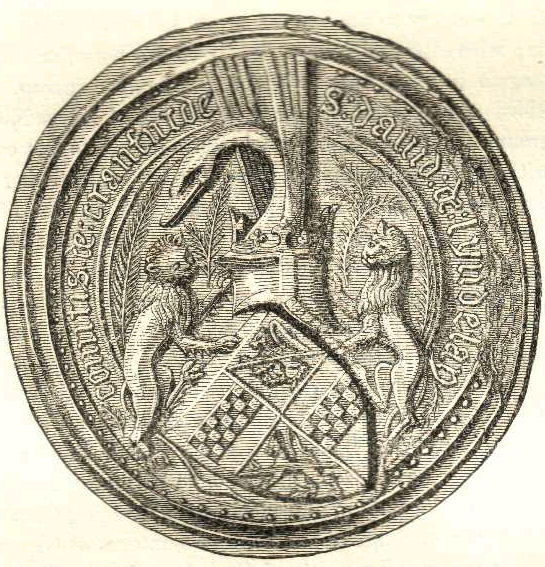
[seal of
David first earl of Crawford]
A letter in French from the first earl of Crawford to Henry
the Fourth of England, in February 1405, inserted in the first
volume of the Lives of the Lindsays (p. 105), on the occasion of a
merchant-ship of St. Andrews having been seized and confiscated by
the English, in violation of the truce, is interesting as showing
that the merchants and town of St. Andrews were under his
protection, and also that at that period French or Latin was the
language used by the Scottish nobles in their intercourse with the
court of England, so much so that the celebrated earl of March,
writing to Henry five years before, apologizes for his letter being
in English, as it was “mare clere” to his understanding “than Latyne
or Fraunche.” With three sons, Alexander, second earl; David, of
Newdosk, and Gerard; he had three daughters, Lady Margaret or
Matilda, married to her cousin, Archibald, fifth earl of Douglas,
duke of Touraine; Lady Marjory, to Sir William Douglas of Lochleven;
and Lady Elizabeth, to Sir Robert Keith, great marishal of Scotland.
Ingelram Lindsay, bishop of Aberdeen from 1442 to 1458, is also said
to have been a son of the first earl of Crawford, but, says Lord
Lindsay, strict proof of his filiation is wanting.
Alexander, second earl, the year after his father’s death, had
a safe-conduct to go to France. In 1416, with the earls of Douglas
and Mar, he had letters of safe-conduct to England, to negociate the
temporary release of the captive king, James the First, on his
leaving hostages for his return, but the negociation was suddenly
broken off. In 1421, however, it was renewed for the entire
liberation of the king, when the earl was again one of the
commissioners. On James’ return in 1423, Crawford was among the
nobles who met him at Durham and escorted him to Scone, where he was
crowned on the last day of May. After receiving the accolade of
knighthood from his majesty’s hand, Crawford departed for England,
being one of the twenty-eight hostages pledged for his sovereign,
his kinsman, Sir John Lindsay of the Byres, being another. In the
treaty for James’ release, the annual income of the hostages is
stated – the earl of Crawford being rated at one thousand merks, and
Lindsay of the Byres at five hundred. The latter obtained his
liberty in 1425, but the earl was detained in England till November
1427, when he had leave to return on giving an equivalent. He is
said to have been active in the capture of the assassins of James
the First, and died in 1438, the year after.
His son, David, third earl, entered into a league of
association and friendship with the powerful earl of Douglas,
lieutenant-general of the kingdom, with the object of drawing to
their party the other great feudal families, and, thus united, to
rule paramount in the state. [Lives of the Lindsays, vol. i.
p. 126.] On the discovery of this league, Kennedy, bishop of St.
Andrews and primate of Scotland, joined with Crichton, the
chancellor, to oppose their machinations. In resentment, the earl of
Crawford, assisted by his kinsman Alexander Ogilvie of Inverquharity,
and other allies, invaded the bishop’s lands in Fife, burning his
granges and tenements, and carrying off an immense booty. After
fruitlessly remonstrating against this outrage, Kennedy formally
excommunicated the earl, for a year, and before it expired he
received his death-wound in a desperate conflict at Arbroath on the
13th January 1445-6, between the Lindsays and Ogilvies,
which arose from the following cause: The Benedictines of the abbey
of Arbroath had appointed his eldest son, Alexander, master of
Crawford, their chief justiciar, or supreme judge in civil affairs
throughout their regality; but he proved so expensive to the monks,
by his retinue of followers and manner of living, that they formally
deposed him, and appointed in his place Alexander Ogilvy of
Inverquharity, nephew of John Ogilvy of Airlie, who had a hereditary
claim to the office. As, however, the master of Crawford had taken
forcible possession of the town and abbey, an appeal to the sword
was rendered necessary. Both parties assembled their forces. Douglas
sent one hundred Clydesdale men to the aid of Lindsay, and the
Hamiltons also assisted him with some of their vassals. The Ogilvies
on their part found an unexpected auxiliary in Sir Alexander Seton
of Gordon, afterwards earl of Huntly, who, as he returned from
court, happened to arrive the night before the battle at the castle
of Ogilvy, on his road to Strathbogie; and although in no way
personally interested in the dispute, found himself compelled to
assist the Ogilvies by a rude law of ancient Scottish hospitality,
which bound the guest to take part with his host, in any quarrel or
danger, so long as the food eaten under his roof remained in his
stomach. With the small train of attendants and friends who
accompanied him, he marched with the Ogilvies to Arbroath, where
they found the Lindsays, in great force, drawn up in battle array
before the gates. As the battle was about to commence, the earl of
Crawford, anxious to avert bloodshed, suddenly galloped into the
field from Dundee, where he had heard of the approaching conflict,
but before he could interfere, one of the Ogilvies’ men darted his
spear through his mouth and neck, and mortally wounded him. The
Lindsays instantly attacked the Ogilvies and their allies with great
fury, and they were driven from the field with the loss of five
hundred men, while that of the Lindsays did not exceed a hundred.
Earl David expired after a week of lingering torture, and his body
lay for four days unburied, until Bishop Kennedy sent the prior of
St. Andrews to take off the excommunication. The superstitious
feeling of the times did not fail to notice that the battle of
Arbroath was fought on that day twelvemonth that the slain earl of
Crawford had ravaged “St. Andrew’s land” in Fife. Ogilvy of
Inverquharity, sorely wounded, was taken prisoner and carried to the
castle of Finhaven, where he died. According to the tradition of the
district, the countess of Crawford, who was his own cousin-german,
in the agony of finding that her husband had been mortally wounded
in the affray, rushed to Inverquharity’s chamber, and smothered him
with a down pillow. The Lindsays afterwards burnt and wasted the
lands and houses of the Ogilvies, and from this time the feud
between the two clans raged incessantly until the accession of James
the Sixth to the English throne. By his wife, Marjory, daughter of
Alexander Ogilvie of Auchterhouse, hereditary sheriff of Angus, the
earl had five sons; Alexander, fourth earl of Crawford; Walter
Lindsay of Beaufort and Edzell; William Lindsay of Lekoquhy,
ancestor of the Lindsays of Evelick in Perthshire and their various
cadets; Sir John Lindsay of Brechin and Pitcairlie, killed at the
battle of Brechin in 1452, ancestor of the house of Pitcairlie in
Forfarshire, and their junior branch of Cairnie; and James, who,
accompanying the princess Eleanor, daughter of James the First, to
Germany, when she went to be married to Sigismund of Austria,
espoused an heiress near Augsburg, where his descendants, the
Crafters, were reported to be residing in the last century.
Alexander, fourth earl, the victor at Arbroath, was styled
“the tiger,” or “earl Beardie,” from the ferocity of his character
and the length of his beard or rather, as one writer suggests, from
the little reverence in which he held the king’s courtiers, and his
readiness to ‘beard the best of them.” [Lives of the Lindsays,
vol. i. page 134.] In 1446, he had the office of heritable
sheriff of Aberdeen, and besides being justiciary of the abbey of
Arbroath, as already mentioned, was also justiciary of the abbey of
Scone. He was one of the guarantees of a treaty of peace with
England, one of the wardens of the marches, and ambassador to the
English court in 1451. With the earl of Douglas and Macdonald of the
Isles, titular earl of Ross, he entered into a league of mutual
alliance, offensive and defensive, against all men, not excepting
the king himself; on hearing of which, the king – James the Second,
then in his seventeenth year – sent for Douglas to Stirling castle,
and after vainly urging him to break it, on his refusal, drew his
dagger, and stabbed him to the heart. Crawford immediately flew to
arms, and assembling all his forces encamped at Brechin, with the
intention of intercepting the earl of Huntly, his old antagonist at
Arbroath, now appointed lieutenant-general of the kingdom, who was
hastening with an army to his sovereign’s assistance. The contending
parties met on the 18th May 1452, on a level moor, about
two miles north-east of Brechin. The forces of Huntly far
outnumbered those of Crawford, but the victory, which had long
remained doubtful, was at last inclining to the latter, when John
Collace of Balnamoon, one of his most trusted vassals, who commanded
a division of three hundred men, stationed in the left wing,
deserted to Huntly. Before the battle he had requested Crawford
that, in the event of their victory, his son might be put in fee of
the lands of Ferne, which lay near his house. “The time is short,”
replied the earl, “stand bravely by me to-day, and prove yourself a
valiant man, and you shall have all and more than your desire.” His
defection was fatal to the earl, whose troops, weakened by the
departure of Balnamoon’s division, and furiously attacked by
Huntly’s forces, took to flight in every direction. Among the slain
were the earl’s brother, and nearly sixty gentlemen, with numerous
persons of inferior rank, while on Huntly’s side the loss did not
exceed five barons, and a small number of yeomen, but he had to
lament the loss of two brothers. Earl Beardie fled to Finhaven, and
on alighting from his horse he called for a cup of wine, and was
heard to exclaim that he would “willingly pass seven years in hell,
to gain the honour of such a victory as had that day fallen to
Huntly.” He had already been denounced a rebel, and his lands, life,
and goods, were declared forfeited to the state, his coat of arms
being torn, and his bearings abolished. The lordship of Brechin,
with the hereditary sheriffship of Aberdeenshire, was also taken
from him, and given to Huntly, his victorious opponent. His power,
however, was little weakened by this defeat, and as soon as he had
recruited his forces, he took a terrible revenge on all who had
either refused to join his banner, or, like Balnamoon, had deserted
him in the battle, ravaging their lands, and destroying their
castles and houses. But after the submission of the Douglases, being
abandoned by many of his allies, he took an opportunity of the king
passing through Forfarshire, in April 1453, on his way to the north,
to appear before his majesty, in a mean habit, bareheaded and
barefooted, and with tears in his eyes he made a speech, in which he
acknowledged his offence, and craved mercy for his adherents, being
more concerned for their safety than for his own. “When the earl had
endit,” says Pitscottie, “the noble and gentle men of Angus, that
came in his company to seek remission, held up their hands to the
king maist dolorously, crying, ‘Mercy!’ till their sobbing and
signing cuttit the words that almaist their prayers could not be
understood.” At the intercession of Huntly and Kennedy, bishop of
St. Andrews, with whom he had been privately reconciled, and by
whose advice he had thus acted, he was pardoned, and afterwards
entertained James magnificently in his castle of Finhaven. As,
however, the king had sworn, in his wrath, “to make the highest
stone of Finhaven the lowest,’ his majesty went up to the roof of
the castle, and threw down to the ground a stone which was lying
loose on one of the battlements, thus keeping his oath strictly to
the letter. Earl Beardie became a loyal subject, but in six months
afterwards, he was seized with a fever, of which he died in 1454. By
his wife, Elizabeth Dunbar, he had two sons, minors, David, fifth
earl of Crawford, created duke of Montrose by James the Third, and
Sir Alexander Lindsay of Auchtermonzie, who long after succeeded as
seventh earl. He had also a daughter, Lady Elizabeth Lindsay wife of
John, first lord Drummond.
In the time of this earl a noble Spanish chestnut tree, nearly
forth-three feet in circumference, ornamented the court of the
castle of Finhaven, and, according to tradition, a gillie or
messenger-lad having cut a walking-stick from it, the earl was so
enraged that he hanged him on one of its branches, and from that
moment the tree began to decay. The ghost of the gillie, it is
locally said, has ever since walked between Finhaven and Carriston,
under the name of Jock Barefoot.
David, fifth earl, appears, soon after his accession to the
title, to have been a prisoner to James earl of Douglas, on a second
rebellion of that nobleman, speedily suppressed, in March 1454, as
in a charter, dated 27th February 1458-9, he grants
Herbert Johnstone of Dalibank, ancestor of the house of Westerhall,
the lands of Gleneybank, with the office of baillie of the regality
of Kirkmichael in Dumfries-shire, “for his faithful service at the
time when he was held a captive by the late James earl of Douglas,
and chiefly for the liberation and abduction of his person from
captivity, and from the hands of the said earl.” [Lives of the
Lindsays, vol. i. p. 145.] His lordship had a charter of the
office of sheriff of Forfar, 19th October 1466, on the
resignation of James Stewart, afterwards earl of Buchan. On the
downfall of the Boyds, he rose daily in power and influence, and for
twenty years, – from 1465 to 1485, – was employed in almost every
embassy or public negociation with England. On 9th March
1472-3 he obtained a grant from King James the Third of the
lordships of Brechin and Navar for life; in July 1473 he was
appointed keeper of Berwick for three years; on the 26th
October 1474, he appeared as procurator for King James on the
betrothment of the princess Cecilia, youngest daughter of Edward the
Fourth of England, and the prince royal of Scotland, which took
place in presence of various English commissioners and gentlemen, in
the Low Greyfriars’ church at Edinburgh, and a description of which
is given in Tytler’s History of Scotland, vol. iv. p. 242;
and in May, 1476, he was constituted high admiral of Scotland, for
the suppression of the rebellion of the earl of Ross, (MacDonald of
the Isles,) who, alarmed at the formidable preparations against him,
speedily submitted.
In 1474, this earl made a new entail of the family estates,
settling them on his heirs-male for ever, a document which regulated
the succession for many generations afterwards. In 1480, he was
appointed master of the king’s household, and after the raid of
Lauder in 1482, he became lord chamberlain. Although one of the
purifiers of the royal council, as they termed themselves, and
present at the famous secret meeting of the nobility, where
Archibald earl of Angus acquired the name of Bell-the-Cat, and
wherein it was resolved to put to death Cochrane and the other
favourites of the king., he would not be a party to the plot for
deposing his sovereign, and on being made aware of such a design, he
abandoned the factious nobles, and gave his whole support to the
throne. In 1487 he was appointed justiciary of the north, along with
the earl of Huntly, After the disbanding of the royal forces at
Blackness, and the hollow pacification that then took place, the
earl of Crawford was created duke of Montrose, by royal charter,
dated 18th May, 1488, to himself and his heirs, being the
first instance of the title of duke having been conferred on a
Scottish subject, not of the royal family. The grant conveyed to his
grace the castle and borough of Montrose, with its customs and
fisheries, and the lordship of Kincleven in Perthshire, to be held
in free regality for ever, with courts of justiciary,
chamberlainship, &c., on the tenure of rendering therefrom a red
rose yearly on the day of St. John the Baptist. On this creation the
duke added to his arms an escutcheon argent, charged with a
rose, gules, which he carried by was of a surtout over his
arms. Subjoined is an engraving of his seal and his autograph, from
the first volume of Lord Lindsay’s Lives of the Lindsays
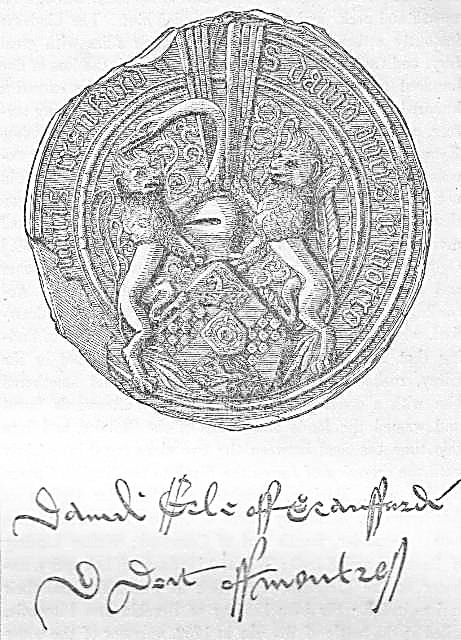
[seal of Crawford, Duke of Montrose]
A
new royal or public herald was also created on this occasion under
the name of ‘Montrose,’ as appears by the Exchequer Rolls. At the
battle of Sauchieburn, soon after, (112th June 1488), the
duke eminently distinguished himself, on the side of his unfortunate
sovereign, James the Third, but was severely wounded, and being
taken prisoner, was compelled to ransom himself and his followers,
and was deprived of all his public offices. The act rescissory
which, on the 17th October following, was passed in the
Estates, annulling all grants of lands, and creations of dignities,
conferred by the late king since the 2d of February preceding, was
conceived not to affect the original patent of this ducal title, as
the young king, James the Fourth, had previously directed a free
pardon, by letters patent, to be issued under his privy seal, to the
duke of Montrose, which he placed in the hands of Andrew Lord Gray,
to remain in his possession until the duke should resign to that
nobleman the hereditary sheriffship of Forfarshire. This was
accordingly done on the 6th November 1488, in his grace’s
name by procurators appointed by him for the purpose, he having
previously protested against the whole proceeding as illegal and
unjust. On the 19th September 1489, he received a new
patent or charter, under the great seal, of the dukedom of Montrose,
and in February following, he was appointed a member of the secret
council, but subsequently to the battle of Sauchieburn he took
little part in public affairs. He died at Finhaven, at Christmas
1495, in his fifty-fifth year.
The dukedom of Montrose, it has been decided by the House of
Peers, ended with him; as having been by the renewed patent
conferred for life only; In 1848, the earl of Crawford and Balcarres
presented a petition to the queen, claiming the title of duke of
Montrose, on the ground of its being vested in the heir male. This
petition, in accordance with the rule and practice in contested
peerage cases, was referred to the House of Lords, and the claim was
opposed both by the duke of Montrose, of the noble house of Graham,
and by the Crown;. After a lapse of nearly five years the House of
Lords gave their decision on 5th August 1853, by adopting
a resolution to the effect that the earl of Crawford and Balcarres
had not made out his right to the dignity. (See MONTROSE, Duke of.)
By his wife, Elizabeth, eldest daughter of James, first Lord
Hamilton, the duke had 2 sons, Alexander, Lord Lindsay, and John,
styled master of Crawford, who became 6th earl. His elder
son, Alexander, Lord Lindsay, when a mere stripling, had revived an
old feud with the Glammis family, and that with such violence as to
require the interference of parliament, March 6, 1478. On the 22d
April 1479, he was committed to the castle of Blackness for chasing
two monks. In the autumn of 1489 he quarrelled and fought with his
younger brother John, by whom he was wounded, and died shortly after
at his castle of Inverqueich. He had married Lady Janet Gordon
(afterwards the wife of Patrick, son of Lord Gray), whom popular
rumour accused of having smothered her first husband with a down
pillow while lying ill of his wound.
John, the second son, became the sixth earl of Crawford. In
1504, on the abortive rebellion of the Hevrideans and Western
Islanders, in support of Donald Dhu, grandson and heir of John, Lord
of the Isles, he was appointed, conjointy with Huntly, Argyle,
Marischal, Lord Lovat, and other powerful barons, to lead the array
of the whole kingdom north of Forth and Clyde, against them. [Gregory’s
History of the Western Highlands, p. 98.] Lord Lindsay says that
this earl’s extravagance was great. Besides alienating lands held
in capite of the crown, and thus incurring the displeasure of
the king, he was reduced to resign the hereditary sheriffdom of
Aberdeenshire to William, earl of Errol, 10th February
1510, and it was not regained for many years after his death. [Lives
of the Lindsays, vol. i. p. 180.] On 23d April, 1512,
twenty-three years after his brother’s death, letters “to search
John, earl of Crawford, for the slaughter of Alexander, his
brother,” were issued by Lord Gray, sheriff of Angus, charging the
earl, his cousins, Sir David and Alexander Lindsay, and others their
accomplices, to give surety to appear before the king’s justiciary,
on the third day of the next justice-eyre at Dundee to “underlie the
law” for the said crime; and not appearing they were denounced
rebels, 24th July 1513. Two months afterwards, the earl
was killed at Flodden, where he had a chief command, His children
all died in infancy, but a natural son, John Lindsay of Downie, in
Forfarshire, was father of Patrick Lindsay, archbishop of Glasgow.
Alexander, seventh earl, the younger son of Earl Beardie, and
previously styled Sir Alexander Lindsay of Auchtermonzie (a barony
inherited from his mother), succeeded his nephew, as collateral heir
male. He was one of the four noblemen appointed by parliament, 1st
December 1513 continually to remain with the queen-mother, to give
her counsel and assistance as regent of the kingdom. For the
suppression of the deadly feuds that then raged both in the
Highlands and on the borders, he was appointed high-justiciary north
of the Forth, while Lord Home received the same office south of that
river. Crawford, however, died shortly afterwards, at a great age,
in May 1517. By his wife, Margaret, daughter of Campbell of
Ardkinglass, he had David, his successor, another son. Alexander, of
Rathillet, who died without issue, and a daughter, married to Sir
Archibald Douglas of Kilspindie, high treasurer of Scotland.
David, eighth earl, took part with the queen-mother and Angus
against the regent duke of Albany, and on the departure of the
latter for France in 1524, he was one of the nobility who attended
her majesty when she brought the young king, then only thirteen
years of age, from Stirling to Edinburgh, and, on 30th
July of that year, made him assume the government. The earl was
subsequently deprived by James of large estates in the Lowlands, and
of his lands in the Hebrides, which so incensed him against the king
that it was believed he might easily have been induced to join the
English interest, but the unnatural conduct of his son (by his first
wife, Lady Marion Hay, only daughter of the third earl of Errol),
withdrew his attention from all but his domestic sorrows. This son,
Alexander, called the “evil” or “wicked master” of Crawford, had
been put in fee of the earldom by his father, as future earl, and
the barony of Glenesk had been assigned to him in consequence, by
charter under the great seal, 2d September 1527. Being, however, of
an unruly and turbulent disposition, he seized his father’s fortress
of Dunbog, and, at the head of a band of robbers and outlaws,
pursued a wild and lawless life, oppressing the lieges, tyrannizing
over the inferior clergy, and exacting ‘black mail’ from the whole
surrounding country. In 1526 his father had been obliged to appeal
to the crown for protection from “bodily harm,” threatened against
himself, his second wife (Isabel, daughter of Lundy of Lundy), and
his friends, by his unnatural son, who, on expressing his
contrition, was, through the intervention of the archbishop of St.
Andrews, and others, received into favour, on condition of his
banishing his evil associates, and relapsing not into crime. In
1530, he was indicted for killing a servant of Lord Glammis, and on
the 16th February 1530-1, he was arraigned at a
justice-eyre held at Dundee, the king himself presiding in person,
for, among other crimes alleged against him and his accomplices,
having besieged his father’s castles, with the intention of
murdering him, surprising him at Finhaven, laying violent hands upon
him, and imprisoning him in his own dungeon for twelve weeks, and on
another occasion carrying him by force to Brechin, and confining him
for fifteen days; besides, breaking open his coffers, pillaging his
writs, and seizing his rents and revenues. He was found guilty, but
his life was spared. Both he and his issue had forfeited their right
to the succession, which opened in due course of law to the next
heir-male under the entail of 1474, namely, David Lindsay of Edzell.
A special charter of entail thereafter passed the great seal, dated
16th October 1541, to the said David Lindsay, and the
heirs male of his body, whom failing, to others therein enumerated,
and failing them, to the earl’s own nearest legitimate heirs male
whatsoever, bearing the name and arms of Lindsay. Soon after, “the
wicked master” was ignominiously slain at dundee, having been
stabbed by a cobbler “for taking a stoup of drink from him.” His
father, after a lingering illness, died at the castle of Carnie in
Fife, on the 27th or 28th November 1542.
David Lindsay of Edzell succeeded as ninth earl. Having no
issue by his first wife, )the dowager Lady Lovat,) in his generosity
he adopted David Lindsay, the son of “the wicked master,” who had
been secluded from the succession by his father’s forfeiture, and in
his favour resigned all the lands of the earldom, with the exception
of Glenesk and Ferne, executing the requisite charters under the
great seal 2d May, 1546, by which that youth was reinstated in his
birthright, and put in fee of the earldom as master of Crawford. By
his second wife, Catherine, daughter of Sir John Campbell of Lorn
and Calder, whom he married in 1549, the ninth earl had five sons:
Sir David Lindsay of Edzell, whose male line is extinct; John, Lord
Menmuir, ancestor o the earls of Balcarres; Sir Walter Lindsay of
Balgawies, a convert to popery, and the most zealous and daring
“confessor” of his time; James, the protestant rector of
Fettercairn, who died young, 15th June 1580, while on a
mission to Geneva; (an elegy to his memory by the celebrated Andrew
Melville is inserted in the Deliciae Poetarum Scotorum); and
Robert, of Ballhall. The earl had also two daughters, Margaret and
Elizabeth, the wives respectively of John earl of Athol, and Patrick
third Lord Drummond. He died in September 1558.
David, tenth earl, the son of “the wicked master,” proved very
ungrateful to his benefactor, the ninth earl. He joined the
association for Queen Mary in 1568, and adhered steadily to her
interest. He had married, soon after his restoration to the family
succession, Margaret, daughter of Cardinal Bethune. In the contract
dated at St. Andrews, 10th April 1546, the cardinal
expressly called the bride his daughter, and he gave her four
thousand merks in dowry. The nuptials were solemnized at Finhaven
with great pomp and magnificence in presence of the cardinal, who
was assassinated the following month. The earl had four sons; David,
eleventh earl; Sir Henry of Kinfauns, thirteenth earl; Sir John
Lindsay of Ballinscho and Woodwray; and Alexander first Lord Spynie
(see SPYNIE, lord); and a daughter, Lady Helen, married to Sir David
Lindsay of Edzell.
David, eleventh earl, is described in the family genealogies
as “ane princely man,” but a sad spendthrift. Soon after his
accession to the title, the old family feud with the house of
Glammis was revived through the following unfortunate accident. On
the evening of the 17th March 1577-8, the earl and Lord
Glammis, then chancellor, happened to meet, at the head of their
respective followers, in a narrow street, called the School-house
Wynd, in Stirling, as Crawford was passing to the castle, and the
chancellor returning to his lodging, after making his report to the
young king, James the Sixth. They made way for each other, and
called to their attendants to do the same; all obeyed, except the
two last, who, having jostled, drew their swords, and attacked each
other. In the uproar which ensued, Glammis received a mortal wound
in the head by a pistol-bullet, from whose hand is uncertain, but
the earl was unjustly blamed for it. Thomas Lyon, uncle of the
chancellor, and tutor or guardian of his infant son, and usually
styled master of Glammis, as presumptive heir to that barony, to
avenge his nephew’s death, immediately carried fire and sword into
the Lindsay’s country, while the earl himself was imprisoned in
Stirling, but soon released. He was indicted for the crime, but his
trial it appears was postponed, ad David Lindsay of Edzell and
Patrick Lord Lindsay of the Byres, his sureties, were fined for his
nonproduction to underlie the law, 5th March 1579. [Pitcairn’s
Criminal Trials, vol. i. part 2, p. 85.] The 3d of November was
appointed for his subsequent appearance, and it is presumed that he
was then acquitted. From a curious circular addressed to his
principal friends, and printed in the appendix of the first volume
of the Lives of the Lindsays, the earl on this occasion seems to
have had recourse to the usual practice of the Scottish barons of
those days, namely, to appear at his trial with such a host of
attendants as was likely to overawe the judges. Not long afterwards
he and the earl of Huntly went to France, whence he proceeded to
Italy. He returned to Scotland by the last day of October, 1581,
when he sat in the parliament then held in Edinburgh.
After the raid of Ruthven in 1582, he joined the association
formed to liberate the king, and on the escape of James to St.
Andrews, Crawford, Huntly, Argyle, and others of the banded nobles,
occupied the town, with their followers, while Gowrie and the other
insurgent lords made their submission. The king then commanded two
chief nobles of each faction, Angus and Mar on the one side, and
Crawford and Huntly on the other, to withdraw from court for a
season, to “prevent the renewal of factious debates.” Shortly after
this, the master of Crawford was appointed chief master stabler to
King James, who wrote to the magistrates of Dundee, “commanding them
to elect and take Crawford to be their provost, albeit they had
chosen their own provost.” He was one of the jury on the trial of
the earl of Gowrie, and in the confiscations that were subsequently
carried on by Arran and his friends, Crawford obtained the abbey
lands of Scone, and the church lands of Abernethy. On the 1st
of November 1585, the banished lords, supported by Queen Elizabeth,
entered Scotland, with a large army, and marched unexpectedly on the
king at Stirling. No one was with him except Arran and the earls of
Crawford and Montrose, who garrisoned the castle with their
followers. Arran fled, but Crawford and Montrose retired into the
castle with the king. The castle soon surrendered, and Crawford and
Montrose were committed to the charge of Lord Hamilton.
The earl had been converted to the popish faith by father
William Crichton, a well-known Jesuit, and on the arrival of the
news of the decapitation of Mary queen of Scots at Fotheringay 7th
February 1586-7, he and the other Catholic lords, Huntly and Errol,
entered into a correspondence with Spain, then preparing the
invincible armada for an attack upon England. In the previous year
they had assembled their forces at the Bridge of Dee, when the king
marched to oppose them, and the simple fact of Arran, Huntly,
Montrose and Crawford having subsequently held a meeting at the
lodging of the latter, had created new suspicion against them. At
the celebrated reconciliation banquet which took place at Holyrood-house
early in 1587, Crawford and Glammis, and other hereditary enemies,
walked together hand in hand to the cross, where they drank to each
other amid the thunder of the castle guns, and the songs and shouts
of the citizens. But this reconciliation was but a hollow one. Long
standing feudal enmities could not be so easily healed. In May of
that year, Crawford, Huntly and Bothwell were accused of treasonable
insurrection against the king, but nothing was established against
them. In their correspondence with the prince of Parma, they
undertook, with the aid of six thousand men, to render the king of
Spain master of Scotland. This correspondence falling into the hands
of Elizabeth, was by her sent to James. In the meantime, a
preliminary plot, for seizing the king’s person, and excluding from
court the chancellor Maitland and the master of Glammis, high
treasurer, the king’s chief councillors, came to light, and on
Huntly’s arrival in Edinburgh he was arrested; when, news being
brought of Crawford and Errol’s having come in arms to the North
Ferry, the whole kingdom was alarmed; but the earls made their
submission. a few days after, Crawford and Huntly met at Perth, and
at first designed to fortify that town; but hearing that the
treasurer Glammis had arrived in Angus, they waylaid him, and chased
him to the house of Kirkhill, which being set fire to, he was
obliged to surrender to his cousin the laird of Auchindown, who kept
him some weeks’ prisoner in the north. In April 1589, the three
earls, Crawford, Huntly, and Errol, collected their forces in
Aberdeen, whence they issued a rebellious proclamation, but the king
advancing against them, their followers dispersed. Crawford fled,
and the treasurer, being released, interceded with the king for him
and Huntly. They “offered to enter their persons in ward, and submit
themselves to the punishment his majesty might be pleased to
impose.” Crawford went to Edinburgh on the 20th of May,
and was warded in his own lodging. On the 24th he was
tried, with Huntly and Bothwell, also implicated in the same
rebellion, and all found guilty of repeated acts of treason. James,
however, would not allow any sentence to be pronounced against them,
but committed Crawford to Blackness, Bothwell to Tantallon, and
Huntly to his old quarters in Edinburgh castle, and after keeping
them a few months in confinement, he took occasion, amidst the
public rejoicings on the approach of his marriage, to set them at
liberty. A key to his majesty’s conduct on this occasion is
furnished by the fact of his having, on the first news of his
mother’s execution, connived at, if he did not encourage, the
treasonable correspondence with Spain, and permitted Jesuits and
other popish priests to travel unmolested through the kingdom, and
had himself instigated the rebellion. soon after the earl had a
safe-conduct to pass through England, on his way to France. He
returned to Scotland in 1601, after an absence of eleven years, and
died 22d November 1607. He was twice married. His first wife, Lilias,
daughter of David, second Lord Drummond, with whom he received the
then large tocher of ten thousand merks, died young; This earl was
of a suspicions and jealous disposition, and an old north country
ballad, entitled ‘Earl Crawford,’ (printed in Buchan’s Ancient
Ballads of the North of Scotland,) relates that a merry
jest of Lady Crawford as to the father of her child (David, who died
in infancy) was taken by her husband in earnest.
“I turn’d me right and round about,
And aye the blythe blink in my e’e.–
It was ae word my merry mou’ spake
That sinderit my guid lord amd me.”
He
sent her home to her family in disgrace, when her brother offered to
marry her to
...................”as fine a knight
That is nine times as rich as he.”
She answered,
“Oh! Hand your tongue my brother dear,
And ye’ll let a’ your folly be,
I’d rather as kiss o’ Crawford’s mouth,
Than a’ his goud and white monie.”
She rode back to her husband’s castle to entreat his forgiveness and
“comfort,” but he refused to listen to her. Soon after he rode over
to Stobhall, the seat of the Drummonds, to sue for pardon himself,
but the lady returned him the same answer he had given her:
“Indeed I winna come mysel’
Nor send my waiting maid to thee, –
Sae take your ain words hame again,
At Crawford castle ye tauld me.”
The earl’s second wife was Lady Griselda Stuart, daughter of
the earl of Athol. The following is the autograph of the eleventh
earl:
[autograph of eleventh earl of Crawford]
His eldest son, David the Twelfth earl, was so reckless and
extravagant that he acquired the name of the “prodigal earl.” He had
been sadly neglected by his father in his youth, and while at the
university of St. Andrews, was often left without clothes or food,
but what his tutor, Mr. Peter Nairn, could procure for him, “as his
poverty and credit could serve.” [Lives of the Lindsays, vol.
ii. p. 50.] He afterwards gathered a band of broken Lindsays around
him, and pursued with unrelenting fierceness his feudal and personal
enemies. On the 25th October 1605, he slew, “under
assurance,” between Brechin and the Place of Edzell, his kinsman Sir
Walter Lindsay of Balgawies, brother of Lord Edzell [Pitcairn’s
Criminal Trials, vol. iii. pp. 65 and 248], and the son of that
earl to whose generosity his father owed his estates and honours.
The relations of Sir Walter bitterly resented this injury, and his
nephews especially determined to be revenged. On the 5th
July 1607, between nine and ten o’clock at night, the latter, with
eight followers, six of them Lindsays, attacked, in the High Street
of Edinburgh, the master of Crawford, then without attendants, and
accompanied only by Lord Spynie, the uncle of both parties, and who
was anxious for a reconciliation between them, and Sir James Douglas
of Drumlanrig. All three were wounded, the master severely, and Lord
Spynie mortally. Sir David Lindsay of Edzell, (styled Lord Edzell,
as a lord of session,) and Alexander Lindsay of Canterland, his
second son, were subsequently, on the 6th September 1609,
indicted as suspected connivers at the death of Lord Spynie, but no
one appearing against them, on the 19th of that month
they formally protested that no one should at any future time be
allowed to call them to account. To prevent the continual alienation
of the estates of the earldom carried on by this earl, the family
got him imprisoned in Edinburgh castle, where he spend the last
years of his life under surveillance, but acting in every
respect otherwise as a free agent. In consequence he was sometimes
styled ‘Comes Incarceratus,’ of the ‘captive earl.’ He died in the
castle in February 1621, and was buried in the chapel of
Holyroodhouse. He had been divorced from his wife, Lady Jean Ker, of
the Lothian family, and had only one child, a daughter, Lady Jean
Lindsay, who having run away with a common “Jockey with the horn,”
or public herald, lived latterly by begging. [Lives of the
Lindsays, vol. ii. p. 51.] By a grant under the privy seal, of
date 4th June 1663, King Charles the Second granted her a
pension of one hundred a-year, “in consideration of her eminent
birth and necessitous condition.”
The prodigal earl was succeeded by his uncle, Sir Henry Lindsay of
Kinfauns, thirteenth earl of Crawford, He had been master of the
household to the queen (Anne of Denmark), and in his younger days he
built the house of Carraldstone (now Carriston) in Forfarshire. On
2d September 1592, David Cochrane of Pitfour complained to the king
and council that he had raised letters against Harry Lindsay of
Kinfauns for having come to his house, at the head of a band of
armed men, forcibly expelled his wife “with nyne young bairnes,” and
taken violent possession of it. Lindsay was accordingly charged to
deliver up the house, &c., and to answer before the king and council
for this act of oppression; on which he delivered up the house to
its lawful possessor, and withdrew his men from it. After he had
succeeded to the title, it is recorded of him that he gathered “all
he could together of the wrackit estate of the earldom of Crawford.”
[Lives of the Lindsays, vol. ii. p. 52, note.] He died
in 1623. By his wife, Beatrix, daughter and heiress of George
Charteris of Kinfauns, he had four sons; Sir John of Kinfauns,
(invested with the order of the Bath at the coronation of James the
First of England in 1603,) who died without issue; and George,
Alexander, and Ludovic, successively fourteenth, fifteenth, and
sixteenth earls of Crawford.
George, fourteenth earl, succeeded to a dilapidated estate,
and having, in 1629, sold Finhaven to his kinsman, Lord Spynie, he
quitted Scotland, and served with distinction, as colonel of a foot
company of Dutch or Germans, under Gustavus Adolphus, but was basely
killed in 1633, by a lieutenant of his own regiment whom he had been
provoked to batoon. A council of war (consisting of Germans) being
held upon the latter, he was acquitted of the slaughter, on account
of its being contrary to the Swedish discipline to cudgel any
officer. But General Leslie (afterwards commander-in-chief of the
Covenanters, and earl of Leven), being then governor of Staten,
where the earl was buried, caused his murderer to be immediately
apprehended and shot. [Lives of the Lindsays. vol. ii. p.
56.] The earl left an only child, Lady Margaret Lindsay, who died in
1655, in Caithness.
His brother, Alexander, fifteenth earl, who had attained the
rank of colonel in the Swedish service, became insane, and was kept
in confinement till his death in 1639.
His youngest brother, Ludovic, sixteenth earl, had entered the
Spanish service, in which he rose to the rank of colonel. In 1641,
he returned to Scotland, to give his support to Charles the First,
whose cause he upheld with so much constancy during the whole civil
wars, as to be distinguished by the name of the “loyal earl.” The
strange plot known in history as “the Incident,” was the joint
concoction of him and Montrose. Its object was to seize the marquis
of Hamilton, his brother the earl of Lanark, and the marquis of
Argyle, the most powerful of the covenanting nobles, and convey them
on board a vessel in Leith roads, where they were to be detained
till the king should gain such an ascendancy in Scotland, as would
enable him to try them as traitors. Crawford and his men were to
seize Edinburgh the same night, capture the castle, release
Montrose, then a prisoner, and deliver it into his hands as
governor. On the discovery of the plot, (through the information of
a gentleman who was invited to join in it,) Crawford was arrested,
but liberated without caution or security, in little more than a
month afterwards. While in prison the earl of Lindsay paid him a
visit, and proposed to save his life, on condition of his resigning
the earldom of Crawford in his favour. To this he is said to have
assented, and thereby, through Lindsay’s interest, to have escaped
punishment. Accordingly, on the 15th January, 1642,
Crawford resigned his earldom into the king’s hands at Windsor, for
new investiture to himself and the heirs male of his body, whom
failing, to John, earl of Lindsay and the heirs male of his body;
whom failing, to his own heirs male collateral for ever. This
transaction has been usually but erroneously assigned to 1644.
On the raising of the royal standard at Nottingham, 25th
August 1642, the earl of Crawford joined Charles there immediately,
and was created commander of the volunteers. At the head of his own
regiment of horse, he fought gallantly under charles, at the
unfortunate battle of Edgehill, on 23d October following; and, at
the battle of Lansdowne, on 5th July 1643, he contributed
greatly to the rout of the parliamentary forces. Soon after, being
sent for a supply of powder, he was intercepted by Sir William
Waller, and defeated with the loss of his ammunition, and a troop or
two of his regiment. Having subsequently received a reinforcement of
cavalry from the king at Oxford, Crawford, commissary Wilmot, and
Sir John Byron (ancestor of the noble poet of that name), attacked
and defeated Waller, killing six hundred of his men, taking eight
hundred prisoners, with seven pieces of cannon, and all their
colours He fought at Newbury, 20th September 1643, and at
Reading. Five days after, he had a narrow escape in an attempt to
gain the town of Poole for the king, through the treachery of
Captain Sydenham, one of the garrison, who for forty pounds and a
promise of preferment, agreed to admit him and a force under him
into the town, but having previously acquainted the governor, no
sooner had a portion of them got in than they were unexpectedly
attacked and nearly all killed or taken prisoners. The earl was one
of the few who cut their way out. Soon after, in company with Sir
Ralph Hopeton, he invaded Sussex, and took Arundel castle, but being
attacked at Alton near Farnham, by Waller, he made his escape with a
few only of his troops, the rest, to the number of nine hundred,
being all taken, with twelve hundred arms.
With the marquis of Montrose, he marched into Scotland, in the
beginning of April 1644, when Dumfries was taken by them, but they
were soon obliged to retreat to Carlisle. For this he was, on the 26th
of the same month, excommunicated by the commission of the General
Assembly. Sentence of forfeiture was pronounced against him in
absence by the Scots parliament, on the 26th July
thereafter, and on the same day was passed a ratification in favour
of the earl of Lindsay of his right and patent as earl of Crawford,
which title was conferred on him by parliament, and he was
thereafter designated earl of Crawford-Lindsay.
Earl Ludovic had, in the meantime, rejoined the royalists, and
he acted as a general in Prince Rupert’s army, when it was defeated
at Marston-moor, 2d July 1644. He afterwards, with Lord Reay and
other Scots officers, threw himself into Newcastle, but that town
being taken by storm by the Scots army under General Leslie, in the
following October, his lordship was made prisoner and sent to
Scotland. He arrived at Edinburgh, 7th November, and was
conducted bareheaded, and with every mark of indignity, by the
Watergate of the Canongate to the Tolbooth. soon after he was tried
and condemned to death as a traitor, mainly, according to Wishart,
through the influence of his cousin the earl of Lindsay, who had
usurped his honours, and now thirsted for his blood. It was debated
whether he should be at once beheaded, or his execution delayed for
some days, that he might suffer along with the other prisoners, and
the last alternative was carried. After the battle of Kilsyth,
August 15, 1645, the marquis of Montrose despatched the master of
Napier and Nathaniel Gordon to release Lords Crawford and Ogilvie
and other imprisoned royalists. The humblest prayers were now made
to these two noblemen by the magistrates of Edinburgh, for their
intercession with the victorious Montrose, which they cheerfully
promised. His lordship was at the battle of Philiphaugh, 13th
September the same year, where the royalists were totally defeated.
He escaped, however, and met Montrose the next day at a ford beyond
the Clyde, where they again separated, Montrose conducting what
remained of the foot to Inverness and Crawford the horse to the
Mearns. They then retired to the Highlands, and in the various
skirmishes, retreats, &c., that afterwards took place, the earl
figured conspicuously. In the beginning of 1646 he advanced into
Buchan, and burnt the town of Fraserburgh. He then went to Banff,
but was compelled to retire hastily into Moray, with some loss, in
February, by a division of Middleton’s army. He continued with
Montrose till the king delivered himself up to the Scottish army at
Newark, and sent them his commands to lay down their arms. With
Montrose and three others, he was specially excepted from pardon by
the articles of Westminster, 11th July 1646, but by an
agreement made betwixt General Middleton and Montrose, he was
permitted to retire unmolested beyond the seas; on which he
accompanied the Irish auxiliaries to Ireland, in order to consult
with the marquis of Antrim, as to a new scheme which he had
organized with Montrose for the king’s rescue, and having obtained
frm that nobleman a promise of two thousand men, he proceeded to
Paris, where he arrived on the 13th October, and
communicated his plan to the queen, Henrietta Maria. Finding,
however, himself and his scheme neglected and discountenanced, he
repaired to Spain, “to crave arrears,” says Bishop Guthry (Memoirs,
p. 180), “due to him by that king,” and received the command of
a regiment of Irish infantry in the Spanish service. IN 1651 he was
again in Paris, as, in the midst of the tumults of the Fronde, he
appeared as a partisan of Cardinal de Retz, guarding him in his
citadel of Notre Dame, with fifty Scottish officers, who had served
under Montrose. He is said to have died in France in 1652. this
chivalrous and loyal nobleman was the last of the old original line
of the earls of Crawford. He had married Lady Margaret Graham,
second daughter of William earl of Strathern, Menteith, and Airth,
(dowager Lady Garlies,) but had no issue.
The male representation of the family of Crawford devolved on
George third Lord Spynie (see SPYNIE, lord), at whose death in 1671,
John Lindsay of Edzell, descended from David ninth earl of Crawford,
became heir male of the family, and entitled in terms of the
charters of 1546 and 1565, and the act of parliament 1567, to the
earldom of Crawford. He preferred his claim thereto in the second
parliament of James the Seventh, but was not successful.
The title was taken up, as already mentioned, by the earl of
Lindsay, who under the name of Crawford-Lindsay became seventeenth
earl. This was John, tenth Lord Lindsay of the Byres, (see LINDSAY,
lord,) born about the year 1596, and served heir to his father 1st
October 1616. He was created earl of Lindsay by patent, dated the 5th
May 1633; but in consequence of joining Lords Balmerino and Rothes,
and the party who opposed the king in the act of uniformity, the
patent was stopped at the chancery. He continued to act a
conspicuous part on the side of the covenanters, and was considered
one of the leaders of the party. In November 1641, he was appointed
an extraordinary lord of session; obtained a patent as earl, with
precedence from the date of the warrant; and was also constituted
one of the commissioners of the Treasury then names. This commission
expiring in 1644, the estates, on the 23d July of that year,
appointed him lord treasurer until the next triennial parliament.
The office was confirmed to him in 1646 by King Charles, after his
surrender at Newark. In January 1645 he was chosen president of the
parliament in room of the earl of Lauderdale. Possessing most of the
principal offices of the state, it seems beyond a doubt that it was
by his instigation and influence that the Scots parliament passed
sentence of forfeiture against Ludovick earl of Crawford in 1644,
when he himself immediately assumed the title. [Crawford Case,
p. 26.] Besides his various offices, he acquired also the
revenues of five bishoprics, those of Caithness, Ross, Moray,
Dunkeld, and Dunblane. He was one of the council of war that
directed the movements of General Baillie’s troops against Montrose,
and when Baillie in the north vainly attempted to bring the latter
to a battle, the earl was stationed at the castle of Newtyle with an
army of reserve, to prevent Montrose from crossing the Forth. His
lordship had severely censured the campaigns of Argyle, and
insinuated that the result would have been different had he
possessed the command. The force under h im was newly raised, while
he himself was without military experience, and he was saved from
disgrace and defeat only by the desertion of the Gordons from
Montrose, when the army of the latter had arrived within seven miles
of his camp. In consequence of this event, Montrose retraced his
steps northward, in pursuit of Baillie, who, in the meantime, was
encamped on Deeside, where he was joined by Crawford-Lindsay, when,
exchanging a thousand of his raw recruits for a similar number of
Baillie’s veterans, the earl returned with these and the remainder
of his army, through the Mearns into Angus. thereafter, he entered
Athol, and in imitation of Argyle, plundered and burnt the country.
After the battle of Kilsyth, so disastrous to the covenanters,
Crawford-Lindsay, with Argyle, Lanark, and others, sought refuge in
Berwick, from the victorious army of Montrose; but the defeat of the
latter at Philiphaugh, retrieved their affairs again.
After the surrender of the king to the Scots army in 1646, the
earl was sent, with the duke of Hamilton and the earl of Cassillis,
to his majesty at Newcastle, to entreat him to accede to the
Westminster propositions, but in vain. In December of that year, he
ineffectually opposed the vote by which the Scots parliament
resolved to deliver up the king to the English, and in his speech on
that occasion appealed to the national honour and generosity in his
behalf. In signing officially, as president of the parliament, the
public warrant of surrender, he recorded his solemn protest against
it as an individual; and after the restoration he presented a paper
to the high commissioner and the parliament, explanatory of the
same, and requiring that its truth should be investigated by
witnesses, in order that he might be acquitted of all individual
participation in the transaction. The inquiry was accordingly made,
and the truth of his statement substantiated to his satisfaction.
In 1647, when Charles was a prisoner at Carisbrook,
Crawford-Lindsay and his brother-in-law the duke of Hamilton, became
the head of the constitutional royalists, in opposition to the earl
of Argyle and the extreme presbyterians, and in the following year
he entered with zeal into the ‘Engagement,’ for raising an army to
attempt the rescue of the king. The endeavours of Hamilton, at this
juncture, to propitiate Argyle and the protestors, created a
suspicion among the ultra-loyalists that he had a secret
understanding with them, and to efface this impression he is said to
have got up a mock duel between Crawford-Lindsay and Argyle. Taking
offence at some speech of his in parliament, the latter sent a
challenge to the former, and they met at Musselburgh Links; but the
duel was prevented from taking place. for the conduct in this
business Argyle was obliged by the commission of the General
Assembly to perform public repentance before them, and Lindsay was
desired to do the same, but refused.
On the defeat of the royal army at Preston, and its subsequent
dispersion, Argyle and his party got into power, and
Crawford-Lindsay was, by the act of classes, deprived of his offices
of high treasurer, president of the parliament, and lord of session,
voted a pubic enemy, secluded from parliament, and ordered to be
confined to his house, under a penalty of one hundred thousand
marks, decree being pronounced against him on the 10th
February 1649. On the arrival of Charles the Second in Scotland in
1650, a coalition of parties took place, when he was admitted to
court, having, at the king’s command, with some other noblemen,
consented to make public acknowledgment of repentance for accession
to the late ‘Engagement,’ as required by the church. He had, the
previous year, peremptorily refused to make this acknowledgment, and
escaped to Holland. After the defeat of Argyle at Dunbar by
Cromwell, Crawford-Lindsay and his friends again took the lead in
the state, and at the coronation of the king at Scone, on January 1st,
1651, he carried the sceptre. “On Saturday the 15th day
of February,” says Sir James Balfour, “his majesty came at night to
the Struthers, (his lordship’s family seat,) where he was
entertained by the earl of Crawford till Monday the 17th.”
[Annals, vol. iv.] He had previously obtained from Charles a
ratification of the resignation of the earldom of Crawford in his
favour, which was confirmed by act of parliament after the
restoration, in 1661.
When the king marched into England, in 1651, Crawford-Lindsay
was appointed by his majesty, under the privy seal, a member of the
Committee of Estates in charge of his affairs in Scotland, and he
also received a commission as commander-in-chief under the earl of
Leven, general of the forces raised in that country. A meeting of
the Committee of Estates was held at Alyth in Forfarshire, 28th
August, 1651, when they were surprised by a body of Monk’s cavalry
sent fro Dundee for the purpose, and Crawford-Lindsay, with several
others, was taken prisoner. He was sent by sea to England, and
confined, first in the Tower of London, and afterwards in Windsor
castle, for nine years. the following interesting notice appears in
Lamont’s diary, (page 45,) “Aug. 1652. – About the beginning of this
month, the Lady Crawford took journey from Leith for to go to London
to her husband, now prisoner in the Tower. She went in the journey
coach, that comes ordinarily betwixt England and Scotland.” The earl
was specially excepted out of Crowell’s Act of grace and pardon, 5th
May 1654, by which lands of the clear yearly value of four hundred
pounds sterling were settled, out of his estate, upon his countess
(Lady Margaret Hamilton, second daughter of the second marquis of
Hamilton) and her children. By the authority of the English
parliament, then reinstated in power by General Monk, the earl was,
at last, on the 3d of March, 1660, released from his long and
tedious imprisonment. After the restoration, he was restored to his
offices of high treasurer president of the council, and
extraordinary lord of session, the treasurership being granted to
him for life, by patent dated 19th January 1661; and,
after being detained for sometime at court, with the king, he was
received with enthusiasm on his return to Scotland. His entrance
into Edinburgh was a triumphal procession, “being met and convoyit
with numbers of horsemen, and saluted with a volley of the greatest
ordnance of the castle,” [Nicoll’s Diary, page 308.]
In the subsequent attempted establishment of episcopacy, the
earl was the only member of the government in Scotland who remained
true to the covenant. He was “the champion and sole hope” of the
presbyterians, and both in parliament and at court defended their
cause with constancy and zeal; till the king was, at last, convinced
by the earl of Middleton, that his removal from office was
indispensable for the success of their favourite project. In 1663,
at the suggestion of Archbishop Sharp, notwithstanding that he had
been that ambitious prelate’s first patron, the king, in an
interview which the earl had with his majesty, put it to him whether
he would consent to the abjuration of the covenant commonly called
the Declaration, passed in the fifth session of parliament, 1662. He
replied that he could not do it with a safe conscience, and at once
surrendered the white staff as treasurer, which was given to his
son-in-law, the earl, afterwards duke of Rothes. In the following
year he resigned his place of extraordinary lord of session, and
retired from all public business to his country-seat of Struthers.
He died in 1678, in his eighty-first year. He had two sons, William,
eighteenth earl, and the Hon. Patrick Lindsay, ancestor of the
viscounts Garnock (see GARNOCK, viscount of]; and four daughters,
Lady Anne, duchess of Rothes; Lady Christian, countess of Haddington;
Lady Helen, married to Sir Robert Sinclair, baronet, of Stevenston,
Haddingtonshire, and Lady Elizabeth, countess of Northesk.
William, eighteenth earl of Crawford, and second earl of
Lindsay, concurred heartily in the Revolution; for years previous to
which event he had been living in retirement. Before the death of
Charles the Second, he had determined on emigrating, but was refused
permission to leave the kingdom. By King William he was appointed, 5th
June 1689, president of the parliament; 15th April 1690,
a commissioner of the treasury; and 9th May following,
one of the commission for settling the government of the church. He
was one of the most active agents in effecting the overthrow of
episcopacy. His correspondence with Lord Melville, secretary of
state for Scotland at that eventful period, has been printed among
the ‘Leven Papers,’ and several of his letters are inserted in the
appendix to the second volume of the ‘Lives of the Lindsays.’ He
died March 6th, 1698, leaving a numerous family. His
second son, the Hon. Colonel James Lindsay, was killed at the battle
of Almanza in Spain in 1707.
The eldest son, John, nineteenth earl of Crawford and third of
Lindsay, was sworn a privy councillor in 1702. He was an officer in
the army, and was made colonel of the horse guards, 4th
May, 1704. He afforded a steady support to the treaty of union,
among the subordinate details of which was the settlement of a
question of precedency which had long been debated between the earls
of Crawford and Sutherland, and after protracted investigations, was
decided in favour of the earls of Crawford, who rank accordingly as
the premier Scottish earls on the union roll. He was one of the
sixteen representatives of the Scottish peerage chosen by the last
parliament of Scotland, 13th February 1707, and was
rechosen at the general election in 1708. He attained the rank of
lieutenant-general in 1710, and died in 1713. He left a son, and two
daughters, Lady Catherine Wemyss, wife of General Wemyss, governor
of Edinburgh castle, and Lady Mary Campbell, wife of Dugald Campbell
of Glensaddell, and ancestress of the Campbells of Newfield, heirs
of line of the family.
Of the son, John, twentieth earl of Crawford and fourth earl
of Lindsay, styled “the gallant earl,” and one of the most
distinguished soldiers in Europe of his time, a memoir is given
below.
On the death of John, twentieth earl of Crawford, in 1749,
without issue, the titles of Crawford and Lindsay devolved on his
cousin, George, fourth viscount of Garnock, only surviving son of
Patrick the second viscount (see GARNOCK, viscount of). Hi was the
great-grandson and direct male heir of Patrick, younger son of John,
seventeenth earl of Crawford, and first earl of Lindsay, and thus
became the twenty-first earl of Crawford, fifth earl of Lindsay, and
fourth viscount Garnock, to which latter title he had succeeded in
1738. He served as a volunteer with the allied army in the
Netherlands against the French, and was one of the reconnoitring
party who owed their lives to the presence of mind of the gallant
earl of Crawford on the morning before the battle of Roncoux, as
related in that nobleman’s life. In 1747 he was a lieutenant in Lord
Drumlanrig’s regiment in the service of Holland. In 1749, he
succeeded to the earldom, and devoted himself to the restoration of
the family fortunes, by buying up the debts that affected it. He
also purchased various lands contiguous to the estates. His lordship
married, 26th December 1755, Jane, eldest daughter and
heiress of Robert Hamilton of Bourtreehill in Ayrshire. He had gone
to reside at Kilbirnie castle, in that county, which he repaired and
ornamented, Struthers in Fifeshire, the seat of the Lindsays of the
Byres, being then totally ruinous. On one fine Sunday evening in
April 1757, a servant, going to the stables, saw smoke issuing from
the roof, and gave the alarm of fire; in a few minutes the castle
was in flames. Lord Crawford ran to the countess’ room, and catching
up his infant daughter (Lady Jean Lindsay, afterwards countess of
Eglinton), hurried with her into the open air. they took refuge in
the manse, ans then removed to Bourtreehill, and afterwards to
Fifeshire, where the earl built a house near the ruins of Struthers,
subsequently enlarged and named Crawford Priory. He died in the 11th
August, 1781. He had four sons, and a daughter.
His eldest son, George Lindsay Crawford, twenty-second earl of
Crawford, and sixth of Lindsay, born at Bourtreehill 31st
August 1758, entered the army in 1776, and rose to the rank of
major-general, which he reached 1st January 1805. He had
been appointed in 1798 lord-lieutenant of the county of Fife, but
was deprived of that office in 1807. On the change of
administration, however, he was reinstated therein 23d May same
year. He died, unmarried, 30th January 1808. His three
brothers having predeceased him, without issue, the whole male
descendants of the treasurer, John seventeenth earl of Crawford,
then became extinct, and the succession to the earldom of Crawford,
reverted, in terms of the patent of 1642, to the earls of Balcarres,
the heirs male of earl Ludovic (see ante). The
Crawford-Lindsay estates, being destined to heirs-female, went to
the twenty-second earl’s only sister, Lady Mary Lindsay Crawford.
The succession of her ladyship was opposed, unsuccessfully, by
Colonel William Claud Campbell, grandson of Lady May Lindsay, sister
of “the gallant earl,” and heir of line of the Crawford-Lindsay
family.
The titles of earl of Crawford and Lindsay, and viscount
Garnock, were assumed by David Lindsay, serjeant in the Perthshire
regiment of militia, then quartered at Dover, who directed an
advertisement to be inserted in the Edinburgh Weekly Journal, of 16th
March, 1808, cautioning the tenants on the estates as to the payment
of their rents. He was served heir to his grandfather, John Lindsay
of Kirkforther, the same year, and died, without issue, early in
1809. He appears to have been de jure Lord Lindsay of the
Byres. (See LINDSAY, surname of.]
In 1810 Mr. John Crawfurd from Castle Dawson, in Ireland,
preferred a claim to the titles and estates of Crawford and Lindsay,
as the nearest heir, asserting himself to be the lineal descendant
of the Hon. James Lindsay, third son of John, first Viscount Garnock.
Some of the documents on which he relied, having been found to have
been vitiated and otherwise altered, the claimant and another person
were in 1812, tried on a charge of forgery, and, being convicted,
were sentenced to fourteen years transportation. In 1820, having
through strong influence exerted on his behalf, procured a pardon,
he returned from New South Wales, when he renewed his claim, and
large sums having been subscribed on his behalf by many who thought
it well-founded, he assumed the title of earl of Crawford, and twice
voted at the election of peers in Holyroodhouse. On his death during
the prosecution of his suit, his son asserted his pretensions with
equal assurance, but in 1839 they were found untenable, and his
counsel abandoned the case. Ample information of one of the most
singular instances of peerage imposture on record, will be found in
the work by Dr. Adams entitled ‘The Crawford Peerage,’ (manifesto of
John Crawford,) published at Edinburgh in 1829, quarto; and in the
‘Examination of the Claim of John Lindsay-‘Crawford to th estates
and honours of Crawford,’ in refutation of that work, by Mr. Dobie,
writer, Beith, 1831, 4to.
The titles of earl of Crawford and Lord Lindsay were by
judgment of the House of Lords, on 11th August 1848,
declared to belong to James, seventh earl of Balcarres; who,
thereupon became the twenty-fourth earl of Crawford, and thus this
long-litigated question was at last set at rest.
CRAWFORD, DAVID,
of Drumsoy, historian, was born in 1665 at Drumsoy, near Glasgow,
and was educated for the bar. He preferred, however, history and
antiquities to the study of the law, and was appointed
historiographer royal of Scotland by Queen Anne. In 1706 he
published ‘Memoirs of the Arrairs of Scotland, containing a full and
impartial Account of the Revolution in that Kingdom begun in 1567.’
This work, which went through two editions, was held in so much
estimation, as to be frequently quoted as an authority by Hume,
Robertson, and others, until Mr. Malcolm Laing published, in 1804,
‘The Historie and Life of King James the Sexth,’ from the original
manuscript. To this manuscript Crawford formally referred for the
authentication of certain passages in his ‘Memoirs,’ although it
contained nothing that could in the least countenance them. Every
statement in the ‘Historie’ unfavourable to Queen Mary, or to
Bothwell, he carefully suppressed; while every vague assertion in
Camden, Spottiswoode, Melville, and others, or in the State Papers,
he had transcribed from the Cotton MMS., is inserted in the Memoirs,
and these writers are quoted in the margin as collateral
authorities. Crawford having thus constructed spurious memoirs of
his own, had the impudence to declare on the title-page, and in the
preface, that the work was “faithfully published from an authentic
manuscript.” Truly, therefore, might Mr. Laing style Crawford’s work
“the most early, of not the most impudent, literary forgery ever
attempted in Scotland.” He died at Drumsoy in 1726. – his works are:
Courtship à-la-mode; a Comedy. 1700.
Love at First Sight; a Comedy. 1704.
Memoirs of the Affairs of Scotland, from 1566 to 1581;
containing a full and impartial Account of the Revolution in that
Kingdom in the year 1567; to which is added, The Earl of Morton’s
Confession. Edin. 1706, 8vo. 2d edit. Edin. 1707, 12mo.
CRAWFORD, WILLIAM,
a clergyman of considerable repute in his day, was born in Kelso in
1676. He was educated at the university of Edinburgh, and after
taking his degrees, was ordained minister of Wilton, a small country
parish in the Merse. In 1711 he made a most energetic opposition to
the settlement of ministers by presentations, instead of by popular
election, in which he was supported by some of the most eminent
clergymen then in the Established Church. He wrote a small work,
entitled ‘Dying Thoughts,’ and some sermons He died in 1742.
CRAWFORD, twentieth earl of,
(John Lindsay, fourth earl of Lindsay,) a distinguished military
commander, was born 4th October 1702. He was the son of
John, nineteenth earl of Crawford, by a daughter of Lord Doune (son
of the sixth earl of Moray), and widow of Thomas Fraser of Strichen.
He lost his mother when he was a child, and as his father’s military
duties required him to reside generally in London, the care of
himself and two sisters was committed to an old governante at the
family seat of Struthers in Fife. When he was a boy in frocks the
question of the union was the all-engrossing topic of discussion,
and his lordship frequently, in after life, related that one day
when the dukes of Hamilton and Argyle were dining with his father,
(who supported the treaty,) a warm debate on the subject took place
between them, as he was playing about the room, when the duke of
Argyle took him up in his arms, and set him on the table among the
bottles and glasses, saying to his father, “Crawford, if this boy
lives, I wonder whether he will be of your sentiments.” The earl
replied, “He certainly will, if he has a drop of my blood in his
body.” Whereupon his grace kissed him, and set him down, saying, “I
warrant he will make a brave fellow.”
On the death of his father in December 1713, when he was only
eleven years old, his grand-aunt, the dowager-duchess of Argyle,
sent for the children to her house in Kintyre where the young earl
resided till of age for the university, when he was first sent to
Glasgow, and afterwards to Edinburgh. Mr. Rolt, his biographer,
relates that during his residence in the Highlands he fell in love
with a young shepherdess, in whose company he spent a great deal of
his time among the hills, not even going home to meals, which he was
accustomed to make on her oaten bread; and his lordship afterwards
often declared that the pleasing sensations and harmless
recreations, which he enjoyed with his little shepherdess, made a
stronger impression of him mind than all the gallantries of the
politer world, and all the pleasures of a court. while at college he
gave many proofs of resoluteness and daring, and became the champion
of the university, his fellow students generally choosing him for
their leader in their disputes with the citizens. His favourite
study was history, and he is represented as being more pleased with
one lesson in Quintus Curtius, than with twenty lectures in
philosophy, and more eager to understand a stratagem in the
Commentaries of Caesar, than to explain the abstrusest subject in
logic. From Edinburgh he returned to the duchess of Argyle, with
whom he continued, under the tuition of a private tutor, till he was
nineteen years of age, when, after spending a short time in London,
he was, in 1721, entered at the military academy of Vaudeuil at
Paris. He continued there for two years. His progress in learning
was so rapid, and his acquirement of all the manly and elegant
accomplishments usual with young men of rank and fortune so great,
that his talents excited general admiration. In horsemanship
fencing, and dancing, particularly, he surpassed all competitors.
The following instance of his boldness is recited by his biographer:
A grand entertainment was given at Versailles in 1723, by the young
king, Louis the Fifteenth, on occasion of his being declared of age,
and among other amusements a fishpond was to be drawn in the
gardens. The earl was among the spectators on the occasion, and
being pressed upon and insulted by a French marquis in his court
robes, he took the offender up in his arms, and threw him, robes and
all, headlong into the pond, in presence of the king, to the great
mirth of the spectators.
After quitting the academy, he remained some time at Paris,
and then returned to England, one of the most accomplished gentlemen
of the age. In December 1726, he obtained a captain’s commission in
one of the three additional troops of the second regiment of Scots
Greys, then commanded by General Sir John Campbell. On these troops
being disbanded in 1730, he retired to the seat of the
duchess-dowager of Argyle at Campbelltown, where he continued about
eighteen months, during which time he studied mathematics, history,
and military strategy. His recreations were sailing in a small
Norway boat, and hunting, in which he took extraordinary delight,
following the hounds on foot over the mountains when inaccessible
for horses.
On the last day of January 1732, his lordship was appointed to
the command of a troop of the seventh or queen’s own regiment of
dragoons. The same year he was elected one of the sixteen
representatives of the Scots peerage, in the room of the earl of
Loudoun deceased, and was thrice rechosen afterwards. In June 1733,
he was appointed a gentleman of the bed-chamber to the prince of
Wales; in February following he obtained the captain-lieutenancy of
the first regiment of foot-guards; and in the subsequent October was
nominated to a company of the third regiment of foot-guards.
Finding no chance at that time of distinguishing himself in
the British service, and being desirous of acquiring military
experience in the field, his lordship obtained the king’s permission
to go out as a volunteer to the Imperial army, the emperor of
Germany being then at war with France. He joined the Imperialists at
Bruchsal, near Heidelberg, on the Rhine, in June 1735, and was
received by their commander, the celebrated Prince Eugene of Savoy,
with every mark of distinction. There being, however, no prospect of
active duty in that quarter, with Count Nassau, Lord Primrose, Mr.
Stanhope, and Captain Dalrymple, also volunteers, he proceeded to
the army under Count Seckendorff, by whom, October 17, 1735, they
were sent on a reconnoitring excursion, when, meeting with a party
of the enemy, three times their number, a skirmish ensued, in which
Count Nassau was shot by a musket-ball, and expired next day, and
Lord Primrose severely wounded, close beside Lord Crawford. The same
afternoon was fought the battle of Claussen, in which Lord Crawford
highly distinguished himself by his bravery and good conduct, and
the result of which compelled the French to repass the moselle.
The preliminaries of peace being concluded the same month, the
earl quitted the Imperial army, and after making the tour of the
Netherlands, returned to Britain, where he remained inactive for two
years. Anxious to be again employed, he obtained the king’s
permission to serve as a volunteer in the Russian army, under
field-marshal Munich, then engaged with the Imperialists in a war
against the Turks. In April 1738 he embarked at Gravesend for St.
Petersburg, and on his arrival there he was gratified with a most
kind and gracious reception from the czarina, Anne Iwanowna, who
conferred on him the command of a regiment of horse, with the rank
of general in her service. In the beginning of May he left the
Russian capital for the army, and after a harassing journey of more
than a month, during which he was exposed to imminent danger from
the enemy, he at length arrived at the camp of Marshal Munich, who
received him with all the respect due to his rank and character.
The army having passed the Bog, on its way to Bender, was
three times attacked by the Turks, who were as often repulsed. A
fourth sanguinary battle took place July 26 when the Turks and
Tartars were again defeated, and the Russians took post on the
Dniester, July 27. In this last engagement Lord Crawford, who
accompanied the Cossacks, excited their astonishment and admiration
by his dexterity in horsemanship; and having sabered one of the
Tartars, whom he had engaged in personal combat, he brought his arms
with him to England as a trophy of his prowess. Munich afterwards
retreated to Kiow, when the earl left him to join the Imperialists
near Belgrade, with whom he continued for six weeks. On the Imperial
army going into winter quarters, his lordship proceeded with Prince
Eugene’s regiment to Comorra, thirty-three miles from Presburg,
where, and at Vienna, he remained till the middle of April 1739,
occupying his leisure with drawing plans, and writing observations
on the Russian campaign. He then joined the Imperialists under
marshal Wallis, at Peterwaradin, and was present at the battle of
Krotzka, near Belgrade, commenced July 22, 1739, about three in the
morning, when he had his favourite black horse shot under him, and
while in the act of mounting a fresh horse, he received a severe
wound in the left thigh by a musket ball, which shattered the bone
and threw him to the ground. General count Luchesi, observing his
lordship lying as if dead, ordered some grenadiers to attend to him.
They accordingly lifted him up, and placed h im on horseback, but
were compelled to leave him in that condition. He remained in that
situation till about eight o’clock, when he was discovered by one of
his own grooms, holding fast by the horse’s mane with both hands,
his head uncovered, and his face deadly pale. He was carried into
Belgrade, suffering the most excruciating agony His wound was at
first considered mortal, but though not immediately fatal, he never
recovered from its effects. He was removed from Belgrade, September
26, to a vessel on the Danube, in which he sailed to Comorra, where
he arrived December 27, and there the principal part of the bullet
was extracted February 20, 1740. He left that place April 28, and
proceeded up the Danube to Vienna, where he arrived may 7, being all
the time in a recumbent posture, pieces of the fractured bone
continually coming away. He was able to walk on crutches for the
first time September 3, and on the 20th of that month he
was removed to the baths of Baden, where he remained till August 11,
1741. Then proceeding by Presburg, Vienna, Leipsic, and Hanover, he
arrived at Hamelin October 3, and had several interviews with George
the Second, who was there at that time. He now departed for England,
where, during his absence, he had not been neglected; for, in July
1739, he was made colonel of horse and adjutant-general; on October
25 of the same year, colonel of the 42d Highlanders, and December
25, 1740, colonel of the grenadier guards.
In May 1742 he went for a relief to the baths of Bareges in
France, where he arrived June 12, and after frequent bathing, on
July 12, three years after he had received his wound, he was able to
walk about with one crutch and a high-heeled shoe. He left Bareges
September 25, and after visiting the king of Sardinia at Chamberry,
proceeded to Geneva. Afterwards passing through Milan, Genoa,
Modena, Verona, and Venice, he travelled by Trieste, Gratz, Lintz,
and through Bohemia and Saxony, to Hochstet, where he joined the
British army, of which field-marshal the earl of Stair was
commander, May 24, 1743, George the Second being also there at the
time. At the battle of Dettingen, fought June 16, the earl of
Crawford commanded the brigade of life guards, and behaved with his
usual coolness and intrepidity. After encouraging his men by a short
speech, he led them to the charge, the trumpets at the time playing
the animating strain of “Britons, strike home.” At the beginning of
the battle his lordship had a narrow escape, a musket ball having
struck his right holster, penetrated the leather, and hitting the
barrel of the pistol it contained, fell into the case without doing
him any injury. The earl showed the ball to King George next day at
Hanau, where his majesty, on seeing him approach, exclaimed, “Here
comes my champion!”
Having been promoted to the rank of brigadier-general, his
lordship joined the combined armies in camp near Brussels, in the
beginning of May 1744. At the battle of Fontenoy, April 30, 1745, he
behaved with great gallantry and judgment, and conducted the retreat
in admirable order. Of this battle he wrote a very interesting
memoir, described by General Andreossi “as essential to the history
of that war.” The earl was make major-general May 30 following.
On the breaking out of the rebellion in Scotland, in 1745, his
lordship was ordered home, to take the command of the corps of six
thousand Hessians, employed by government in that service. With
these troops he secured the towns of Stirling and Perth, with the
passes into the low country; while the duke of Cumberland proceeded
north after the rebels. On this visit to his native country the earl
formed the acquaintance of Lady Jane Murray, eldest daughter of the
duke of Athole, whom he married at Belfore, in England, March 3,
1747. When the rebellion was suppressed, his lordship rejoined the
army in the Netherlands, and at the battle of Roucoux, October 1,
1746, he commanded the second line of cavalry, which drove back the
French infantry with great slaughter. Previous to the battle, being
out with a few other gentlemen reconnoitring, he was very nearly
surprised by a party of the enemy, had not his own admirable
presence of ind saved him and those who attended him from the
danger. Upon his lordship and his friends coming in their view,
which was not until they were close upon them, the French party
immediately levelled, and presented their pieces to fire. His
aide-de-camp and other gentleman had mistaken them for Austrian
troops, and were riding up to them to let them know they were
friends, when his lordship, discovering them to be French, and
finding it too late to retreat, at once resolved upon personating a
French general, and riding boldly up to them, he said in French to
the officer, “Ne tire pas, nous sommes amis” (Don’t fire, we are
friends), and without giving him time to ask any questions,
proceeded to demand the name of his regiment. The officer replied,
“The regiment of Orleans;” on which his lordship said in French, “It
is very well keep a good look-out with your post. I am going a
little farther to reconnoitre the enemy more distinctly.” He then
rode off quietly, followed by his friends, and when fairly out of
reach, they clapped spurs to their horses, and so got safely to
their own quarters. In 1743, the earl had been made colonel of the
fourth or Scottish troop of horse guards, and on its being disbanded
in 1746, the command of the 25th foot was given to him,
December 25th of that year. He got the command of the
Scots Greys on the death of the earl of Stair, May 22, 1848, and on
the 26th of September following, he attained the rank of
lieutenant-general.
At the conclusion of the campaign he went to Aix-la-Chapelle,
for the benefit of the baths. His wound again breaking out,
occasioned him much suffering, and while confined to his bed, his
countess was seized with a violent fever, of which she died, after
four days’ illness, October 10, 1747, seven months after her
marriage, and before she had completed her twentieth year. At the
opening of the campaign of 1748, the earl joined the duke of
Cumberland and the confederate army at Eyndoven, and remained with
them till the conclusion of peace in that year. He commanded the
embarkation of the British troops at Williamstadt, February 16,
1749, and then returned to London, where after suffering the most
excruciating tortures from his wound, he died, December 25, 1749, in
the 48th year of his age. Having no issue, the earldoms
of Crawford and Lindsay devolved on his cousin George, viscount of
Garnock, as above mentioned. His Life, by Richard Rolt, was
published at London in 1753 in quarto, printed for Mr. Henry Kopp,
his faithful servant, who brought him off the field of battle when
wounded so severely at ‘’‘Krotzka.
His lordship has been admitted into Walpole’s Catalogue of
Royal and Noble Authors, in virtue of the following work:
Memoirs of the life of the late Right Honourable John earl of
Crawford, describing many of the highest military achievements in
the late wars; more particularly the campaigns against the Turks,
wherein his lordship served both in the Imperial and Russian armies.
Compiled from his lordship’s own papers and other authentic memoirs.
London, 1769. 8vo.
CRAWFORD, ROBERT
(properly Crauford), a distinguished general of division, third son
of Sir Alexander Crauford, baronet, of Kilbirnie, Stirlingshire,
entered the army young, and on 1st November 1787, was
appointed captain of the 75th Highlanders, with which he
served in India. In the short interval of peace following on the
treaty of Amiens, signed March 27, 1802, he visited the continent to
improve himself in the scientific branches of his profession. He
afterwards again served in India. In the end of October 1806, having
now attained the rank of major-general, he was sent out to South
America with the command of an expedition, consisting of four
thousand two hundred men, destined originally to effect the conquest
of Chili, but on the arrival of the news of the expulsion of the
British from Buenos Ayres, ordered to that city to serve with the
force under General Whitelocke. In May 1807 they reached that city,
when the inhabitants attacked the British troops with such fury that
a third part of them were destroyed, and Crawford and three
regiments taken prisoners. Whitelocke concluded an unfavourable and
disgraceful capitulation, in virtue of which the prisoners were
restored and the whole British troops were withdrawn from the river
Plata. Crawford afterwards distinguished himself greatly in the
Peninsula. At the battle of Roleia (17th August, 1808),
where the British and French were for the first time opposed to each
other, he led one of the divisions of the right wing. He was also at
the battle of Vimiera fought on the 21st of the same
month. From that time till he received his death-wound at Ciudad
Rodrigo in January 1812, at the head of his division, he commanded
the advance of the army in pursuits, its rear-guard in retreats, its
outposts when in position, and its detached corps, when such by any
chance was needed; nor, in any of these situations, did he fail to
earn the decided approbation of Lord Wellington. Indeed, in point of
intelligence and military skill he was regarded as second only to
that great commander, and his unremitting attention to the wants of
the troops under his charge secured for him both their attachment
and their respect.
In the army of Sir John Moore he had the command of the light
brigade. In the memorable retreat upon Corunna, in December 1808,
the hazardous operation of crossing the Esla on the road to
Benevente, then a roaring torrent swollen by melting snow, and over
plants laid across the broken arches of the bridge of Castro, in the
dark, was successfully performed by General Crauford with
rear-guard; after which he blew up the bridge. He was subsequently
sent by Sir John Moore with three thousand men, on the road to Vigo,
to secure that port for the embarkation of the troops, should it be
found impossible to do so at Corunna. With these General Craufurd
joined the army under Wellington, the morning after the battle of
Talavera. This gallant band, at the distance of nearly sixty miles
from the field of battle, were met by several Spanish runaways from
the action of the 27th (July 1809), with tidings that the
British were defeated and Lord Wellington killed. Withdrawing fifty
of the weakest from his ranks, Crauford hurried on with the
remainder, and reached Talavera at eleven o’clock on the morning of
the 29th, having marched sixty-two English miles in
twenty-six hours. This march, says Alison, deserves to be noted as
the most rapid made by any foot soldiers on any nation during the
whole war.
After the surrender to the French of Ciudad Rodrigo, July 10,
1810, Wellington found it necessary to retreat before the superior
force of Massena. He had commanded the advanced guard under General
Crauford to fall back, which they did after making a gallant
resistance, and on the 16th they took shelter under the
guns of Almeida. In the retreat he commanded the rear-guard, four
thousand five hundred strong, and on the 24th of July he
was assailed on the banks of the Coa by a French force of twenty
thousand infantry and four thousand cavalry, with thirty guns, and
after a bloody combat of two hours, a heavy rain separated the
contending parties, and Crauford retired with his division to the
main body of the army. In this contest, a loss of about five hundred
men was sustained on both sides. As this engagement took place in
opposition to positive orders of Wellington, to avoid fighting under
their then circumstances, it created some discussion at the time,
and General Crauford published his own statement of the affair in
one of the newspapers, in reply to a boasting official despatch of
Massena. The Sierra de Busaco was considered by Wellington a
favourable position for checking the pursuit, and there, on
September 27, a battle took place. Three divisions of Ney’s corps
advanced on Crauford’s division. He commanded part of them to
withdraw behind the crest of the ridge whereon they had been formed,
while he remained in front, alone, observing the enemy. On the
approach of the French he gave the word to charge, when two
regiments, the 43d and 52d, concealed behind the hollow, obeyed his
command, and the French were bravely repulsed. That same night he
drove the enemy from the village where they had taken up their
quarters, after first sending them a polite message desiring them to
retire. he also distinguished himself at Fuentes d’Onore, May 5,
1811, and Wellington’s despatch contained his well-deserved eulogy.
After the combat of El Bodon, September 24, 1811, the British
troops were ordered to be concentrated around Fuente Guinaldo.
Crauford, eager for fighting, remained with his division all night
sixteen miles off, while only fifteen thousand men under Wellington
were collected in front of the whole French army under Marmont,
sixty thousand strong. It was only next day at three o’clock that
Crauford’s division arrived. When he came back, Wellington only
said, “I am glad to see you safe, Crauford.” The latter replied,
“Oh! I was in no danger, I assure you.” “But I was from your
conduct,” said his lordship. In any other officer such a neglect to
obey orders would not have been overlooked.
At the storming of Ciudad Rodrigo, on the 19th
January 1812, General Crauford was at the head of his division,
directing his men, when a musket-ball took his left arm, and,
penetrating into his side, lodged in the lungs. He fell back into
the arms of one of his soldiers, and was instantly carried to the
rear, where the medical attendants bled him twice. He then dropped
into a slumber, from which he did not awake till long after dawn
next day. He never entertained an idea of his recovery, and when
General Stewart, who remained constantly with him, and others of his
attendants, talked of future operations, he shook his head, and
replied in a feeble voice, that his futurity, at least upon earth,
would be of short duration; On the 23d, the pain of his wound
abated, and he spoke, from that moment, with greater composure and
apparent ease; his conversation being chiefly of his wife and
children. He repeatedly entreated his aide-de-camp to inform his
wife that “he was sure they would meet in heaven,” and that there
was “a providence over all which never yet forsook, and never would
forsake, the soldier’s widow and orphans.” About two o’clock on the
morning of the 24th he fell into another deep sleep, from
which he never awoke. He was buried, on the evening of the same day,
at the foot of the breach which his division had so gallantly
carried. His funeral was attended by Lord Wellington, General
Castanos, Marshal Beresford, and a number of staff and other
officers. He had introduced a system of discipline into the light
division, which he had so long commanded, that made it unrivalled in
the army.
General Crauford married Bridget, daughter of Henry Holland,
Esq., and had three sons, Charles, Robert, and Henry. A monument, by
Bacon, junior, has been erected to his memory, and that of
Major-general Mackinnon, who also fell at Ciudad Rodrigo, in St.
Paul’s Cathedral, London.
Between Sir Thomas Picton and General Crauford there was
always a great rivalry. They were, says a veteran who knew them
well, not formed by nature to act cordially together. The stern
countenance, robust frame, saturnine complexion, caustic speech, and
austere demeanour of the first, promised little sympathy with the
short thick figure, dark flashing eyes, quick movements, and fiery
temper of the second, nor, indeed, did they often meet without a
quarrel. Nevertheless, they had many points of resemblance in their
character and fortunes. Both were inclined to harshness and rigid in
command; both prone to disobedience, yet exacting entire submission
from inferiors; and they were both alike ambitious and craving of
glory. They both possessed decided military talents – were
enterprising and intrepid; yet neither was remarkable for skill in
handling troops under fire. This also they had in common; they both,
after distinguished services, perished in arms fighting gallantly,
and being celebrated as generals of division.
CRAWFURD, QUENTIN,
a learned writer, was a native of Scotland, but resided many years
in France, and died at Paris in 1819. He was the author of:
Sketches relating to the History, Religion, Learning, and
Manners of the Hindoos. Lond. 1792, 2 vols. 8vo.
Essai sur la Litterature Française. Paris, 1803. 2 vols. 4to.
Melanges d’Hist. Et de Litt., &c., 1809, 4to.
CRAWFURD, ARCHIBALD,
a minor poet, was born, of humble parentage, in the town of Ayr,
about 1779. After receiving the mere rudiments of English reading,
when only thirteen years of age he went to London, to learn the
trade of a baker with the husband of his sister. After an absence of
eight years he returned to his native town, and, at the age of
twenty-two, attended the classes of the writing-master in Ayr
academy for a quarter of a year, which was all the instruction he
ever received in penmanship. He then proceeded to Edinburgh, and
obtained employment with a gentleman of the name of Charles Hay,
Esq., with whom he remained for several years, and who indulged him
with free access to his extensive library. Hence, he soon became
acquainted with the best English writers, particularly in the
departments of history and the drama. On quitting Edinburgh, Mr.
Crawfurd next engaged in the family of Leith Hay, Esq., at one time
member of parliament for Perth, in whose service he continued for
upwards of five years. It was on a daughter of this gentleman that
he wrote his popular song of ‘Bonnie Mary Hay,’ set to music by R.
A. Smith. It originally appeared in the Ayr and Wigtonshire Courier,
and he afterwards introduced it into his tale of ‘The Huntly
Casket.’ This sweet little lyric was composed as a grateful
acknowledgment of the kindness experienced at the hand of the young
lady, while the author was suffering under typhus fever.
Having saved a little money from his earnings, about 1811 he
returned to Ayr, and entered into business as a grocer. This
speculation, however, proved unsuccessful, and after struggling for
a year or two, he was compelled to compound with his creditors. He
then became an auctioneer, took a small shop for the sale of
furniture, got married, and soon saw his children growing up around
him. It was not till a late period of his life that he ventured on
authorship. during the political excitement of 1819, he produced a
satirical pamphlet, published anonymously, entitled ‘St. James’ in
an uproar,’ of which not less than three thousand copies were sold
in Ayr and the neighbourhood. This production having attracted the
notice of the authorities, the printer was apprehended, and
compelled to give bail for his appearance, but luckily no
prosecution followed. To the columns of the Ayr and Wigtonshire
Courier, a journal of moderate politics commenced in 1819, Mr.
Crawfurd contributed several pieces both in prose and verse, and
particularly his ‘tales of my Grandmother,’ the principal portion of
which first appeared in that newspaper. At this period he occupied a
small furniture shop in the High Street of Ayr, with a single
apartment in the back premises for the accommodation of his family.
In this room, under the most discouraging circumstances, were the
greater part of his tales and poetry composed. Urged by his friends,
Crawfurd commenced taking the names of subscribers for a volume of
his ‘Tales of my Grandmother,’ which was printed at the press of the
‘Ayr Courier’ in 1824. This edition being cancelled, the work, with
some additional tales, was published by Messrs. A. Constable and Co.
of Edinburgh, with whose imprint is appeared in 1825 in two volumes
12mo. It was well received by the public, and flatteringly noticed
in most of the literary journals of the day. The tales are chiefly
founded on traditions familiar in the west of Scotland, told in a
brief sketchy style, and with considerable dramatic effect.
Scattered through the volumes are some very pretty verses. The
crisis of 1826 having caused the bankruptcy of Messrs. Constable and
Co., their bill for payment of his portion of the profit was unpaid,
and instead of making a profit he lost twenty-four pounds by the
transaction.
Shortly after, Mr. Crawfurd, in conjunction with one or two
literary friends, commenced a small weekly periodical in Ayr, under
the title of ‘The Correspondent,’ the price of which was three
halfpence, being among the first of the modern cheap publications.
It met with great encouragement, but a misunderstanding amongst the
parties concerned led to its discontinuance. He subsequently brought
out a periodical on his own account, entitled ‘The Gaberlunzie,’
which continued for a few months. This little production contained
several interesting tales and some poetry of a superior order from
his pen. Amongst the latter of these, the song ‘Scotland, I have no
home but thee,’ afterwards set to music, soon became popular. His
later years were spent in the exercise of his business as an
auctioneer, while in his leisure hours he continued to indulge his
fancy in tale-writing, with an occasional poetical production. He
died in Ayr in 1843.
2nd Jan, 2008
Dear Mr. McIntyre,
On the
following web-page under your management
(http://www.electricscotland.com/history/nation/crawford.htm),
there is a text quoting Anderson's The
Scottish Nation on the origin of Crawfords. It is
patently erroneous since there is significant research which
supports George Crawfurd's (the 17th century historian)
description of the origins of the surname Crawford, including
our descent from Thorlungus, the Anglo-Danish warlord who came
to Scotland from Northumbria in the wake of William the
Conqueror's bloodbath in that land. The early history of the
Crawford cadet lines is likewise most authoritatively presented
by him (George Crawfurd). George Crawfurd's work is based on old
documents, many of which are no longer in existence and to which
Anderson only had access through Crawfurd's writings. In effect,
Anderson's genealogy of the Crawford family (as do Robertson
and Paterson) follows George Crawfurd's publications and
manuscripts quite closely. Only in the matter of origins does
Anderson contradict Crawfurd.
The attribution
of Crawford arms to the Earl of Richmond is based on a spurious
comparison of the two arms. In fact, the arms of Crawford
(Gules, a fess ermine) originated with the Loudoun Baron Jacobo
filio Lambini or his son James, a knight during the times of
Kings David I and William the Lion of Scotland. James de Loudoun
of Loudoun was father to Margaret Loudoun who married Reginald
Craufurd in the early 1200s, when the Barony of Loudoun passed
to an heir of the Crawfordjohn branch of Crawfords. Sir Reginald
Craufurd took the arms of Loudoun as his own as was not uncommon
at the time since arms were usually associated to estates or
baronies. Jacobo appears to have been a Flemish knight who may
have come come north when King David (son of Malcolm Canmore)
took the throne. He might have been among the knights he brought
with him back to Scotland. Thus if anyone was a descendant of
the Earl of Richmond it might have been him. However, he is not
related to that gentleman historically since the 1st laird of
Loudoun was likely Flemish and certainly not Norman. In fact,
the name Lambini appears to be Greek, and relates to the
Byzantine Empire. There was no regulation of the arms of nobles
and gentry at that time, so it is very spurious to relate one to
another based on similarities of design. There were only a few
variants used in that time, and so design in arms tended to be
repetitive.
Thorlungus
appears to have been a cousin of Margaret of England who married
Malcolm Canmore. Queen Margaret was later canonized and known
historically as St. Margaret. Thorlungus likely received the
lands of Crawford from King Malcolm since there are documents
naming him as the Overlord of Craufurd back in the late 11th
century. His grandson was confirmed in the Barony by that name
by either King Alexander or Kind David, sons of Malcolm.
In my capacity as
member of the Executive Council of the Clan Crawford
Association, l would like to request that if you are to post
anything on our House and surname, that you consult with us to
assure its historic validity. I would also like to refer you to
our website (www.clancrawford.org)
where a review of the history of our House is posted. We are one
of the oldest noble families of Scotland tracing our descent
back to the advent of surnames and even further back. We would
appreciate an accurate representation of our history.



