HISTORY OF STALWART, MICHIGAN |
| This is an assembly of R.G. Crawfords'
recollections of life in early Stalwart, recorded sometime in the 30's, and
embellished by stories from others as noted. The larger work was compiled
and written by Robert B. Crawford in 1969. I have taken no liberties
with this text in transcribing, except to add an ocassional
comma, change surname sequence for family grouping, or
to complete a word in order to maintain continuity and readability.
The original 1969 compilation has 32 typed
and numbered pages. Pages 5 and 27, which were previously missing, have
now been located and are included in this update. My greatest appreciation
to Judy Adams, Rhonda Jenks, Edie Debro McDermott, and M. Miller, all
descendants of the Crawford family, who made this possible, and the numerous
additional families who have now joined us for this virtual adventure
with our Stalwart friends and kin. Special Thanks to Donna White
(djwhite1960@yahoo.com), Chippewa County researcher, for her work with local
cemeteries and documentation. Remember; if you have histories,
stories or anecdotes, or (especially) photographs of early Stalwart
or any of its families, please forward copies to me. All such
submittals are added to the existing surname space, but
in a colored box with the name of the
submitter, in order to identify and keep newer material
separate from the original document.
Skip Gottfried, great-grandson of Robert KINGHORN
and Annie McEVERS, and grandson of their daughter Agnes KINGHORN BROWN. April
1999, Memphis, TN.
Text and several photos updated October 2002
- added Thomas Reynolds, Robert O'Brien, and the contracting of Evaline Hall
as first Teacher
Thank you to those who have helped
me get this far with this Project. Especially to my
Mom, Moretta, daughter of Agnes KINGHORN BROWN, who provided
the first few KINGHORN-related pages of this
text, and Beverly KINGHORN, wife of James
Robert KINGHORN, a grandson of Stalwart's Robert KINGHORN. It is
Beverly and her daughter Amy who were able to provide the first
bulk of the missing History pages, and the very special photograph of
Robert and Annie. A HUGE Thank You to the folks at
ElectricScotland.com who have made this online presence possible. They clearly
understand the positive role and contributions of the Scots worldwide, as
evidenced in the Stalwart story.
The early STALWART community, and our pioneer ancestors
who founded it, should be a cherished keepsake, as well as
an inspiration to us, in our modern too-busy world. You
can contact me at witan1@aol.com,
anytime. |
| Text appearing in a colored box such as this
has been found and/or contributed from sources other than the original R.G.
Crawford collection, and is duly noted. These additions have been included
in an effort to provide perspective and detail. My most sincere thanks to
all contributors. |
|
| INDEX |
Use this chart to jump to
surname sections, or to send e-mail to a descendant. |
INDEX |
This is NOT a complete list
of all names. Many families married locally! |
| family & year of
homestead |
came to Stalwart from
... |
descendants found! |
family & year of
homestead |
came to Stalwart from
... |
descendants found! |
| Hanna - 1878 |
Donegal, Ireland>Owen Sound,
Ontario |
Robert
Tompsett |
Mike
McEvers |
Richard
Hannah |
Shannon
Davis |
Campbell - 1881 |
Goderich, Ontario |
|
|
|
| Scott - 1878 |
Canada |
|
|
|
|
McWilliams - 1881 |
Ireland>Ellengowan & Paisley,
Ontario |
|
|
|
| Johnston - 1878 |
Tara, Ontario |
|
|
|
|
Waybrant - 1881 |
Kinkardine, Ontario |
Jan
Francis |
Judy
Adams |
Chuck H. Hall |
| Forgrave - 1879 |
Owen Sound, Ontario |
|
|
|
|
Hewer - 1881 |
Gloucester>Beevin, Ontario |
|
|
|
| Boskill - 1879 |
Canada |
Jane
Harrison |
|
|
|
Duncan - 1881 |
Canada |
|
|
|
| McKenzie - 1879 |
Canada |
|
|
|
|
O'Brien
- 1882 |
eastern Canada |
Mary Etta
Kreklau |
|
|
| Purdy - 1879 |
Canada |
|
|
|
|
Carr - 1882 |
|
|
|
|
| O'Neil - 1879 |
Port Hope, Ontario |
Jane
Harrison |
|
|
|
Maltas - 1891 |
Toronto, Ontario |
|
|
|
| Kinghorn - 1880 |
Scotland>Colbourne, Ontario |
Skip
Gottfried
Amy
Sather |
Betty
Johnson
Jon
Travis |
William
Kinghorn
Scott
Kinghorn |
Jeff Foreman |
Pogue |
Canada |
Jennifer
Nalley |
|
|
| Tripp - 1880 |
Percy, Ontario |
Jan
Tripp |
|
|
|
Reynolds |
Massachusetts |
|
|
|
| Martin - 1880 |
Canada |
|
|
|
|
McEvers |
Guelph or Cobourg, Ontario |
Mike
McEvers |
Skip
Gottfried |
|
| Beggs - 1880 |
Canada |
|
|
|
|
Johnson |
|
|
|
|
| Kay - 1880 |
Kinkardine, Ontario |
|
|
|
|
Cotton |
Canada |
|
|
|
| Storey - 1880 |
Canada |
Jon
Travis |
|
|
|
Norlin |
Sweden |
|
|
|
| Hall - 1880 |
New England>Ontario |
Chuck H. Hall |
Eva
Ward |
Shawn Marie
Ribble |
Kaylene |
|
|
|
|
|
| Crawford - 1880 |
Donegal, Ireland>Owen Sound, Ontario |
Sandy Caden |
Edie
McDermott |
Judy
Adams |
Mary
Miller |
Rhonda
Jenks |
|
|
|
|
| Kelly - 1880 |
Ireland>Canada |
Dawn
Thurlow |
|
|
|
|
|
|
|
|
| Stevenson - 1880 |
Moskoka, Ontario |
Dawn
Thurlow |
|
|
|
|
|
|
|
|
| Sims - 1881 |
Scotland>Canada |
Dawn
Thurlow |
|
|
|
|
|
|
|
|
|
HOW THE STALWART SETTLERS CAME TO
STALWART
Some of the first settlers came by way of the Mackinac
Trail to Strongville, then east to Pickford, then south and east through
what was later known as Sunshine, past Bassett' s and Sampson' s to Riley's,
then east following the ridges until they came to Richard Hanna's
homestead.
Others like McKenzie and Forgrave came by sail boat
to Sharp's Landing on Munoskong Bay. Then they walked across the Gogamain
Swamp to the sand ridge where John Campbell had his place. Or they came up
the Munoskong River on the John Auger to Stirlingville and from there
either they followed the sand ridge past where Kelly's settled and to the
Ames place and the O'Briens. Others came south from Stirlingville and joined
the trail by way of Riley's and Hanna's.
McKenzie and Forgrave carried their furniture a distance
of over two miles across the Gogamain swamp including a cookstove which they
carried on a pole between them. Whether they carried their furniture the
remaining three or four miles to their homesteads is not recorded. R. G.
Crawford and others brought their household goods with horses or oxen and
"jumper" from Stirlingville by way of Riley's and Hanna's. A jumper was a
sort of sled with wooden runners made from maple saplings with the frame
or bed raised to about eighteen inches above the ground so as to pass over
low stumps and stones. Sometimes the load would be on the jumper and sometimes
the jumper was on the load!
Robert G. Crawford was a sailor on the Great Lakes.
After his ship had tied up for the winter one fall, he walked from the Sault
and located his homestead, and returned and filed his claim. Then he came
back and built a shanty and chopped the required acreage that winter. One
night as he and his brother, Tom, were sleeping they were awakened by some
animal among the cooking utensils. There was a hole in the bottom of the
door and as it was a bright moonlight night, they could see the hole. R.G.
got his muzzle-loading shotgun ready and told Tom, "When he darkens that
hole, I'll let him have it." It wasn't long until the hole was darkened and
the shotgun roared and then -- They knew they had killed a skunk.
The next spring R.G. went back sailing as he was
single and wanted to earn enough to keep improving his property. During the
summer his cousin, George Crawford, who was living east of Pickford, heard
that a friend of Bill Scott's named Robert Kinghorn was coming to "jump"
his claim. So George walked to the Sault and met Robert Crawford's boat as
it was passing through and told him what was intended. He went on to Marquette
and went to the land office to see what he could do. He was told to go back
and if no one was on the property to stay, but if the man was there it would
be better to leave it.
In the meantime, Bill Scott was moving Kinghorn in
to occupy the homestead with all his belongings on a jumper and got mired
in the beaver meadow. They had to unload and carry everything up to higher
ground, then get the jumper out. When Scott started to load up again Kinghorn
said, "Never mind, one place is as good as another. I'll stay here." It seems
that Scott had that quarter section planned for another friend and tried
to persuade Kinghorn to go on, but he had gone far enough. So R.G.'s place
was unoccupied when he got back, and he stayed on it.
The shanty in which he had killed the skunk caught
on fire when he was burning the wood he had cut in the winter, so he built
another, bigger and better than the first had been, and he put it back farther
from the line. That winter he worked in the lumber camps, and for many winters
after. In the winter of 1883 he came home from camp on a weekend and there
was a Methodist missionary in the neighborhood, so he and Evaline Hall decided
it was a splendid time to get married. They were married on the 29th of January,
and set up housekeeping in the shanty. He went back to the lumber camp. The
missionary was Robert A. Wood.
FIRST SETTLERS IN STALWART
1878 Richard Hanna, John Johnston, William
Scott, John Scott, --- Harris.
1879 Thomas Forgrave, John J. McKenzie, Thomas
Boskill
1880-1882 Robert G. Crawford, Joseph Storey,
--- Begg, Sam Martin, James Duncan, Alexander Kay, Robert Kinghorn, John
Crawford, James Stevenson, Robert O'Brien, John Campbell, Richard Hewer,
Charles Tripp, Philip Waybrant, Alexander McWilliams, Henry Carr, Andrew
Sims, John Flood, Henry Hammond Hall, William Maltas, --- McGinnis.
PERSONAL HlSTORY of STALWART, MICHIGAN
As reported to the Chippewa County Historical Society
by R. G. Crawford sometime in the 1930's
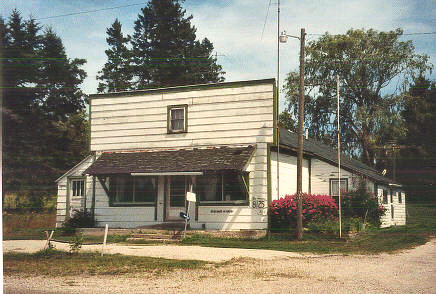 Name: Name:
Stalwart received its name when the post office was
established in 1881 at this settlement. Edgar J. Swart, postmaster at Prentis
Bay at the time, and John J. McKenzie made application for a post office
for the new settlement and it was finally granted. The Post Office Department
at Washington, D.C. asked the settlers to submit a name for their post office.
As Garfield was the new President of the United States, they chose this name
for their settlement. Word came back, however, that there vas already a post
office established by that name. So the name of Arthur was submitted by the
settlers, but there was a Post Office in Michigan by this name also. So the
Post Office Department at Washington, D.C. submitted to the settlers the
name of Stalwart, because president Garfield was a Stalwart factor in the
Republican party, and it would still be named for him. The name was accepted
and the little village still honors in name the unfortunate President whose
untimely end brought about the Civil Service Reform Law. (President Garfield
met his death at the hands of a man who had been begging the President to
give him a job. As the President could not do this, the man shot him. Soon
after, Congress passed the law whereby those desiring government jobs must
pass a civil service examination. This gives all an equal chance of looking
out for themselves and placing no responsibility on the President.) |
- photo of the Stalwart Post Office (closed 6/5/1995)
- contributed by John (bryce@chartermi.net) |
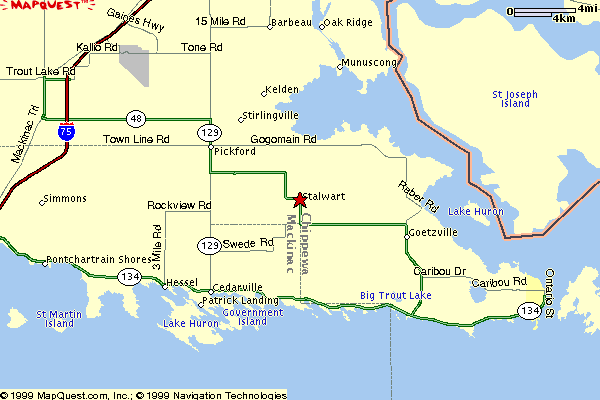
Location:
Stalwart is located on State Highway M-48, 10 miles
south and east of Pickford and 24 miles north and west of DeTour, and 8 miles
north of Prentis Bay on Lake Huron. Many settlers referred to this community
as the "Green Bush".
History:
The first settlers who came to Stalwart in the summer
of 1878 were Richard Hanna, John Johnston, William Scott, John Scott, and
a Mr. Harris. They came by way of Pickford and cut a trail through the woods
from the burnt land from a point on the Munoskong River at what is now Sunshine
community. The trail was cut in a southeasterly direction for about four
miles. Mr. Hanna had a yoke of oxen, but one of these died before all his
goods were landed, which made it necessary for his wife and young children
to stay in Pickford until the following spring.
The Homesteaders:
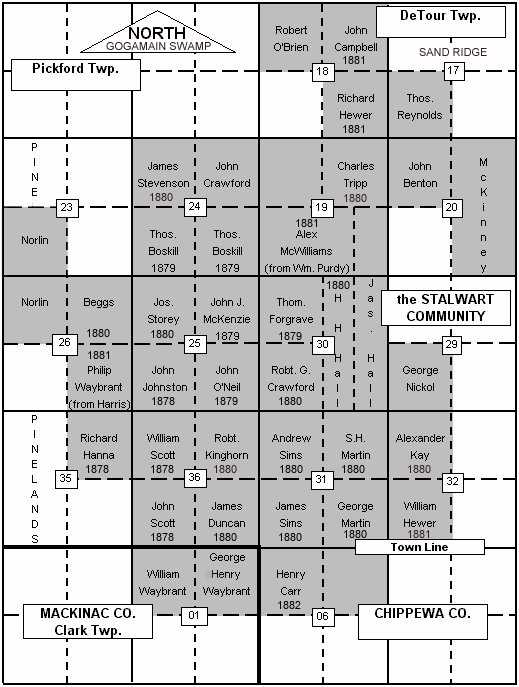
These first pioneers took up homesteads on the four
corners of sections 25-26-35-36 Town 43 N-one east.
1) John Johnston on the S.W. Quarter of Section
25,
2) Harris on the S.E. Quarter of Section
26,
3) William Scott on N.W. Quarter of Section
36, and
4) John Scott on the S.W. Quarter of Section
36,
5) Richard Hanna on the N.E. Quarter of Section
35, all in township 43-one east.
In the spring of 1879, Thomas Forgrave and John James
McKenzie and Thomas Boskill came to Stalwart and took up homesteads as
follows:
6) Thomas Boskill on the S.E. Quarter of Section
24;
7) John James McKenzie on the N.E. Quarter
of Section 25 town 43 - 1 east.
8) Thomas Forgrave on the N.W. Quarter of
Section 30-43-2 east.
Later in the same year
9) William Purdy took up a homestead on the
S.W. Quarter 19-43-2 east.
In the fall of 1879,
10) Henry Hammond Hall took up a homestead
on the east half of 30-43- 2 east, and
11) John 0'Neil took up a homestead on the
S.E. Quarter of Section 25-43-1 east.
In the month of January 1880,
12) Robert George Crawford took up a homestead
on the SW quarter of 30-43-l east.
In the same year,
13) Andrew Sims and
14) James Sims took up homesteads on the west
half of section 31-43-2 east.
Also Joseph Storey and Mr. Beggs came the same year
and took up homesteads,
15) Storey on the NW quarter of 25-43-1 east
and
16) Beggs on the NE quarter of 26-43-1
east.
In that same year
17) Samuel H. Martin took a homestead on the
SE quarter of section 31-43-2 east. Also
18) James Duncan took a homestead on the SE
quarter of section 36-43-1 east.
[then in 1881:]
19) Alexander Kay located on a homestead on
the NW quarter of section 32-43-2 east;
20) Robert Kinghorn the NE quarter of section
36-43-1 east;
21) John Crawford on the NE quarter of section
24-43-1 east;
22) Robert O'Brien on the NW quarter of section
18-43-2 east;
23) James Stevenson on the SW quarter of section
13-43-1 east;
24) John Campbell on the NE quarter of section
18-43-2 east;
25) Richard Hewer on the SE quarter of section
18-43-2 east; and
26) Charles Tripp on the NE quarter of section
19-43-2 east
27 [?] in Two Miles
This is a complete list of homesteaders up to December
31, 1882, making a total of 27 within a radius of two miles. All these came
from Canada.
Philip Waybrant came to Stalwart in 1881 and located
on the homestead first taken by Harris.
Alexander McWilliams, Sr. also located in 1881, on
the homestead first taken by William Purdy.
William Waybrant and Henry Waybrant located on homesteads
in section 1-42-1 east in Mackinac County just south of John Scott and James
Duncan.
Henry Carr bought the NW quarter of section 6-42-2
east from the Detroit Mackinac and Marquette Railroad Company in 1882. This
company had acquired a grant from the state to build a railroad but the railroad
was never built.
Sawmill at Prentis Bay
When the first settlers came to Stalwart there was
a sawmill running at Prentis Bay, and a store, postoffice, and camp were
located here also. The pioneers of Stalwart cut a trail south to an old tote
road which had been used by the people of Prentis Bay for hauling supplies
to their camp. This new trail was used by homesteaders of Stalwart to carry
their supplies from the mill and store to their homes in the new community.
These sturdy pioneers needed no physician to inform them that exercise was
healthy. For they surely had all the exercise they needed when they carried
their groceries on their backs for eight miles or more.
These old pioneers experienced many hardships because
they lacked conveyances and roads. When John McKenzie, Thomas Boskill and
Thomas Forgrave came in the spring of 1879, they moved their goods in by
way of Munoskong Bay. They bought a sailboat in the Sault and came to what
was known as Sharps Landing on the South of the bay. There was an old lumberman's
tote road from the Bay to within two miles of their homesteads. The distance
being about five miles. Half of the way was swampland, which made it very
wet and muddy to travel. Added to this discomfort was the fact that the only
method of conveying their goods was on their backs. Thomas Forgrave and John
McKenzie carried a cookstove on two poles all of the distance from the shore
to their home. (Modern men should think of this when they grumble because
they have to carry something heavy up a flight or two of stairs to their
new apartment.) These two men stated that this was their hardest trip.
It is quite surprising just what one really can do
when determination takes possession of the mind.
Surplus Burned
Added to this trying experience, Providence again
tested the stamina and fiber of these men in a most unlooked for manner.
A little shack near the store was used for a storehouse for the excess goods
which they were not able to take with them. One day when they returned for
another load they found the shack and most of their goods burned. This was
certainly an application of the old saying, "when it rains it pours." Did
they give up? Well, many would have felt like doing so, and some might actually
have carried out the threat. But not they. They "put their chins up", and
with them went their determination to conquer these new difficulties in the
wilderness. When the altitude of your chin, your hopes, and your determination
are high, you just have to succeed.
Henry H. Hall moved some of his goods up the river
in a flat bottom boat for the most of the way. The remainder he carried up
the old tote road from the shore.
But the men were not the only ones who bore the burdens.
We must not forget the women. One cannot fully describe the weary heartaches
which the mothers in these new-found homes must have endured - perhaps silently
- because the pioneer women had to carry the torch and make the little homes
in the wilderness a haven of rest for their husbands and children. Even though
the furniture, kitchen utensils, and even the groceries were scarce sometimes,
they had to smile and encourage the rest of the family. For happiness and
contentment are greater than all.
The postoffice at Prentis Bay was the nearest point
for mail for the Stalwart homesteaders. The mail came from St. Ignace by
sailboat in the summer and by dog team in the winter.
The first post office at Stalwart was established
in 1881 with John J. McKenzie as the first postmaster. (Mr. McKenzie carried
the mail from Prentis Bay for 14 months without compensation.) The site of
the first post office was on the NE quarter of section 25-43-1 east, in the
J. J. McKenzie home. [It was later moved to Forgrave's store, and postmasters
were Thomas Forgrave, Chester Crawford, James C. Crawford, and Donna Watson.
This location was closed October 31, 1992.]
The first school district was organized at Stalwart
in 1882. The site was SE quarter of section 26-43-1 east on Philip Waybrant's
land. John J. McKenzie was the first director and Miss Evaline Hall the first
teacher.
First Church in 1883
The first church was organized in 1883 known as the
Stalwart Presbyterian Church, with Rev. John Benton the first pastor. The
Methodist Episcopal Church was organized the following year, with Rev. Arthur
Woods as pastor.
The Grange was established in 1904, and the Stalwart
Agricultural Society in 1911.
The Pioneer Historical Society was established in
1925 at Stalwart. The object is to preserve in written form a history of
Stalwart from its earliest founding, and to add to this history year after
year. Twenty-three pioneers passed away before the organization of the Historical
Society, and seventeen since, making a total of forty who have passed on
to their reward.
This is a copy of the history of Stalwart, made
up by Robert George Crawford sometime in the 1930's for the Chippewa County
Historical Society.
Most of this information was taken from A History
of Pickford, Michigan, compiled by the Freshman Class of 1960.
RICHARD HANNA
INDEX
 |
The first permanent settler
in Stalwart was Richard Hanna. Mr. Hanna claimed his homestead in 1878 and
moved his wife and three sons John, William, and Wesley, and three daughters,
Mary Anne, Margaret, and Elizabeth, to the site of the homestead in May,
on which Mr. Hanna had previously constructed a crude log cabin. Two years
after they had moved, the youngest and last child, Alex (Sandy) was
born.
As Mr. Hanna got some land cleared and necessary
improvements made, he built another larger and more comfortable log house
which still stands on the old homestead.
|
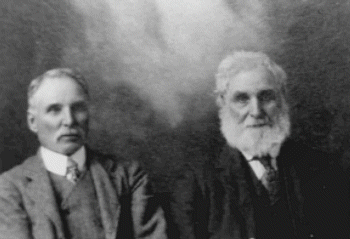
| Richard Hannah (left)
and his father Edward. Photo taken in Pickford during Edward's visit to Stalwart.
Photo courtesy of Dr. Richard Hannah, Calgary, Alberta. |
|
| All necessary household goods, food
items and mail were carried through the woods by blazed trail from Prentiss
Bay, where it came by boat.
When Alex Hanna was still quite young, Mrs. Hanna's
brother came to the home to visit and brought with him the dread Black Smallpox
- every member of the family was stricken and Mrs. Hanna and the oldest son
John died. Also the carrier Sandy Montgomery. The disease was so highly
contagious and deadly that nobody came or left the place thus necessitating
their burial on the homestead. The platt was later set aside and recorded
and is still on record in the Chippewa County Court House. |
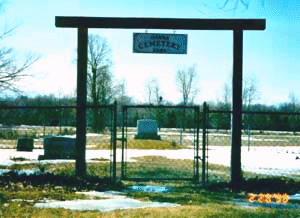
The Hanna Cemetery today |
The struggle for a mere existence in a new raw settlement
was exacting and hard work; mistakes were costly. One had to be on the alert
at all times. Medical help was impossible on short notice. Only the absolute
necessities were carried in. Sugar was obtained by tapping the maple trees
in the spring and boiling the sap to make syrup and sugar.
| Still in use on the old homestead
are two old iron sugar kettles brought from Canada, More and more settlers
moved in and eventually a sort of town council was formed. Mr. Hanna was
put in one of their magistrates. Trials were held for petty crimes in the
community.
The last two members of the family are now gone.
Mrs. Elizabeth Sims, who was well up in her 80's, died in 1962. MISS MARGARET
HANNA was born Nov, 25, 1865, and died Jan. 15, 1964. She was 98 when she
died.
Melvin Hanna, ALEXANDER HANNA's son, still lives
on the original homestead. He married Doris Rosing and they have four children.
Carl married Barbara Thompson and they have four children. Carl married Barbara
Thompson and they have one son, Brian, and live in Pickford. Noel is a Captain
in the Air Force, stationed in North Carolina, where he flies the C-130 Hercules.
Dianne married Kenneth Schmitigal. Shannon lives in Sault Ste. Marie.
Kermit Hanna married Mildred Leach and they have
two children. David married Andrea Greggs and lives in Sault Ste. Marie.
Gloria is Mrs. James Clegg and lives in Pickford. |
...Quoted from A History of Pickford Area Pioneer
Families 1973. The full text can be found on the internet
at http://pickford.icomm.ca/history/
. |
| Melvin Hanna, son of Alex,
lived on the old homestead, and died in 1995 (Doris, his wife, in 1990).
Dianne (Hanna) Schmitigal and her husband are both retired and living in
Goetzville. They have two sons: Jeffrey-married with one son, living in Hartland,
Michigan; and Philip - married with two daughters, living on the Hanna homestead
in Stalwart. Noel Hanna is father to three sons - he is retired from the
US Air Force and Michigan Air National Guard where he was a pilot - flying
the famous A-10 Warthog. He resides in Battle Creek. His three grown sons
are Michael, Christopher, and Andrew. Shannon is living in Galesburg, Michigan.
She has two daughters - Jennifer, living in Grand Rapids, and Allison, a
student at Eastern Michigan University. |
submitted by Shannon Davis 8/7/1999 |
| Obituary - Richard
Hannah
The community was exceedingly grieved last Thursday
evening December 26th, 1912 when word of the death of Richard Hannah of Stalwart,
Michigan, one of Chippewa County's most honorable citizens, was
received.
Richard Hannah was born in 1835 (presumed Ireland)
and when but 13 years of age he moved with his parents to Lindsay, Ontario,
Canada where his boyhood days were spent.
In 1865 he married Catherine Montgomery, and
to this union were born eight children - one dying in infancy.
In 1878 the family moved to Sault St. Marie,
Michigan where they resided one year before moving to his homestead at
Stalwart.
In 1886 the home was saddened by the death
of his wife and the eldest son during an epidemic of smallpox.
Mr. Hanna was an active member of the Methodist Episcopal
Church at Stalwart for 22 years, seldom failing to take his place at the
prayer class or preaching services until the last two years, during which
time his health was failing.
The deceased is survived by three daughters, Mrs.
John McEvers (Mary Ann); Mrs. Alex Sims (Elizabeth) and margaret; also three
sons Wesley, Alexander and William, all of Stalwart. One sister, Mrs. William
Templeton (Sarah) of Hannah, North Dakota.
- excerpted from the files of Dr. Richard
Hannah |
JOHN JAMES CAMPBELL
INDEX
John James Campbell was born in Goderich Ontario,
on November 25, 1863. His father died before he was born and in 1880, he
and his mother migrated to Sault Ste. Marie, where John worked for a year
on the construction of the locks.
In 1881 the Campbells settled on a homestead north
and east of Stalwart in what is called "The Sand Ridge". That was one of
the first homesteads on the sand ridge. 0'Briens were on the west side and
Hewers on the south, the Gogamain Swamp was on the north. Other neighbors
on the sand ridge were the Tripps, the Reynolds, and the Floods and
Brindleys.
Summer days were spent in clearing land and caring
for small crops. In winter most of the men went to lumber camps where the
wages run from $20 and $3O a month and board and room.
Mrs. Hannah Campbell, John's wife, was a native of
Applegate, Michigan, and came by sailboat from Harbor Beach to Point Aux
Frenes and from there to Kirkbrides south of Raber. John and Hannah had nine
children, four of which reached adulthood. Earl was killed in an auto accident,
John married and moved to Muskegon, Harvey lives in the Pickford area with
two sons, and Marie is a teacher in the Sault School System.
The old Campbell homestead, like the other "Sand
Ridge" farms, is slowly going back to nature and the hardy pioneers who worked
so hard and suffered so many hardships are just fond memories.
CHARLES TRIPP
INDEX
Charles Tripp came to Michigan from Percy, Ontario,
in the early part of 1880. Coming first to St. Ignace and later to the Stalwart
area. He homesteaded the North East quarter of Section 19 43-2 East. South
of Richard Hewer's.
The Tripp family consisted of Mr. and Mrs. Charles
Tripp [she, the former Maria Streavers], Charles Allen, James, Hiram, John,
Minnie, Mina, and Bertha. Charles A. never married but was a lumberman working
in the lumber camps and running sawmills. He also operated threshing machines
of his own in the steam engine days.
Jim and his wife had two daughters, Bertha and Tillie.
They obtained the farm of Philip Waybrant on which the school was built,
and they boarded the teachers. Bertha died while she was a young woman. Tillie
married Johnston Duncan and they made their home with her parents. They had
one son, Earl. Not long after Tillie and Johnston were married they all moved
to Cedarville where they kept a dairy for many years.
Hiram married Kate McInnis and they lived for many
years at "Diamond Springs" corner, on the west half of the southwest Quarter
of Section 24. They didn't have any children. They had a store at one time
near the corner, but later moved the building to higher ground, where he
built other more permanent buildings.
John married Nellie Hewer. They lived by the Hanna
creek to the west of his brother Jim. John died when the family was small,
and Nellie moved to Cedarville where she could get work, and later moved
her family to Flint. There she married John Maxwell.
Minnie married Gray and lived in Stirlingville, and
Mina married Hank Farney and lived at Rosedale.
Bertha married Bert Smith, a railroad engineer. They
lived in different places around Stalwart, and Bert worked for Al Tripp quite
often running the steam engine. He also worked as an engineer for the lumber
company at Raber, running the engine on the log train.
Charles Tripp owned a farm a half mile north of Pickford
which was later known as the William Miller farm. Charles Tripp is buried
in Bethel Cemetery north of Pickford.
James and his family are buried in Cedarville
Cemetery.
Bert Smiths are buried in Stalwart.
[* Emma Tripp (see JOHNSON below)]
WILLIAM JOHNSON
INDEX
In writing about the family of Charles Tripp, somehow
the name of Emma was not included. Emma married William Johnson. He came
to the area as a lumberman, working at Point Aux Frene and Raber. They moved
around considerably, living in Pelston in the Lower Peninsula, and out west.
Emma was a good cook, and was employed in camps and boarding houses.
The Johnson family were Charles (deceased), Everett,
William (deceased), Ethel, and Sidney. Everett married Katherine Crawford.
Their children were Robert, Everett (Junior), Dale (killed in action in WW
II and buried in Fairview Cemetery), Lois married William Carlson, Charles
(Jack), Lawrence married Shelva Warren - granddaughter of Mae Warren, Donald
married Nona, a daughter of Louis Crisp, Betty, Ethel, and Jim.
William married in Toledo, Ohio, and he died in Toledo.
Ethel married a doctor in New York, and Sidney married Jane Clegg. They have
a home in DeTour.
Emma Johnson obtained the homestead of Rev. Benton
on the Sand Ridge. After William Johnson, Sr., died, his wife Emma married
Frank Morrell, and they lived on the Sand Ridge until she died. After her
death Frank went back to Iron Mountain where some of his family lived. He
was French, and in his prime of life worked in the lumber camps in Dickinson
County in the winter and in the spring drove logs on the Menominee River.
He told a story of one time when the drive ended at Menominee and the whole
river crew had a big celebration. They were in a hotel dining room dressed
as they had been on the river, including calk boots. One of the men called
in French to a big Frenchman at the end of the long table, "Can you walk
her, Pierre?" Pierre stepped up on the table and walked it full length over
dishes and food. That was one way that Michigan Lumberjacks celebrated the
end of the drive or camp breakup in the spring.
WILLIAM and JOHN SCOTT
INDEX
William Scott was one of the first settlers in Stalwart,
coming here with brother John in 1878. His place was later better known as
the "Maltas" Place. His log house still stands on the Pogue place where it
was moved after Maltas built a new home. William Scott married Catherine
Waybrant, but they didn't stay long in Stalwart, moving to Virginia. In later
years, Mrs. Scott and family came back to Michigan, living in Stalwart and
DeTour, but the only one of the family who stayed was George, who married
Mildred Lehman, and made his home in DeTour. He had a son Charles who married
Mildred Sims.
Different from his brother, John Scott lived on his
homestead all his life. He was married to Nettie McInnis and had as a family;
Laura, who moved to Vancouver when she grew up; Nettie, who went to the Stalwart
Schools and became a registered nurse. She spent most of her nursing career
in Detroit. She married Wilbert Reynolds and retired to the Soo. After teaching
School, Irene became Mrs. David Lavender and lived in Flint. She also retired
to the Soo. After serving in World War I, Vernon married and lived in Detroit.
Alvin farmed the original Beggs homestead until ill health forced him to
move to the Sault where his wife taught school. Marie became Mrs. Garrison
Reginald and lived in Texas and Flint, Michigan. Nina married Ed Bertram
and lives in Sault Ste. Marie. Reginald makes his home in Durand, Michigan.
Leslie didn't marry, and has been a janitor in the Soo Public Schools.
Mr. and Mrs. John Scott are buried in Stalwart
Cemetery.
WILLIAM MALTAS
INDEX
Parts of the story of the Maltas family are taken
from the 1960 Freshman Class History of Pickford.
William Maltas was born in Toronto, Canada, in 1850,
and was over ninety when he died. At the age of 18 he was converted, and
after serving as a blacksmith's apprentice for several years, he married.
He worked in the lumber business and operated a store before coming to the
Soo with six children: Joseph, Charles, William, Annie, Tillie, and Jessie.
Mrs. Maltas died shortly after they moved to the Soo. William Maltas peddled
groceries and dry goods, and preached in several communities where he was
asked to preach.
In 1891, over the bitter protests of his children,
they moved to a farm in Stalwart. It was the former homestead of William
Scott. There he farmed and preached in surrounding localities. He remained
on the farm until 1925 when he moved to Pickford.
In November 1892 he married Annie Miller. She was
a school teacher, and was a big help to him as an itinerant preacher. To
this later marriage were born two children, Ethel and Harry.
The Episcopal Church at Fairview was first called
the Maltas Memorial Church. Later the name was changed to St. Mathias Episcopal
Church, but the old timers still call it the Maltas Church.
JOHN JOHNSTON
INDEX
Furnished by Mae Warren
John Johnston was one of the first settlers to come
to Stalwart, coming in 1878, the same year as Hanna and John and William
Scott. He took up the southwest quarter of Section 25 north of William Scott
and east of Phillip Waybrant. He was married to Mary Sims on May 15, 1882,
in the home of the bride's parents. The minister was Thomas D. Davis and
the witnesses were James Sims and Evaline Hall.
When not working on his homestead, he operated a
meat market on Water Street in Sault Ste. Marie. John Johnston developed
a disease of the spine and moved back to Tara, Ontario, and died there and
was buried in the family lot.
Mrs. Johnston gave the north half of the homestead
to their daughter, Maggie Mae, and sold the south half to John Pogue. She
later married Edward Flood and lived for a while in Fairview. She had two
more daughters, namely Mary and Roberta. Maggie Mae married Lionel Warren
and they lived on her half of the old homestead.
RICHARD HEWER
INDEX
By Pickford Freshman Class of 1960
Richard Hewer came from Gloucester, England in 1875.
With him were his wife and two sons, William aged seven and Robert age five.
His wife was the former Mary Victoria Benfield. They settled in a place called
Beevin near Manitoulin in Canada. Here he was employed by a railroad construction
company. Three more children were born here: Nellie, Mary and Richard.
In 1881 they came from Beevin to Raber, Michigan,
by sailboat, and from there made their way to Stalwart and settled on what
is known as the Sand Ridge, clearing land to make a home.
It was while living there that the story was told
of how Mr. Hewer had a habit of going away without leaving any firewood for
his wife to cook with. She threatened many times what she would do to break
this habit. One day he came home for dinner to find no fire and no sign of
a meal being prepared. He inquired as to the reason. She pointed to a stump
in the dooryard with a pan of biscuits on top of it, and she said, "As soon
as the sun gets hot enough to cook the biscuits, we'll have dinner."
The oldest son, William, married Bertha McInnis and
they took up a homestead in Stalwart on what is now known as the William
Waybrant farm. The land grant to Benjamin Harrison was dated March, 1893.
Their family included: Roy, William, Voyle (deceased), Catherine (deceased),
Austin (deceased), Frank (deceased), and Doris.
THOMAS A. FORGRAVE
INDEX
From an interview with Thomas A. Forgrave on September
17, 1969
Thomas Forgrave came to the Stalwart area in 1879.
The same time as J.J. McKenzie and Thomas Boskill.
Thomas Forgrave brought his wife, Janet, and three
children Minnie, Annie, and Robert. They brought their household goods from
the Soo to Munoskong Bay by sailboat, and carried it all piece by piece through
the Gogomain Swamp to the Sand Ridge at John Campbell's.
Forgrave built a log shanty first where the Stalwart
Fair Ground buildings are now. Rob and Minnie planted two little spruce trees
near the shanty. One of them blew down before the fair buildings were built,
but the other one still stands at this time. The homestead was hardwood forest
and the land was cleared by chopping down those large maple trees, cutting
the limbs off, chopping them into sections and rolling them together and
burning them, Nobody today knows what work that was because no one does that
kind of work anymore. After land was cleared of trees there was still a lot
of big stumps and stones. But the soil was good and good crops were
raised.
Another son was born on August 17, 1882. He was named
for his father, Thomas. The nearest doctor was Dr. Webster at Pickford. Forgrave
didn't have a horse, but he got Robert and Evaline Crawford to stay with
Mrs. Forgrave, and he either walked or borrowed a horse and went for the
doctor. Dr. Webster made the trip by horseback. It was his first patient
in the area, and the first baby born in what became Stalwart.
Thomas Forgrave had good crops and was able to offer
a stack of hay and some potatoes for sale to Hossacks for their lumber camp.
He knew what he wanted and held out for it till finally Hossack gave him
the $400 he wanted. That money gave him a start in the new country. He built
a new frame house and set up a store in one part of it. The story is told
that one time he was bringing home a supply for the store on a jumper and
it broke down between Riley's and Hanna's. He walked home to get material
to make repairs. It was after dark and while he was eating his supper, Mrs.
Forgrave suggested that he wait until morning to go back and bring the load
home. In telling about it, he said, "I just looked at her."
Again Forgrave built a new store building near the
road. He ran the store in that building until his health failed and he turned
it over to Tom. Besides Tom, other operators were Rob Forgrave, Ed Duncan,
Thomas Rothwell, William Talbot, and Chester Crawford.
Other Forgrave children were Janet and William. Janet
died quite young, and of the Forgrave family, Thomas A. Forgrave is the last
of that generation.
The Forgraves were community leaders in church, school,
and social activities.
When asked why they left Canada and came to Stalwart,
the reply was that there wasn' t any homestead land in that part of Canada.
Forgrave bought a farm and there was a drought for three years. He didn't
have his farm paid for so he lost it. That was why they came to Michigan.
Tom said that Rob was born in Owen Sound in 1877.
Note: Tom said he was born in 1882, but Crawford's
were married in January 1883.
| The following newspaper clipping, assumed to
be from the Pickford newspaper, was found in Agnes Kinghorn's photos. If
anyone can help affix a date to this series of local Stalwart events, I would
appreciate hearing from you. I know nothing about why my grandmother "made
her home for several years with Mrs. Forgrave", and I have no fixed year
for my grandmother's journey from Stalwart to Port Hope, Ontario, where she
married my grandfather in 1910. However, her older sister Jennie was not
married until 1894 (becoming "Mrs. William Brown"), which thereby defines
the possible date range, 1894-1910. |
-STALWART-
(Special Correspondence) |
- Miss Maud Nally has returned home from Gatesville.
- Miss Maud Moore is visiting friends here this week.
- Miss Susie Crawford of the Soo visited friends here during the week.
- Mrs. Brooks of Pickford visited her parents Sunday and Monday last.
- Mrs. James Foreman [Nellie Kinghorn] spent a few days with her parents
during the week.
- Miss Martha Duncan has gone to visit her sister, Mrs. William Spencer.
- H.H. Hall has gone to the Soo to make an extended visit with relatives.
- Robert Forgrave is in the Soo for a load of merchandise for Stalwart store.
- The subject for discussion at Grange meeting Thursday was "The Rural School".
- Tuesday's rain made plowing possible and the farmers hereabout are improving
the time.
- Miss Nettie Scott has been engaged by Mrs. Forgrave to take the place made
vacant by Miss Kinghorn's departure.
- William Osborn of Grand Valley, Ontario, is visiting friends and relatives
here. He is on his way to the Canadian northwest to make his future home.
- A pleasant dancing party was given at the home of Mr. and Mrs. Robert Kinghorn
Tuesday night. It was in the nature of a farewell for their daughter Agnes.
- Miss Agnes Kinghorn, who has made her home for several years with Mrs.
Forgrave, departed Wednesday for Port Hope, Ontario, to live with her sister,
Mrs. William Brown. |
JAMES DUNCAN
INDEX
James Duncan was one of the early settlers in Stalwart.
He came first in 1879 but he didn't take up a homestead and bring his family
until 1881. Jim Duncan was a tall man with a black beard. Some of the boys,
when asked how big they wanted to be, would say, "As big as Duncan." He was
born in Canada in 1846 and died in Stalwart in 1911. His family - Edward,
Norman, Minnie, Susie, Emily, Johnston, Martha, George, Alma, William, and
Earl. Ed was a brick and stone mason. He married Annie Forgrave, who died
when their daughter Annie was born. Later he married Lena Renshaw and lived
in northwest Canada. Norman was also a mason and plasterer. He married Mabel
Clark. Minnie married William Johnson, a lumberman; Susie married Charlie
McConkey and they went out west. Emily married William Spence. They lived
in Raber until the lumbering business closed down. They had a large family.
Johnston worked in the woods and on the highways. His wife was Tillie Tripp.
Martha lived in the Sault. She married Tom Butler. George became a dentist
and lived in Ferndale. Alma died from after effects of the measles. William
died in infancy. Earl stayed on the farm with his mother after his father
died. He and Kate Sims were married and lived in the Sault, where he worked
on the police force and on the locks.
James Duncan served on the school board and like
all the early settlers took his politics seriously. During the Presidential
campaign in 1896, he put up a tall flagpole but couldn't get paint to paint
it so he mixed buttermilk and red ochre to paint it. Every one knew Duncan's
Morgan horse he called "Dolph", just as they knew Ed Flood's
"Fly", Forgrave's Blacks and John Crawford's "Old Mag",
the old gray mare with the crooked hind leg.
SAM and GEORGE MARTIN
INDEX
Sam and George Martin, brothers, came to Stalwart
in 1880 and took up homesteads in the east half of Section 31-43-2 east.
George didn't stay long, but Sam built a house and cleared a farm. Their
road was across the Andrew Sims homestead. They boasted that their house
was the first one in Stalwart with factory-made windows. Sam Martin had the
first yoke of oxen, and he did freighting for neighbors. The nails in the
house were all wooden pegs which Sam made himself. Mrs. Martin was Katherine
Richardson. Her brother James came and helped her farm after Sam died. Sam
died in 1891 at the age of 52. The family, most of them born in Canada, were:
Cynthia, Myrtle, Lottie, Charlie, Orrie, and Agnes. Cynthia didn't live in
Stalwart; Myrtle married Dan Smith and lived in DeTour, Pickford, and Sault
Ste. Marie. Lottie was married to Angus McLeod and lived in DeTour, but came
to Stalwart and lived on the old homestead many years. Orrie was crippled
with rheumatism when he was a boy. He walked with a cane, and was loved by
all the children. Agnes married and went to California.
George Martin lived in the Sault and owned considerable
property. The Martin subdivision was some of his property.
Charlie didn't marry, but followed the woods work.
He was reputed to be among the toughest of lumberjacks. Working camp in the
winter and rafting the summer. He was last seen in Iron Mountain in 1926.
Believed to have met with foul play.
JOHN J. McKENZIE
INDEX
John J. McKenzie was one of the settlers who came
to "the Green Bush" in 1879. With him were his wife and one son, James, one
and a half years old. In 1880 another son, Alex, was born, and a daughter
Kate was born in 1883. Douglas was born in Stalwart, August 14, 1885; Ruby,
in the Soo, June 1, 1889; and Alice, the youngest, was born in Bay City,
June 18, 1893.
Like most of the first settlers, McKenzie built a
temporary cabin and after a few years built a better one. The second one
was of logs, too, and to date it still stands, although the outside is covered
with shingles and the logs cannot be seen. Although the McKenzie family didn't
live very long in Stalwart, he was a prominent citizen while they were there.
He was the first Director of the School Board, Justice of the Peace, and
the first postmaster. He carried the mail from Prentis Bay the first fourteen
months he was postmaster without compensation.
Like the other men in the new settlement, John McKenzie
had to work in the woods in the winter. He worked in the office at Prentis
Bay and slept in the same room as the boss. One evening while Mrs. McKenzie
and the children were at home alone, one of the neighbors came and told her
that the grocer in Pickford had put poisin in the flour that he bought and
wanted her to go with him and have the grocer arrested. She realized that
the man was mentally ill, and persuaded him to go home until she got the
chores done. As soon as he was gone, she fastened all the doors and windows
and wouldn't let him in when he came back. She put the lights out and prayed
for John to come home.
John woke up with the feeling that his wife needed
him badly. It was so real that he got up and dressed. The boss asked what
he was doing, and he told him that his wife needed him and couldn't be persuaded
to wait until morning. When he got home and learned what was going on, he
went to Thomas Forgrave across the road and together they planned what they
would do. They had to get him to the Sheriff, but they couldn't arouse his
suspicions, so they told him that they would go with him and help him get
the Sheriff to arrest the grocer. That way they got him to the Soo, and under
the control of the Sheriff.
When Kate McKenzie was three years old, the family
moved to the Soo, where John became a customs officer, a position he held
for many years. In 1901, Kate McKenzie taught school in Pickford and boarded
with Mr. And Mrs. Fred Johnson in Pickford. Mrs. Johnson was a sister of
Jim Stirling. She rode her bicycle to the Soo and back on weekends when the
weather permitted. Mrs. Kate (McKenzie) Evans has a China cup and saucer
which the Kinghorn sisters brought as a gift when she was born. It came from
Scotland.
I had a visit with Mrs. W. A. Evans in East Tawas,
Michigan, on October 20th, 1969. She was the Kate McKenzie who was born in
Stalwart. I wish I could write all the things she told me about the early
days in Stalwart.
JOHN CRAWFORD
(Shoemaker)
INDEX
John Crawford was born in County Donegal, Ireland,
in 1832. He had three brothers and a sister. His mother brought the family
to Canada when John was fourteen years old.
He told this story of his boyhood in Ireland. One
day he and some other boys were playing on the sidewalk in front of a tavern.
They were trying to see who could jump the farthest from the edge of the
sidewalk into the street The tavern keeper came out and jumped, and told
them that the boy who could beat that jump would get a gallon of whiskey.
Johnny Crawford beat the tavern keeper, so he got the jug of whiskey and
"We all got drunk."
He learned the shoemakers trade, and had shoe shops
in several places. There were always better opportunities in the next town.
He married Mary Fair, and they lived in Milbank, Ontario, for quite a few
years. Most of their family was born there. Once he went to California, going
by boat to Panama, crossed over to the Pacific on foot, and up the Pacific
Coast again by boat to San Francisco. There he set up shop and stayed a year.
During that year the trans-continental railway was completed, so he came
home by train. He had jobs for the whole family, and was for moving right
away, but his wife Mary refused to go. The only time she wouldn't go along
when he wanted to move.
About 1870 the family moved to Owen Sound and lived
there until they moved to Sault Ste. Marie. They kept a boarding house, and
he had his shoe shop where the Park Hotel was later built. It was there that
his mother died at the age of one hundred and five years. She was buried
in the cemetery on Ashmun Hill, beside the ravine. He could have bought the
site where the First National Bank is now for $600, but he didn't think it
was worth it.
Another move, this time to Stalwart, where he took
up a homestead between two hills. He built a log house and log barn. The
house was on the south side of the river, and the barn was on the north side.
He had an abundant water supply, the east branch on the Munoskong River.
He had a shoe shop in DeTour for a while, and one in Pickford.
His family: Sarah, married Lot Roe and lived in Toronto;
Robert G. married Evaline Hall and lived in Stalwart all his married life;
Jennie married John Mattern and lived in Sault Ste. Marie; Adaline married
Joseph LaLonde and lived in Montana; Tom married Susannah Stevenson and lived
in Stalwart; Ida Victoria married James Stevenson and lived in Stalwart;
Bessie (deceased); Effie (deceased); Maud married James Richardson and lived
in the old home.
They didn't live many years in the log house. They
built a frame house close to the town line road, and he had his shop in the
front part of the house. The last move was from a shop and home which he
had moved to a location on his son Bob's place back to the old home again.
They are both buried in the Stalwart Cemetery.
ROBERT GEORGE CRAWFORD
Robert G. Crawford, [son of John Crawford], was born
in Milbank, Ontario, on November 21, 1858. When he was twelve years old his
family moved to Owen Sound, Ontario. He lived in Owen Sound with his family
until he was about seventeen, when he went sailing. He sailed for seven years
and in that time he was on all the great Lakes. He worked on one steamship.
It was in 1880, after navigation closed, that he walked from the Soo to Stalwart
and located his homestead, sleeping in the woods at night. He stopped at
his Uncle William' s east of Pickford and he wanted him to take the farm
land a mile east of Pickford, on the north side of the road, but for some
reason he didn't.
One winter he worked in a camp on Maud Bay. A lumber
company on the south end of Sugar Island hired him to carry supplies to Maud
Bay because he could handle a sailboat. On one trip down he had a pony to
deliver to John Stevenson at Raber Bay. He sailed in as close as it was safe
and John came out with a rowboat. They jumped the pony overboard and John
led it, swimming to shore. That was the beginning of a friendship that lasted
until John Stevenson died.
His pay that winter was twelve dollars a month with
board and bunk, two dollars more than the others because he sailed the boat
in the fall. He was told in DeTour that there was good farmland west of there,
so one morning he set out to see. He thought he must have gone as far as
what was later Neil Cameron's, but didn't find what he wanted.
R. G. Crawford and Evaline Hall were married on January
29, 1883. They became active in church work early in their lives in the new
community. Mrs. Kinghorn died and there was no church and no cemetery, so
Thomas Forgrave and Robert Crawford each donated a half acre joining each
other for a cemetery, and Mrs. Kinghorn was the first to be buried in the
Stalwart cemetery.
For the first Presbyterian Church, Thomas Forgrave
donated the land next to the cemetery, Andrew Sims donated the tamarack logs,
and the neighbors built the church. The Methodist Church was a frame building
with flattened poles for studding. It was built on land donated by John J.
McKenzie.
After his marriage, R.G. didn't sail any more. He
devoted his summers to work on the farm, and in the winter he usually went
to camp. He was Superintendent of the Sunday School, and Elder in the
Presbyterian Church for many years, going to the General Assembly in Chicago
once. He was sexton of the cemetery, where all grave lots were free. Many
times he had to leave his work in the fields to help someone pick out a lot,
or to show someone where their lot was. He was Master of the Grange, Secretary
of the Foresters, Secretary of the Fair Society, and Treasurer of the Raber
Township Schools.
Their children were: Harry, who died in infancy;
Chester, married Mabel Waybrant; Ida Grace, married George Hewitt; Robert,
married Ethel Waybrant; Kate, married Everett Johnson; Janet, married George
Slater; twins Virgil and Virgillia, (Virgil died in infancy) and Virgillia
married Vern Eveliegh; Olive, married Russell Sims; Susan M., married William
Hewer; and Mary, married Clifford MacLean.
Robert G. Crawford was 84 years old when he died,
and Evaline Crawford was 87 when she died. They are buried in the Stalwart
Cemetery.
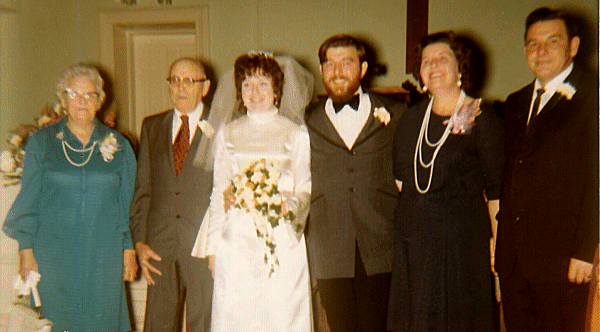 |
(L to R) - 1971 - Ethel Waybrant & Robert B.
Crawford (son of R.G. Crawford), their daughter
Judith and her husband Ronald Adams, and his parents Ruth Chamberlain and
Arthur Adams.
Photo courtesy of Rhonda Jenks. |
THOMAS CRAWFORD
Thomas Crawford, son of John Crawford, was born in
Milbank, Ontario, about 1865, and lived with the family until they came to
Michigan. He was a good shot with the rifle, and got his quota of deer and
other game in the new country. He married Susanna Stevenson and they built
their home on the river between his father's and her father's.
Their family consisted of: William (deceased), James,
Bell, Mary, Myrtle, Robert, Lyla, Susie, Fred, and Ward.
Tom Crawford bought his land from his father and
father-in-law and other parties. He was a good farmer, and they were both
economical. He made money on peas which he grew on contract with a seed company.
In the winter he didn't go to the lumber camps as much as the other men did,
but he had good timber of his own, and worked at that.
After his farm was well cleared, he built a large
frame house close to the county road, and that is where their family grew
up and left for homes of their own.
He belonged to the Orange Lodge, and was Master for
many years.
HENRY HAMMOND HALL
INDEX
Henry H. Hall brought his family to Stalwart in 1880.
He took up a homestead a mile long and a quarter mile wide. He later on traded
one forty to Thomas Forgrave for forty of hardwood. Forgrave wanted some
clay land, and Hall wanted a maple sugar bush. With his wife Katherine he
brought two sons, Charles and James, and a daughter Evaline. Charles married
Mary Jane McKinney and they made their home in Fairview, where George Sims
lived for many years. James married Annie Scott, sister of William and John
Scott. At first they lived in a log cabin across from brother Charles, but
took the east half of section 30 beside his father. Charles moved to the
Soo with the McKinney's, and his family grew up in Algonquin (then called
"Nieceville"). His family: George, Minnie, Katherine, William, Florence,
and Ella.
James' family grew up in Stalwart. John, Hammond,
Lawrence, Alex, Robert, Dewey, Myrtle, Malcolm, George, and Leonard.
Evaline married Robert G. Crawford, and her family
is listed in the account of her husband.
It is understood that Henry Hall was born in New
England. His father was an English surveyor. After his marriage, he was called
back to England, and didn't return, and Henry was born after he left. His
mother remarried a man named Cameron, and had children named Cameron who
were half-brothers to Henry. One, named Angus Cameron, visited Hall's in
Stalwart.
Henry married Katherine Robertson in Tingwick, Quebec.
Her mother made her home with them until she died. They lived in Vermont,
and Upper and Lower Canada, before coming to Sault Ste. Marie. He was a cooper
and surveyor. The first two winters spent in Stalwart were in a log house
built by a man named Purdee. The first winter Purdee lived with them. Once
Jim Hall shaved using Purdee's razor. When Purdee learned about it he remarked,
"It may be good for the razor to be strapped on a calf skin." Jim replied,
"It should be almost as good as a goat skin." The second winter Alex McWilliams
lived with them, having become owner of the property where he remained the
remainder of his life.
Mrs. Hall was a good cook, having been a cook at
Sailor's Encampment and at Prentis Bay. She was a mid-wife for many births.
While at Prentis Bay, she was present at the birth of Arza Swart, who was
one of the sheriffs of Chippewa County. Their door was always open to the
sick, the weary, the homeless, and everyone else.
Daddy and Granny Hall are buried in the family lot
in Stalwart Cemetery.
| Charles H. Hall's children, of
course, were my aunts and uncles.
George became a sailor on the Great Lakes and ended
his career on the Detroit River as captain of the mail boat which provided
mail service to the big ships passing through. He married Belle ? and had
one son named John (Jack). He lived with my mother Kathryn (or Catherine
as it appears in the book) the last few years of his life, and died around
1960.
Minnie lived her entire life around the Soo and her
house was on Ashmun Hill in Algonquin. She married Steve Bernier and had
3 sons and 1 daughter. She died at 59 yrs.
Kathryn (my mother) married Francis (Frank) Stephens
of Devonshire England and they had 6 children - 4 sons and 2 daughters. They
moved to the lower Peninsula and the last 3 were born there. Frank was sent
back to England in 1936 and Kathryn raised the family by herself and her
early training from Stalwart must have helped her as she was one brave and
tough lady. Mother died in 1981 at the age of 92. Bill went to California
and married Ruth? He never returned to Mi. as far as I know and sort of lived
the life of a cowboy in the mountains there. Florence married Hugh Miller
and had 2 sons. They lived in the Soo all their married life. Ella married
Fred St. Amand and had 1 son and 1 daughter. They lived many years in a suburb
near Detroit.
As a side note, my middle name is Florella, made
up of parts of Florence and Ella. So that continues the Hall legacy. Mom
spoke often of R.G. Crawford, the Waybrants, her Uncle Bill Scott and Aunt
"Kate" and so many of those names I remember hearing in my early years.
Contributed by Eva F. Ward. |
ALEXANDER McWILLIAMS
INDEX
Alexander McWilliams was born in Northern Ireland
and his wife, Mary Lowney, was born on the Isle of Man. They both came to
Canada and met there and were married. They lived in Ellengowan and Paisley,
Ontario. Their family consisted of: James, John, Maggie, Tillie, Alex, Annie,
Mary, and Harry. Jim was a blacksmith and worked for John Bone in his shop
on West Spruce Street for many years. His wife, Rose, ran the Belle Isle
Inn on Ridge Street. John went to North Dakota and raised his family there.
His wife's name was Ellen. Maggie and Tillie went to the Canadian Northwest.
Maggie's married name was Blythe, and Tillie's name was Osbourne. Mary married
Alva Hillier from Dafter, and they lived on Carrie Street in Sault Ste. Marie.
Alex and Annie and Harry were the only members of the family who lived in
Stalwart. Alex married Cassie Crawford, Harry married Mary Crawford, and
Annie married Hank Waybrant.
Hank and Annie had eight children: Harry, Bert (killed
in World War I and buried in France), Ida, Annie, Dorothy, Della, Ethel,
and Mary. Anne died when Mary was less than a year old, and Hank was killed
in a farm accident a year and a half later. The four older children went
on their own, but the younger ones were raised by uncles and Aunt Mary Hillier.
Jim and Rose raised Dorothy, Alex and Cassie raised Della, and Harry and
Mary raised Ethel, while Mary Hillier raised Mary.
Alexander McWilliams was up in years when he came
to Stalwart, so he didn't do much farming, and the land was hard to clear
and to work. He kept a few cows and he had one horse, "Old Jack". Jack was
the only horse in the community for some time. He was a black indian pony,
and he lived until after he was thirty. They had a grove of apple trees grown
from seed, some of them were very good, and some were very sour. In the spring
they would tap trees in the maple woods and make syrup and sugar. A story
Harry told about the syrup making was: They had a good run of sap and had
boiled it down in the big iron kettles in the woods until they could get
it all in two milk pails. Annie and Harry wanted to carry the pails, but
the old man said they would only spill it, so he started for the house with
a full pail in each hand. They were just about out of the woods when he tripped
and fell flat, spilling all the syrup. We don't remember what was said.
Alexander McWilliams and wife Mary were among the
first members of the Stalwart Presbyterian Church. I can still see them in
memory, coming down the road to the little log church at night. He had a
lantern in one hand and a cane in the other, and she had her hand on his
arm.
Alexander McWilliams was born in 1827 and died in
1919. Mary Lowney McWilliams was born in 1830 and died in 1918, and they
are both buried in Stalwart Cemetery.
ALEX McWILLIAMS II
Alex and Cass made their home next to his fathers
on the bank of the Little Munoskong. They didn't have any children, but they
raised his niece, Della Waybrant. They kept quite a herd of cows and made
butter and sold it to customers in Sault Ste. Marie, Pickford, Raber, and
DeTour.
Cassie died in the spring of 1926 from the after
effects of the flu. Alex lived alone for about ten years before he died.
They are both buried in Cottle Cemetery.
Della Waybrant taught school for several years, teaching
in Stalwart, Pickford, and Cedarville. She married Howard (Mike) Rudd and
lived in Cedarville and Sault Ste. Marie. Their children: Wayne (deceased),
Dean, Myles, Jocelyn, Mickey, and Thanna.
HARRY McWILLIAMS
| Harry McWilliams, the youngest of
the family of Alexander and Mary (Lowney) McWilliams worked in lumber camps
and on farms until he married Mary Crawford, sister of Alex's wife. He
homesteaded forty acres a mile west and a mile and a half north of Stalwart
corner. When Harry's sister died they took her daughter, Ethel Waybrant,
into their home and raised her.
When Harry's parents became old and feeble he built
another house beside their house and cared for them as long as they lived,
receiving their property in return. After the parents died they moved back
to the homestead, but after a few years trying to make a living on forty
acres, they went to Flint Michigan, where he worked at the Buick Factory
until he retired. They sold their property in Flint and bought a home in
Pickford where they lived out their lives.
Ethel Waybrant stayed with her Uncle and Aunt until
after her Grandparents died and after the end of World War I, when she married
Robert B. Crawford. They bought her grandfather's place and lived there a
few years. Her children were: Evelyn married Eldon Debro; Anne married Kenneth
Bennett; Berniece married Ruben Waybrant; Peggy married Ben Zenda: Harry
married Hazel Gugin; Kathleen married Howard Parrish; Ronald married Rosel
Kuehne; Eugene married Loretta Carr; and Judith not yet married.
Harry and Mary McWilliams are buried in Stalwart
Cemetary. |
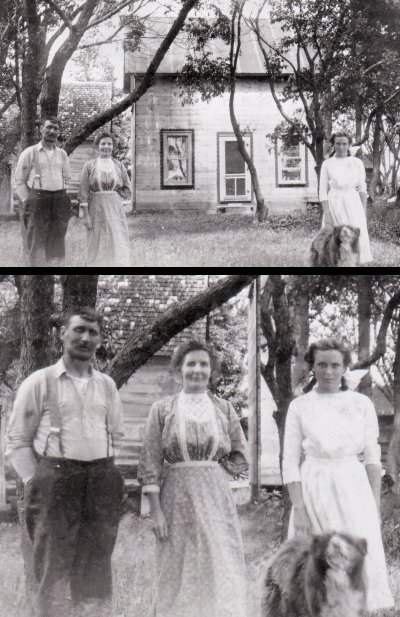
Harry McWilliams and Mary Crawford in front
of their farmhouse, with Ethel Georgiana Waybrant, who lived with them
after her father died (see story below).
Photo courtesy of Rhonda Jenks. |
PHILIP WAYBRANT
INDEX
Philip Waybrant came to Michigan from Kinkardine,
Ontario. He had been married twice. His first family remained in Canada.
Among those who remained in Canada were Arminnie, John, Alexander, Philip,
and Hector.
His second wife was Anne Splan. From that union were:
William, George Henry, John, James Ruben, Thomas, and Sarah, Kate, Clara,
Becky and Ida.
Philip Waybrant acquired the southeast quarter of
section 26 which was originally homesteaded by Harris. It was on Waybrant's
farm that the first school was built, the site being leased from Waybrant
for one dollar a year. Philip Waybrant contracted to complete the school
house after the log walls had been raised.
William Waybrant brought the first team of horses
and wagon to Stalwart. He took a homestead in Mackinac County south of John
Scott's place. After his father died, William's mother had her home with
him. He didn't farm very much, but moved to DeTour where he worked on Watson's
coal dock. Then he left DeTour and the coal dock and moved back to Stalwart
and bought the homestead of William Hewer, which was the southeast quarter
of Section 32-2-east. He married Anna Pratt and had two children, William
and Edna. William Jr. was born on his father's sixty-fifth birthday.
George Henry (Hank) homesteaded the north east quarter
of section 1-42-2 east, being the quarter section east of William Waybrant's
in Mackinac County. Hank Waybrant married Annie McWilliams and they had eight
children: Philip Henry, Albert, Ida, Anne, Dorothy, Della, Ethel, and
Mary.
Hank worked his farm in the summer and worked in
the woods in the winter. He was foreman of the Mud Lake Lumber Co., and for
H. P. Hossack and Company. On December 24, 1902, Annie died from quinsy,
and a year from the next August, Hank was killed while helping Jim Duncan
stack hay. One of the stacking poles broke and struck him in the back. The
four older children were old enough to care for themselves, but the others
had to be cared for by others. James McWilliams and wife, Rose, raised Dorothy.
Alex and Cassie McWilliams took Della, Harry and Mary McWilliams brought
up Ethel, and Mrs. Mary Hillier, her aunt, raised Mary.
Jack Waybrant went to Colorado to live.
James Ruben married Nellie Kay. They moved to
Hermansville, Michigan, where he worked on the railroad. They moved back
to Stalwart when the children were still quite young. They were Ida, Mabel,
and James Clifford. Jim bought the Alex Kay homestead and worked in the woods,
sometimes as foreman and sometimes as a jobber.
James Ruben and wife were both born in Kinkardine,
Ontario, in 1867 and they both died in Stalwart in 1926, and were buried
in the Stalwart Cemetery.
Tom Waybrant and wife had quite a family. They were:
Caroline, Tom, Albert, James, Edmund, Philip, Adaline, and Loraine.
Tom worked in the woods in the winter, rented farms
in summer or worked on contract. Thomas Waybrant spent his old age in Cedarville
and at the last with his daughter Adaline and her husband, Melville
Moore.
Kate Waybrant married William Scott. See the William
Scott item.
Ida was the youngest of Philip Waybrant's children.
She married Martin Francis at DeTour. Their children were: Allen, Edna, Ruben,
and Audrey. Martin Francis died and Ida married Kennedy.
ANDREW SIMS
INDEX
Andrew Sims was born in Scotland in 1825 and his
wife was born in Wales in 1826. Her maiden name was Mary Thomas. Andrew died
in Stalwart in 1896 and Mary died in 1925. She was six years old when she
crossed the ocean and the trip across the ocean took six weeks. The Sims
family came to Michigan in 1878. They had eleven children, all born in Canada,
but only five came with their parents to Michigan; George, Alex, Bob, Lizzie,
and Mary. There was another son, James, who came to Michigan and took up
a homestead. It was beside his fathers, and the two took up the west half
of section 31-2-east. Their homesteads were filed in 1881.
Andrew Sims was a lay preacher, called a circuit
rider. He went to different settlements to preach. The family walked from
the Soo to Stalwart, called "The Green Bush", and carried their belongings.
Bob, the youngest, was 14 years old, and had to carry his share. They built
a log cabin near the road where they lived for a few years until they could
build a better house on higher ground. The lumber for the new home had to
be brought from Prentis Bay with oxen and jumper. The roads where the mud
was too deep had to be corduroyed, and the mud was too deep in many places.
Before Andrew Sims died, he left the homestead to Alex with the provision
that Alex's mother have her home with him.
George Sims [married Mary Milne and] homesteaded
in Barbeau, but after eleven years he sold out and moved to Fairview, where
he bought the homestead of Charles Hall. That was the George Sims home for
many years. They had a family of: Andrew, Annie, Mary, Fairly, William, and
Alex.
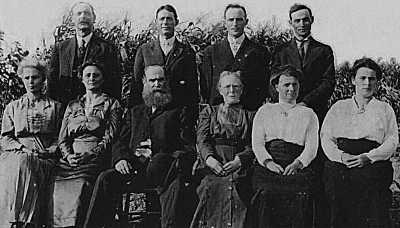
George Sims and his wife Mary Milne, surrounded by
their family:
back row: sons Andrew, Farell, William, Alex
front row: Bell and Maggie (daughters-in-law), George,
Mary, and daughters Annie and Mary.
photo of the George Sims family provided by Dawn
Thurlow, Punta Gorda, FL |
Alex married Lizzie Hanna. Their children were: Annie,
Frank (Robert), Kate, Emily, Ethel, Douglas, George, Jean, and Mildred.
Robert married Minnie Forgrave. They had two boys:
Thomas and Russell. Robert died in 1916 at the age of 49. Minnie died in
1925 at the age of 53. Both are buried in Stalwart.
Lizzie Sims married Joseph Barton. Their home was
in Fairview until their family grew up and then they moved to Pickford. Their
family was Tom, Minnie, Joe, Georgina, and Wilbert.
Mary married John Johnston and they had one child,
Maggie Mae. More of them in the John Johnston story.
The Sims family played an important role in the
development of Stalwart. Always in front when anything of importance to the
welfare of the community came up.
James Sims homesteaded the southwest quarter of section
31, on the south side of his father's homestead. He married Sadie Crawford,
daughter of William Crawford [brother of John Crawford], near Pickford. It
seems that Sadie's father was opposed to the marriage, so they had to elope.
Alex was taken into confidence, and he had to go and find the horses over
near Kay's, bring them home and hitch them to the wagon, and take them to
meet Jim and Sadie somewhere near Riley's. They took the team from there
and went to the Soo and got married, and Alex walked back home. They moved
out to the state of Washington, and Bob Sims took over Jim Sims'
homestead.
ALEXANDER KAY
INDEX
Alexander Kay came to Stalwart from Kinkardine, Ontario
in 1880 and homesteaded the northwest quarter of section 32-43-2 east. His
wife was Arminnie Waybrant, daughter of Philip Wavbrant and his first wife
Kay Britten Waybrant. Their children were Alex, John, Mrs. James (Helen)
Waybrant, Mrs. William Watchorn, Mrs. Abe (Swede) Johnson, and Mrs. William
Hill.
Alex Sr. and Alex Jr. are buried in Stalwart Cemetery,
as are the Watchorns and John Kay.
Alexander Kay had a brother Hugh who, with his family,
lived in Stalwart for some time, but went back to Canada.
William Watchorn lived in various places in Stalwart.
He farmed some, but most of the time he worked out. Their family consisted
of six girls and three boys: Minnie, Fanny, Mary, Charlotte, Marvel, Annie,
Harry, William, and Albert.
"Swede" Johnson was a lumberman and a jobber. After
a few years in the Stalwart area the family moved to the Rexton area.
Alex Kay, Jr. lived with his father and worked out.
He was killed by a train accident at Echo Bay, Ontario, when he was 28 years
old.
John Kay was born in 1880 and married Elizabeth Campbell.
He owned his father's place and lived across the road from Jim Waybrants.
John entered the ministry of the Methodist Episcopal Church and served in
DeTour and other neighboring churches. He died at the age of forty one. He
left two sons and a daughter, Alex, Raymond, and Marjorie.
JOHN NORLIN
INDEX
John Norlin was born in Sweden and came to this country
for work in the lumber camps. He married Minnie Watchorn, daughter of the
William Watchorn's. He farmed on land in the southwest quarter of section
23-43-1 east and the northwest quarter of section 26-43-1 east. Their children
were: Otto, John, Hilda, Edna, and Minnie. John was an officer in the
Presbyterian church, and a member of the Board of the Stalwart Agricultural
Society. He was the designer and builder of most of the Agricultural Society
Buildings. Most of the frame barns built in Stalwart were the work of John
Norlin. He was tireless in his efforts to better his community.
JOSEPH STOREY
INDEX
Joseph Storey was one of the 1880 settlers. His family
were: James, John, Hannah, William, and Harry. His homestead was the northwest
quarter of section 25-43-1 east. Joe started his career as a resident of
Stalwart by serving on the school board. He had some good cedar timber on
his land, so he got a start by cutting the timber and selling it. He also
worked in the lumber camps in the winter.
After the family was grown they sold the farm and
moved to the "Half-Way", where Mrs. [Jenny Splan] Storey kept a boarding
house and served meals to travelers. Joe was caretaker of the stage horses
which were used to carry the mail and passengers between the Soo and
Pickford.
James Storey married Lyla Kinnee. Their family happened
to be all boys: Mervin was the oldest, and as he didn't get married, he lived
at home, taking over the farm work. Voyle worked with his father in the timber
business. When the Dolmite Quarry opened, he went to work there, and got
married and built a home on the north half of the Jim Tripp quarter section.
Paul didn't marry either. He lived in Flint and Detroit for a time but came
home before his mother passed away and took his place beside his brother
Mervin. Mason married Ruth McLean. He went to work at Dolmite, too. Their
children are James, Sharon, Mary Jane, Richard, and Charles. Wayne served
in World War II, and after getting out of the service he married Doris Batho
and went into the meat business with Clifford Harrison. Their children were
Beverly, Martin, and ???
Jim Storey did some farming, but the most of his
life work was in the timber business. He had lumber camps and saw mills and
shingle mills. Jim lived to be 88.
Jack, Will, and Harry didn't live in Stalwart after
they married.
JAMES STEVENSON
INDEX
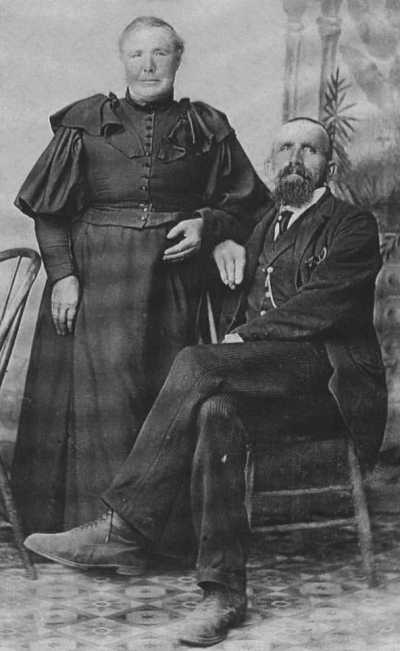 James Stevenson and wife [Isabella] and children
came from the Moskoka Country in Canada. They had lived in Pennsylvania where
Mr. Stevenson worked in the mines where conditions were much different for
the miner than they are now. Stevenson homesteaded the northwest quarter
of section 24-43-1 east. He built their home on the north bank of the East
Branch of the Munoskong River, down river from John Crawford. This is now
the McCord farm. James Stevenson and wife [Isabella] and children
came from the Moskoka Country in Canada. They had lived in Pennsylvania where
Mr. Stevenson worked in the mines where conditions were much different for
the miner than they are now. Stevenson homesteaded the northwest quarter
of section 24-43-1 east. He built their home on the north bank of the East
Branch of the Munoskong River, down river from John Crawford. This is now
the McCord farm.
The family, including Becky who remained in Canada,
were Jack, Jim, Bill, Susie, Bob, Nellie, and Janie.
Jack married Eleanor Jane Kelly and settled two miles
south and four and a half miles east of Pickford. They had six children:
Joe, Jack, George, Alvin, Esther, and Mary. Jack Stevenson was killed in
the saw mill at Raber.
Jim Stevenson married Ida Crawford and settled five
miles east and two miles south of Pickford. They had eight children: Maud,
Lillie, Tom, Susie, Mary, Jim, Ida, and Gordon.
Susie married Tom Crawford and they made their home
on the south bank of the Munoskong River between Jim Stevenson's and John
Crawford's. Their children were William, Thomas, James, Bell, Mary, Myrtle,
Lyla, Bob, Fred, Susie, and Ward.
Bella married Fred Ball. They settled across the
line from Jack Stevenson's. Their children were Bill, Jim, Mabel, Edith,
and Carrie.
Bob married Kate McGuire. They didn't have any
children.
| Nellie married Tom Travis, settled
in Raber, then moved to Pickford and ran the hotel; then moved to a farm
now owned by Leo Nettleton. they later made their home in Detroit. They had
six children: Charlotte, Mim, Louella, Fred Russell, and Lillie.
Becky, who had remained in Canada, married Bill
McKewon.
Bill married Annie Sims, and settled five miles east
and two miles south. They had 11 children: Bill (who married Bess Tripp),
Fred (who married Pearl McCleod), Clifford (who married Delphina Harrison),
Otto (who married Violet Rye), Alex (who married Ellen Hill), Annie (who
married Clark Allen), Robert (who married Shirley Thompson), Mary (who married
Bill Cruickshank), Charlotte (who married Ernest Kaspar), and Susie (who
married Frank Coppel).Vern is deceased.
missing data (above) and photo of James Stevenson
and wife Isabella, provided by Dawn Thurlow, Punta Gorda, FL
|
Bill married Annie Sims. They made their home across
the road from his brother, Jim. They had eleven children: Bill, Fred, Otto,
Annie, Mary, Clifford, Bob, Alex, Charlotte, Susie, and Vein.
Nellie married Tom Traverse. They lived in Raber
where she kept a boarding house, later to a hotel in Pickford, to a farm
east of Pickford, and their last home was in Detroit. Their children were
Lilli., Fred, Charlotte, Russel, Jim, and Luella.
THOMAS REYNOLDS
INDEX
Thomas Reynolds was born in Vermont in 1848. He died
in 1930 and is buried in Stalwart cemetary. His wife, Rachael, was born in
1861 and died in 1941. They came to Michigan from Springfield, Massachusetts
and homesteaded on the southwest quarter of section 17-43-2 east. There were
then homesteaders on the four corners on the sand ridge - Richard Hewer,
Thomas Reynolds, John Benton, and Charles Tripp.
Reynolds bought the Boskill homestead and lived there
the rest of his lifetime. That corner of Stalwart was called Stalwart or
Reynold's Corner. The nearest stores were at Stirlingville and Pickford and
Mrs. Reynolds marketed her butter and eggs by riding on horseback. Tom Reynold's
brought his first barrel of flour from DeTour on a jumper drawn by an ox.
Their children were Wilbert, Thomas, Lizzie, Emily, Mabel, Ruth, and
Della.
ROBERT O'BRIEN
INDEX
By Frank H. O'Brien
| Grandfather, Grandmother, and two
children came to Stalwart from eastern Canada in the year 1882. They left
the oldest daughter, Hattie (Cooks) with her uncle and aunt. She is still
living at the age of 91 near her birthplace. The other members of the family
are all deceased.
Robert O'Brien homesteaded 160 acres of sand land
two miles north of Stalwart, and three more children were born there. George,
that lived all his life in Stalwart, was the last in the vicinity. He was
my father, and told of hunting cows with a riding horse and the old family
dog. The dog rushed a mother bear with a cub and the bear, fighting mad,
rushed the dog. The horse became excited and ran for home, with the dog a
close second, and mama bear closely pursuing. |
- photo of Robert Francis O'Brien and wife Mary,
submitted by great-granddaughter Mary Etta O'Brien Kreklau |
The children in the home had no school bus to take
them to a one room school about three miles distant. There was no hot lunch
and the parents had to pay tuition to Pickford Township. Education came hard
in those days, but there were those who revolted against discipline and one
day the school was burned by a riot student.
I had the pleasure of driving along some of the water
that my grandparents traveled. The country was beautiful, the land was level
and fertile and the climate was warm, with enough rainfall for general farming
and much less cold winters and snow than Chippewa County offers. I wondered
why these pioneers came so far. The answer I received when I asked the old
timers seem to be [that] the rapids at the Soo allowed them to go no
farther.
These folks were a hardy independent type. They wished
to do for themselves. They had dreams of ownership. They were not afraid
of hard work, they appreciated their neighbors, and exchanged ideas. They
were very moral and religious in their own humble way. They had respect for
others, and the children obeyed their parents.
I remember my grandmother O'Brien. She had great
respect for better educated people, but would fight for her rights. Once
she approached a man that had bought her property at a tax sale. She produced
a tax receipt for her home for every year since moving up on the homestead,
and chased the man away with rough words and the family dog.
JOSEPH KELLY
INDEX
| [This family is added due to the close
proximity of Fairview to Stalwart, and the marriages that
took place between descendants of
families from both communities.- SG, 2001]
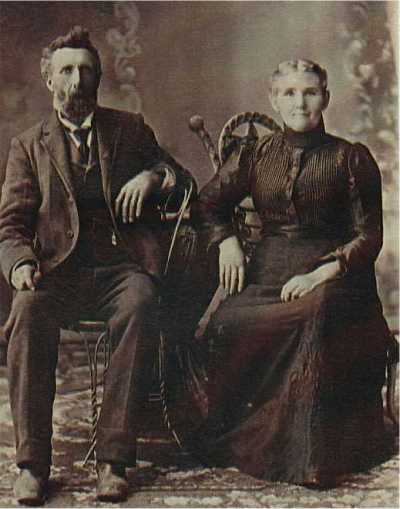 "Joseph W. Kelly was born on Feb. 29, 1855.
Mrs. Kelly (Margaret Jane Curry) was born in July, 1857 [both born in Ireland].
They were married in Canada and had six children when they came to Pickford
from Goderich, Ontario, 1880. They were the first settlers in the Fairview
area, at that time a wilderness. The six children that were born in Canada
were EDWARD, MARY, ELEANOR, GEORGE, BOB, and JOE. Three born here: ALBERT,
WESTLY, and MARGARET. "Joseph W. Kelly was born on Feb. 29, 1855.
Mrs. Kelly (Margaret Jane Curry) was born in July, 1857 [both born in Ireland].
They were married in Canada and had six children when they came to Pickford
from Goderich, Ontario, 1880. They were the first settlers in the Fairview
area, at that time a wilderness. The six children that were born in Canada
were EDWARD, MARY, ELEANOR, GEORGE, BOB, and JOE. Three born here: ALBERT,
WESTLY, and MARGARET.
EDWARD never married.
MARY married Jim Sanderson and had three children,
Westly, Russel, and Maggie.
ELEANOR married Jack Stevenson and had 13 children.
7 died during childhood and 6 grew to adults: Joe, Jack, George, Alvin, Esther,
and Mary. One of their babies, Edie, was the first baby to be buried in the
Fairview Cemetery.
GEORGE died at the age of 28 while working on the
Soo Water Power Canal. He is buried in Bethel Cemetery.
BOB married Kate Spence and had two children, Margaret
and Violet.
JOE married Mary Sims and had three children, George,
Joseph, and Ethel.
ALBERT married Barbara Pierce. They had 5 children:
Lloyd, Violet, Robert, Etta, and Orville. Violet died in her childhood.
WESTLY died in childhood.
MARGARET never married and is still living at the
age of 88.
Mr. and Mrs. Joseph W. Kelly picked up a homestead
where Lloyd Kelly lives now. Six years later they built a big log house on
the east end of the homestead, across the road from where their son, Joe
Kelly, now lives. They lived there until he died at the age of 75 in 1920.
Mrs. Kelly died at the age of 72 in 1919.
Joe Kelly married Mary Sims and homesteaded across
from his parents, where he still lives today. Mrs. Kelly died in June, 1962.
Mr. Joe Kelly, age 93, lives alone next to the homes of his sons, Joseph
William and George. George died in October, 1971, at the age of 58.
Mr. Kelly remembered when they first came that it
was a heavily wooded area with only trails through the woods. They came from
Goderich on the boat that goes to the Soo. They stopped off at Sugar Island
and stayed overnight with an Indian family. Mr. Stirling brought them from
Sugar Island with a tug to Stirlingville. Mr. Robert Campbell brought them
with their belongings about half-way from Stirlingville to Fairview with
his oxen. They didn't have any neighbors for a while, until Richard McConkey
moved next to them.
There have been four generations of Joe Kelly's living
in this same location. Three generations are still living: Joseph R. Kelly,
Joseph W. Kelly, and Joseph C. Kelly."
...Quoted from A History of Pickford Area Pioneer
Families 1973. The full text is unaltered from the last update in
1973 and is presented on the internet at
http://pickford.icomm.ca/history/
for the first time. No update work has been attempted in recent years, but
the door is open to anyone who wishes to. This site is the product of a Pickford
FCCLA project undertaken by Wendy Galer and Daniel Morrison and assisted
by Angie Mishler and Sara Ramsey. The project won a gold medal at the 1999
Michigan FCCLA State Leadership Conference. |
ROBERT KINGHORN
INDEX
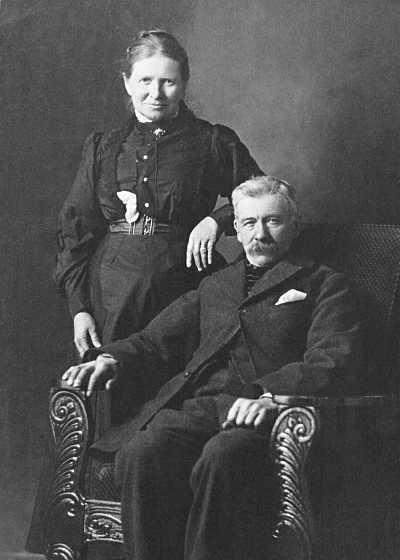 Part of
this was furnished by Mrs. Thomas Kinghorn, Soo, Michigan, August,
1969. Part of
this was furnished by Mrs. Thomas Kinghorn, Soo, Michigan, August,
1969.
Tom' s parents, Mr. and Mrs. Robert Kinghorn, came
to Stalwart from Colburn, Ontario, and homesteaded 160 acres. Mr. Kinghorn
had come from Scotland and married in Canada not long before.
They sold John McEvers 80 acres not long after they
came. Mr. Kinghorn was a carpenter by trade. He built his own house, also
the McEvers' house. Tom can remember when they brushed and corduroyed the
road. They hewed their own logs; no shingles were available, and they had
to split and whittle (with a knife), shakes about four feet long for the
roof.
Thomas and Ellen Kinghorn, brother and sister of
Robert Kinghorn, came from Scotland, but they didn't stay long, and went
back to Scotland.
Mr. Henry Carr and Robert Kinghorn used to walk to
the Soo to do carpenter work for 50 cents a day. They walked around by the
sand ridge trail to get to the Soo. They walked home on Saturday night and
back on Sunday night. One night they saw two wildcats fighting in the path
ahead of them.
Tom remembers when he bought 200 pounds of pork for
$2.00 and beef was a half a cent a pound for front quarters and 1 penny a
pound for hind quarters. Tom's mother was a tailor by trade. She did a lot
of sewing for neighbors - if paid at all she got 5O cents a garment. She
even made ladies corsets. Tom remembers one night when Tom Reynolds came
in early evening with some full cloth (heavy Soo Woolen Mills cloth) to have
a pair of pants made. While he and Dad Kinghorn talked in the kitchen, she
made them and pressed them and had them ready for him when he left.
Mrs. Hall was sick one summer and Mrs. Kinghorn took
care of her at night, walked through the woods coming home each morning.
She acted as midwife and also laid out the dead.
Robert Kinghorn and wife had two children in the
first school census in 1883. Minnie, aged 10, and James [transcibed incorrectly,
s/b Jennie], aged 7. Mrs. Kinghorn died early in their life in Stalwart,
and was the first body interred in the Stalwart cemetery [see comments in
Robert G. Crawford history, and insert on Stalwart Presbyterian Church].
The second Mrs. Kinghorn, Anne McEvers, (Tom's mother), was sister to John
McEvers. Her children were: Nellie, Agnes, Robert, William, Tom, Aaron, Arthur,
and Wilford. Mrs. Kinghorn used to walk to Prentis Bay for groceries. One
time she carried 50 pounds of flour. Robert Kinghorn did carpenter work for
neighbors. About the last job he did was the building of the Raber Township
School in 1900.
photo of Robert Kinghorn and Annie McEvers, provided
by Beverly Kinghorn, Esko, MN
| Stalwart Presbyterian Church
"When Mrs. Robert Kinghorn died in the new community
of Stalwart, Michigan, there wasn't any church in which to hold funeral services
nor a pastor to conduct a service. This led to a meeting of some of the pioneers
in Thomas Forgrave's home. Among those present were Mr. and Thomas Forgrave,
Robert G. Crawford and J. J. McKenzie. As a result of this meeting, the Stalwart
Presbyterian Church was organized on March 12, 1883. For the church building,
tamarack logs were cut on the homestead of Mr. and Mrs. Andrew Sims and hauled
to the site donated by Thomas Forgrave. Mr. Forgrave and Robert Crawford
donated adjoining half acres for church grounds. What lumber was needed was
hauled from Swart's sawmill at Prentiss Bay. The charter members were Mr.
and Mrs. Robert C. Crawford, Mr. and Mrs. Thomas Forgrave, Henry H. Hall,
Robert G. Kinghorn, Mr. and Mrs. Alexander McWilliams, and J. J.
McKenzie.
Sometime between March 11, 1883, and June, 1890,
the session records were destroyed by fire together with some money $7.00
belonging to the session. On June 11, 1890, a congregetional meeting was
held for the purpose of adopting a constitution and by-laws and election
of officers. The following officers were elected by unanimous agreement:
R. G. Crawford, elder; Thomas Forgrave and Henry H. Hall, trustee and managers.
In 1934 the old log church had to be abandoned and the congregation leased
the vacant Methodist Church for one dollar a year. In 1954 plans were made
to build the new church. The men cut timber in the woods and the women raised
money as only church women can and now the church is finished and completely
furnished. The Stalwart Presbyterian Church is a member of the Mackinac Yoked
Parish and is served by Pastors Walter, Venn, and Wartes."
...Quoted from A History of Pickford Area Pioneer
Families 1973. The full text is unaltered from the last update in
1973 and is presented on the internet at
http://pickford.icomm.ca/history/
for the first time. No update work has been attempted in recent years, but
the door is open to anyone who wishes to. This site is the product of a Pickford
FCCLA project undertaken by Wendy Galer and Daniel Morrison and assisted
by Angie Mishler and Sara Ramsey. The project won a gold medal at the 1999
Michigan FCCLA State Leadership Conference. |
JOHN O'NEIL
INDEX
By Mrs. Charles H. Smith (Lulu O'Neil)
John O'Neil was born January 7, 1849 and died October
3, 1931. His wife, Margaret Deborah Boskill, died September 12, 1912. They
came to Sault Ste. Marie with two children, John aged 9 and James A., aged
7, from Port Hope, Ontario. They walked from the Soo to Stalwart carrying
all their belongings with them. O'Neil built a small log house and a log
barn. Later, they built a two story frame house. Mrs. O'Neil grouted the
house with lime and sawdust, and her hands were severely burned by the lime,
but it had to be done. John was a blacksmith, and used the log house for
a blacksmith shop. He cleared half of his quarter section and sold a forty
to a relative, Otto Thompkins. Thompkins was a handy man. He made cedar cisterns,
sleighs, and most anything a neighbor needed. His forty had large cedar trees,
and he made railroad ties from them. He used a maul and iron wedges and by
splitting the large eight foot blocks he made as many as twenty four ties
from one tree, for which he got 25 cents a piece, delivered, at Raber.
John O'Neil, Jr., lived in a house across the road
from where the Raber Twp. School was later built, but he went to the Canadian
Northwest, and his property went back to the original O'Neil farm.
James A. went into business in Pickford, and later
went to Seattle, Washington. Other members of the O'Neil family were Norman,
who lived in Port Huron, Laura married Ben Sachett and lived in Chassell,
Soo, and Battle Creek. Lulu married Charles H. Smith. She still lives in
the Soo with her daughter, Elva. Annie married, and now lives in Orlando,
Florida. Lorne lives in Detroit.
Thomas Boskill, Mrs. O'Neil's brother, homesteaded
the northwest corner of Stalwart corner, later known as the Reynold's
place.
WILLIAM THOMAS BOSKILL
INDEX
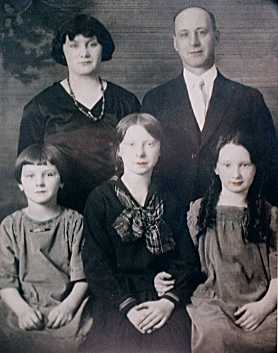 THOMAS BOSKILL, Jr. (son
of homesteader Thomas Boskill) THOMAS BOSKILL, Jr. (son
of homesteader Thomas Boskill)
wife Inez Mary Coulter, children Elizabeth Inez,
Irene Josephine, Dorothy Bernice
contributed by grand-daughter Jane Sanford
Harrison |
ALFRED COTTON
INDEX
Alfred and Mae Cotton came to Stalwart from Canada.
Although they were not among the early homesteaders, they were early settlers.
They bought the north half of Joseph Storey's homestead and built their home
near the spring known as "Diamond Spring."
Alf was a steam engineer and sawmill owner, and built
his sawmill near the spring for water for his steam power. His biggest log
was a pine log sixteen feet long that was too large to float down the Munoskong
river with the other logs, and laid in the river for a long time between
Hall's and Kay's. Each spring the spring flood would move it farther down
stream. One spring an unusually deep flood brought it into Jim Hall's yard.
He rolled it out of the river, loaded it on a dray, and took it to Cotton's
mill. It was too big to get inside the mill, so it was split into four pieces.
When sawed into lumber, it scaled 1,100 board feet.
Cotton's had a family of four. They were Dolly, Clara,
Don, and Eva. They also raised a nephew of Mrs. Cotton, Jack Thomas.
Alf also had a mill at McWilliams' spring, where
he sawed the hemlock and elm logs from the McWilliams' place for a lumber
company in Raber.
When the Cotton's sold their farm and retired, they
moved to Sheboygan, Michigan, and lived with their daughter, Eva. After Alf
died, Mae came back to Pickford and lived with Dolly. She was over ninety
when she died.
JOHN McEVERS
INDEX
John McEvers came to Stalwart from Canada near Guelph.
John was a brother of the second Mrs. Kinghorn. He married Mary Ann Hanna
and they had two children, George and Margaret. John bought a half of the
Kinghorn homestead, but as Robert Kinghorn had built his house on the half
that John McEvers wanted, they ran their line on a diagonal, northwest and
southeast, and Kinghorn kept the north half and McEvers had the south half
which he wanted, and everybody was happy.
John McEvers was the last farmer to change from oxen
to horses. His last yoke of oxen were called Buck and Bright. Other oxen
in the pioneer days were Star and Spot owned by R. G. Crawford, and Jack
and Jerry owned by James Y. Hall.
John McEvers was the undertaker for the Stalwart
community. When someone died, John was usually the first neighbor to come
to the home, and he stayed with the family until the last nail was set in
place by the screw driver in John's hip pocket. John was very thorough in
every thing he did. He never gave his solemn promise to do anything or to
go anywhere, it was always, "Yes, as far as I know." He said that there was
always an uncertainty about the future.
JOHN POGUE
INDEX
John Pogue came to Stalwart with his wife and family
from Canada and bought the south half of the John Johnston homestead. Mrs.
Pogue was a daughter of Mr. and Mrs. George Tompkins. Their family consisted
of: Percy, Gladys, Jennie, Laura, Fairly, and Lena.
John's farm was small and hard to work, so he had
to find outside work. He worked in the woods in the winter and worked at
whatever jobs he could get in the rest of the year. One of his jobs was helping
Al Tripp with his threshing machine and sawmill. He was a good teamster and
a good caretaker of horses.
He bought a farm in the Sunshine area, and they lived
there for some time. Finally, they moved to St. Ignace. In his old age he
was a familiar figure, fishing off the ferry dock. Mr. and Mrs. Pogue both
died in St. Ignace.
NEIGHBORS
To the north of Stalwart and toward Pickford was
the neighborhood known locally as Fairview. In Fairview were the Brindley's,
Flood's, Ames', George Sims', Barton's, Ball's, Nalley's, Kelly's, Campbell's,
Cochran's, and McConkey's.
The other way towards DeTour was the Spence Settlement.
Across from Leaches swamp were Leaches', Bank's, Butler's, Carey's, Bell's,
Crisp's, Moore's, Spence's, and Wahl's.
There is much that could be said about these good
neighbors and the interchange of work and pleasures, but we have to draw
the line somewhere, so we are confining it to patrons of the Stalwart Post
Office.
| Stalwart Businesses
"The first recorded postmaster was John McKenzie
in 1890 through 1894. Thomas Forgrave was next from 1894 to 1900. Then his
son, Thomas Rothwell, bought and kept it until 1925. In 1925 Chester Crawford
became postmaster. In 1946 his son, James C. Crawford, took over and is the
present postmaster.
A grocery store has always been operated along with
the post office. William Tolberth opened the first gas station in Stalwart
when he was postmaster.
Other places of business in Stalwart were a blacksmith
shop at what is now the corner of M-48 and the Bill Crawford farm. John McKenzie
was the owner in 1888 before he had the post office. George Henry had a
blacksmith shop on the opposite side of the road from 1909 to 1920.
A sawmill was run by steam and owned by Alfred Cotton
near Robert O'Brien's before 1900. In 1900 Mr. Cotton moved his mill to Diamond
Springs corner. James Storey had a shingle mill on the other side of the
Springs. Al Tripp had a sawmill in Sand Ridge in 1913. In 1940 James Storey
started another shingle mill and saw mill on the East Branch of the Munuscong
River, two miles east of Diamond Springs.
Russell Sims opened a gas station in 1935, later
adding a grocery section. In 1956 he sold it to Mason Storey, who later sold
it to John Williams."
...Quoted from A History of Pickford Area Pioneer
Families 1973. The full text can be found on the internet
at http://pickford.icomm.ca/history/
. |
SCHOOLS
The first School District was organized in 1882,
and the first classes were held in May, 1883, with Evaline Hall as teacher.
(See the minutes and contracts of the first schoolboard.) According to papers
found in James Duncan's trunk, it would seem that there had been some thought
about making one school district in the community, although a part of the
community was in what was called DeTour Township. But the District was made
entirely in Pickford Township. The pupils who went to the school from DeTour
and Raber townships paid tuition. At first the school term was for three
months and later extended to five months. In 1899 the Raber Township Board
of Education opened a school over Forgrave's store, the term extending from
September, 1899, to February, 1900. During the summer of 1900, the Raber
School hired Robert Kinghorn to build a school on the farm of Robert G. Crawford,
and school began there on September 1st.
Among the first teachers in the District 13 School
were Evaline Hall, Elizabeth Banks, Martha A. Willoughby, Annie Miller, Oscar
Edgar, Minnie Duncan, Ted Brown. Pupils at that time went to the "Tripp School";
to Ted Brown in the summer of 1899, the fall of 1899 to Raber Township School
to Ted Brown, the spring and summer back to the Tripp School, and fall and
winter to Raber Township again. Always to Ted Brown, six terms in all.
| Stalwart School
"Around 1898 the children of Stalwart first went
to the Stalwart District school located on the Tripp farm about one mile
south of Diamond Springs Corner. This school was later called the Tripp
School.
In those days the children and teacher had to walk
to and from school, but now transportation is provided for them. They did
not have school nine months of the year as we do now. School started around
the 15th of April and ended the last of June, then started again in September
and ending in the latter part of November when the cold weather set in.
In 1899 the country was divided into Townships, so
the children of Stalwart and Raber Township had classes above the old post
office in Stalwart. Mr. Edward Brown was the teacher there at that time.
Meanwhile a new school was being built by Robert Kinghorn. This school was
a frame building 24' x 30'. It was completed in time for school to open in
September of 1900 and classes were held there the full nine months.
Some of the families sending their children to this
school were the Forgraves, Martins, Crawfords, O'Neils, Kinghorns, and Halls.
Edith Sprig, Mr. Holt and Mrs. Maltas were some of the teachers that taught
in the Stalwart School. Their salaries were about $30 a month.
In 1941 it was decided to sell the old school house
and buy a larger one from Cedarville and have it moved to the present location
about a quarter mile south of the Stalwart post office. Bernice Crawford,
Robert Beacom, and R. B. Crawford were the teachers for eight years, followed
by Mrs. Ford Bawks. The Stalwart School was closed in 1956 and the students
transported to the new Raber School and then to Pickford."
...Quoted from A History of Pickford Area Pioneer
Families 1973. The full text can be found on the internet
at http://pickford.icomm.ca/history/
. |
RECREATION
In the early days of Stalwart, what recreation the
people had, they made themselves. They co-operated in clearing land, in raising
buildings, and in threshing grain. When a house was to be built, the logs
were assembled at the chosen site, then the neighbors chose sides and proceeded
to raise the building. There had to be four corner men, chosen for their
skill with the axe. Each corner man cut his end of the log so that it dovetailed
with the log it joined. They cut them on a bevel so they locked and couldn't
fall apart. The houses were later hewed on the inside and outside so the
walls were smooth. Perhaps the contract between Philip Waybrant and the School
Board can show how a log building was finished. The logging bees were to
clear the land of heavy logs that one man couldn't handle alone. The logs
were brought together with horses or oxen, and the men piled them in heaps
for burning. The threshing machines were owned by one or two men who went
from farm to farm and the neighbors helped each other. It usually required
twelve or fifteen men for a threshing. The first threshing machine in Stalwart
was run by horsepower, the horses traveling in a circle turned a sort of
capstan which supplies the power. For all these bees and threshing, there
had to be food, and that was where the women had their part. There didn't
need to be as many women as men, but it was an opportunity to get together
and visit, so there was always enough help. After the logging bee or raising,
the people hurried home to get the chores done and get back for the dance,
because there was usually a dance after the bee. There had to be someone
to furnish the music and to call off for the square dances. If there wasn't
a violin, there were mouth organs, and they had fun. People were just as
happy then as now, or maybe happier. Their wants were fewer, and no one was
in want if his neighbor knew of his need. On the Fourth of July there was
the annual picnic in McKenzie's grove. Families came with their food, and
a long table was set up and the food all mixed so no one family ate by
themselves. After dinner there were swings for any who desired it. There
were contests of many kinds, and usually a ball game. It could be a home-made
ball and bat. Maybe someone had a mit, but it was quite likely that someone
would get a finger or thumb out of joint. Another get together exclusively
for the women was the quilting bee. That needs no explanation, because they
still have them. I have tried to make this as interesting as I could. I have
tried to get something about each family that had a part in making family
history in Stalwart. I especially enjoyed visiting Thomas A. Forgrave, the
first child born in Stalwart, Mrs. Mae Warren (Maggie Mae Johnston), Mrs.
W.A.Evans (Kate McKenzie). They enjoyed our talking about the early days
of Stalwart, too. I tried to get some information about Beggs, who homesteaded
across the section line from Storeys; William Clark, who was active in the
first school meetings; George Nickols (Lulu (O'Neil) Smith said he was 'Uncle
George'); and Henry Carr, who bought the northwest quarter of section 6-42-2
east from the railroad. Carr's had one son, Cecil. They sold their place
to Thomas Forgrave and moved to Zion, Illinois.
| Stalwart Fair (Best Little Fair in
Michigan)
"The Stalwart Fair was started in 1906. An Agricultural
Society was organized to carry on the work of the fair. Those who were admitted
were Alex Sims, R. G. Crawford, William Clark, Robert A. Sims, Thomas Forgrave,
Chester C. Crawford, and James Richardson. The main purpose of the fair is
an important and colorful part of our American tradition. Generations of
Americans have come to love and eagerly look forward to what is coming each
year. The County Fair is much more than entertainment, however. It serves
an important educational function in many ways. It is a valuable competitive
spur to farmers, young and old, to do their utmost in increasing the quality
of our already excellent farm products. Today the County Fair is of great
interest to city dwellers, as well as to farmers. The County Fair, therefore,
has become a meeting place between our state, city, and rural dwellers. It
is indeed an important event in the lives of the people in this
district."
...Quoted from A History of Pickford Area Pioneer
Families 1973. The full text can be found on the internet
at http://pickford.icomm.ca/history/
. |
REMEMBRANCES
I remember the first Threshing Machine, owned by
Bob Hewer. It was a horse-powered machine driven by horse going in a circle,
and a man on the seat in the center of the circle with a whip in his hand
keeping the horses going. Part of the old machine lay for years on the side
of the road at the north west corner of the Bill Waybrant homestead in Mackinac
County. Grandfather Crawford had his shoe shop in the front room of his house,
the new one he built on the south side of the river, near the road. The cobblers
bench was in front of a large two-sash window. The different kinds of leathers
were in piles along the wall. The bench was low, and had a seat in one end
made by a hole cut into the top and filled with brown leather, which was
tacked all around, making a depression to sit in. On the other end were
compartments for the different kinds of tacks and pegs. Then there was an
assortment of lasts and bristles and shoemakers wax and linen thread. He
showed me how to make a waxed-end using a bristle which was about five or
six inches long, and a linen thread and wax. He said the bristles came from
the backs of wild boars. He always put a bristle on each end of the thread
so that he could sew from both sides using both hands. The thread was made
of several strands of thread twisted together, depending on how strong a
sewing thread he wanted. The strands were twisted by rolling the threads
together on his knee. Grandfather or father made all my shoes until I was
old enough to earn money to buy my own. Father learned the shoemakers trade
from his father. While living in Canada, father made a pair of boots for
Dave Stevens, who later came to Pickford and had a blacksmith shop near the
bridge. He put Dave's initials on the soles of the boots with nails. Later
Dave wanted to go with a gang cooning apples, and came to Father to have
him take the initials off the boots for fear they might incriminate him.
WILD DOGS OR FOX DOGS
There was a period around the turn of the century
when there developed a pack of wild dogs. No one knew where they came from,
or how they got started, but a lot of domestic farm dogs left home and ran
with them. Some of them never came home, presumably they had been killed
by the pack or shot by some farmer. They seemed to be only in the area around
Stalwart, and they became a real pest because they would travel mostly at
night and kill sheep, pigs, and fowl. Different neighbors captured pups from
time to time, and tried to tame them, but that didn't prove very satisfactory.
Richard Hanna got two or three of them and tried to domesticate them, but
gave up and decided to hang them. So he rigged hangman's rope on the underside
of a ladder, but had difficulties that way, too. The pup would swing up and
get his paws on the rung of the ladder to take the strain off his neck. So
Mr. Hanna had to get up on the ladder with a stick and rap his toes, saying
"Put your feet down Sir. Sure you'll never hang with your feet up there."
Alex McWilliams, Sr.'s old pony, Jack, died and Ham Hall got the carcass
over on the Sand Ridge and salted it good with strychnine after the wild
dogs started coming to eat on it. That ended the wild dogs.
THESE LISTINGS WERE TAKEN FROM THE MINUTES BOOK
OF THE FIRST SCHOOL OF STALWART, MICHIGAN
SCHOOL DISTRICT No.13, TOWNSHIP OF SAULT STE.
MARIE
April 6, 1881
The qualified voters of District No. 13 assembled
pursuant to notice for the purpose of electing district officers.
Moved by Philip Waybrant, seconded by J. J. McKenzie
that Mr. John Crawford act as Chairman. Carried.
Moved by John Johnson, seconded by John Scott that
Philip Waybrant be Moderator. Carried.
Moved by John Oneil, seconded by William Clark, that
Thos. Boskill be Moderator.
Moved by Philip Waybrant, seconded by John Johnson
that John J. McKenzie be Director. Carried.
Moved by John Johnson, seconded by Robert Kinghorn
that Wm. Scott be Assessor. Carried.
Moved by John Oneil, seconded by Wm. Clark that Thos.
Boskill be Assessor.
The above officers duly elected have filed their
acceptance of office.
Notice of formation handed by Philip Waybrant to
Chairman and by Chairman to the Director.
John J. McKenzie, Director
Syned: John Crawford, Chairman
May 18, 1881
Moved by John Oneil, seconded by Wm. Scott that the
school site be on Philip Waybrant's lot on the east line, 30 rods from the
southeast corner. Said site to contain 1/2 acre. Said lot to be square and
the south side of said lot to be 30 rods from the SE corner. (The same to
be leased.)
Moved by John Oneil, seconded by Wm. Scott.
Carried.
Moved by John Oneil, seconded by Wm. Scott that the
job of a school house be let to the lowest bidder. If the bidder is reliable
said job to be let at the school site on Saturday, the 21st of May... Said
schoolhouse to be 20 ft.x 24ft in size, 10 ft wall.... Carried.
May 31st, 1881
Moved by Joseph Storey, seconded by John Oneil that
the school site be leased for 10 years from Philip Waybrant for the yearly
rent of one dollar --$l.00. Carried.
Moved by Joseph Storey, seconded by John Oneil that
the job of building of a school house be left over until the annual school
meeting. Carried.
Sept. 5th, 1881
Moved by Jos. Storey, seconded by Richard Hanna that
Thomas Boskill be assessor for the incoming 3 years.
Moved by John Scott, seconded by Wm. Scott that Joseph
Storey be assessor for the incoming 3 years. Carried.
Moved by Wm. Clark, seconded by R. Hanna that all
hands turn out on 13th September to cut logs for school house. 20 x 24 ft.
outside Carried.
September 24th, 1881
Moved by P. Waybrant and seconded by John Johnson
that Joseph Storey be or act as director at this meeting. Carried.
Moved by John Johnson and seconded by Thomas Boskill
that we borrow One Hundred and Fifty Dollars ($150.00) for the purpose of
building a school house, to take effect immediately. Carried.
For Thirty Dollars ($30.00), John Johnson agrees
to take out logs for the school house and hew them, the bottom side logs
to be hewed on the upper side and also to clear the ground.
February 26th, 1882
Job of finishing school house let to Philip Waybrant
for the sum of $109.75 - to be finished by the 24th of May 1882.
School District No. 13
CONTRACT...
made and entered into between PHILIP WAYBRANT OF
THE TOWNSHIP OF SAULT STE. MARIE, In the COUNTY OF CHIPPEWA and STATE OF
MICHIGAN and JOHN J. MCKENZIE AS DIRECTOR OF SCHOOL DISTRICT NO. 13 of the
TOWNSHIP OF SAULT STE. MARIE in the COUNTY OF CHIPPEWA and STATE OF MICHIGAN
and his successors in office, to finish the school house.
The work would be as follows: Sleepers to be got
out and put in - hewed on one side, 2 ft. centers large enough to size 6
inches at top end. Sleepers to be good straight cedars - Floors to be double
- well laid - joints to be well broke, and well nailed -- Roof to be well
put on with good shingles well nailed. (Shingles to be 16 inches by 5 inches
to weather) boards to be laid close and well nailed. Rafters to be poles
peeled and 2 ft centers. Pitch of roof, third pitch. Gable ends to be boarded
upright and cracks battoned - - four openings for windows and one for door
to be cut in walls - frames made for same - Cased on 2 sides. Door to be
batton door, tounged and grooved - 3 battons - sash to be made for 12 x 14
lights and door to be hung with good strap hinges and latch fastenings and
good lock. Sash to be fitted and glazed -- 12 lights to each window. Beams
to be 2-ft. centers hewed to 5 x 6 inches, well pinned at the ends. Walls
to be chinked and well plastered inside and outside with lime and sand (the
sash to be primed and well glazed) long cedar sleepers to be laid for the
other sleepers to bear on -to be well blocked up - windows and doors to have
jamb on outside of casing on the ends of logs - door to be in end of the
building next to the road.
To be finished on or before the 24th of May,
1882.
Job let for One Hundred and Nine Dollars and Seventy
Five Cents ($l09.75) to Philip Waybrant.
Signed Philip Waybrant - Contractor
John Johnston ) Directors - Witnesses
John J. McKenzie)
Present at the meeting were -- Richard Hanna, John
Johnson, William Scott, Philip Waybrant, Robert Kinghorn.
April 12th, 1882
Moved by Philip Waybrant, seconded by Joseph Storey
that the district borrow Two Hundred Dollars ($200.00) for five years - interest
payable yearly and that district give bonds for the same.
Yeas - -
Richard Hanna
William Clark
James Duncan
John Johnson
John Scott
John Oneil
Robert Kinghorn
William Scott
June 5th, 1882
The district has borrowed the sum of $200 from the
Wayne County Savings Bank, Detroit, Michigan for the term of five years,
with interest at 10 percent payable yearly.
The district board has also hired Miss Evaline Hall
as teacher for three months - at $20 per month.
School starts today, June 5th, 1882
CONTRACT BETWEEN DISTRICT BOARD AND
TEACHER
It is hereby contracted and agreed between the district
Board of School District No. 13 in the Township of Sault Ste. Marie, County
of Chippewa and State of Michigan, and Evaline Hall, a legally qualified
teacher in said township. That the said Evaline Hall shall teach the school
of said district for the term of three months, commencing on the 5th of June,
1882 and the said Evaline Hall agrees faithfully to keep a correct list of
the pupils and the age of each attending school. And the number of days each
pupil is present and to furnish the director with correct copy of the same
at the close of the school, and to observe and enforce the rules and regulations
established by the district board. The said district in behalf of said district
agrees to keep the school in good repair, to provide the necessary fuel to
keep the school house in comfortable condition, and to pay said Evaline Hall
for the said services as teacher to be faithfully and truely rendered and
performed, the sum of twenty dollars per month. The same being the amount
of wages above agreed upon, to be paid on the expiration of each month. Provided,
That in case said Evaline Hall shall be dismissed by the district board for
gross immorality or violation of the contract or shall permit her certificate
to expire or shall have her certificate annulled or suspended by the county
board of school examiners or other lawful authority. She shall not be entitled
to any compensation from and after annulment.
In witness whereof we have hereunto subscribed our
names this Fifth (5th) day of June, 1882.
Philip Waybrant)
John J. McKenzie ) District Board
Joseph Storey)
Evaline Hall - Teacher
return to index at top
CENSUS OF SCHOOL DISTRICT NO.13, PICKFORD TOWNSHIP,
MICHIGAN 1883
NO. NAME
AGE
1 Mary J. Duncan
9
2 Margaret Hanna
13
3 Archibald Begg
14
4 Agnes Begg
9
5 Edward Duncan
8
6 Thomas Waybrant
12
7 Rebecca Waybrant
14
8 Lizzie Hanna
6
9 Susanna Duncan
6
10 Minnie Kinghorn
10
11 James Kinghorn [s/b Jennie
Kinghorn] 7
12 James Oneil
7
13 Catherina Waybrant
18
14 William J. Hanna
16
15 Mary Ann Hanna
19
16 John Oneil
11
17 James McKenzie
5
18 John Hanna
18
19 Addie Crawford
16
20 Ida Crawford
11
21 Maud Crawford
9
22 Ruben Waybrant
16
Sept. 10, 1883
J. J. McKenzie, Director
I certify that the above is correct.
John J. McKenzie, Director
return to index at top

This transcription by
Skip Gottfried, great-grandson of Robert KINGHORN
and grandson of his daughter Agnes KINGHORN BROWN. April 1999, Memphis,
TN.
Text and photos last updated October
2002
If YOU can provide any further documentation relating
to the early STALWART community, or any of it's people, and would like to
see it presented and shared here on-line, please let me know, and I will
transcribe the materials. You can contact me at
witan1@aol.com, anytime.
|


