|
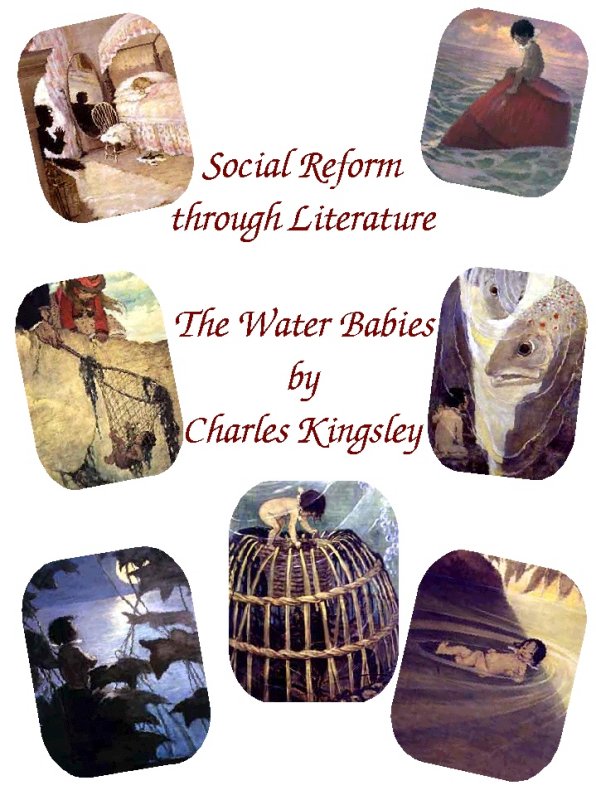
The Water Babies
Charles Kingsley’s Social Reform Fairy Tale
that my mother gave me to read when I was very young.
These illuystrations are part of a group of twelve works housed in the US
Library of Congress, in Washington, DC, by an American artist, Jessie
Willcox Smith (1863-1935) who drew them in 1916 to illustrate “The
Water-Babies,” a book written by the Reverend Charles Kingsley (1819-1875)
to draw attention to the child labour reforms needed in Great Britain
during the Industrial Revolution of the victorian era. My mother
encouraged me to read this book, borrowed from the Children’s Library on
Ward Road of the Dundee Public Library system during my Primary School
years. I have long remembered the story.
Written as a fairy tale for grownups about
children who were forced to work as chimney sweeps (as well as in mines
and factories) with no legal or social protections in the late 19th
Century, Kingsley recounts the magical and sad adventures of Tom, a child
chimney sweep. Tom escapes his cruel and painful indentureship when
fairies transorm him from a soot encrused and sad little boy into a
“water-baby.”
When I read this story in my childhood, I thought Tom had drowned and gone
to heaven, but now I believe Kingsley also intended to introduce the
concept of baptism: the cleansing of the soot being his ministerial
allegory through which Tom found happiness and peace with his new found
friends, other “water-babies” who had been rescued from their cruel
circumstances.
The Water Babies is considered classic
literature – which I hope some of “you lot” (Scottish expression I use for
my family) will read someday. According to the Library of Congress Catalog
regarding these illustrations, “Dozens of editions have since been
published, though none more beautiful or imaginative than that issued in
1916 by the New York publishing house of Dodd, Mead & Company, with
illustrations by Jessie Willcox Smith.”
A footnote to my family and to Kathie Hewitt, and to all my other friends
and employment supervisors who notice my crusading and windmill-tilting –
is it any wonder I’m the woman I am when my mother gave me stuff like this
to read and my Granny’s great heroines were Emmeline Pankhurst and her
daughters and their fellow suffragists?)
The Cry of the Children
(Elizabeth Barrett Browning)
Do ye hear the children weeping, O my brothers,
Ere the sorrow comes with years?
They are leaning their young heads against their mothers,
And that cannot stop their tears.
The young lambs are bleating in the meadows,
The young birds are chirping in the nest,
The young fawns are playing with the shadows,
The young flowers are blowing toward the west—
But the young, young children, O my brothers,
They are weeping bitterly!
They are weeping in the playtime of the others,
In the country of the free.
Do you question the young children in their
sorrow,
Why their tears are falling so?
The old man may weep for his tomorrow,
Which is lost in Long Ago;
The old tree is leafless in the forest,
The old year is ending in the frost,
The old wound, if stricken, is the sorest,
The old hope is hardest to be lost:
But the young, young children, O my brothers,
Do you ask them why they stand
Weeping sore before the bosoms of their mothers,
In our happy Fatherland?
They look up with their pale and sunken faces,
And their looks are sad to see,
For the man's hoary anguish draws and presses
Down the cheeks of infancy;
"Your old earth," they say, "is very dreary;
Our young feet," they say, "are very weak!
Few paces have we taken, yet are weary—
Our grave-rest is very far to seek.
Ask the aged why they weep, and not the children,
For the outside earth is cold,
And we young ones stand without, in our bewildering,
And the graves are for the old."
"True," say the children, "it may happen
That we die before our time.
Little Alice died last year—her grave is shapen
Like a snowball, in the rime.
We looked into the pit prepared to take her:
Was no room for any work in the close clay!
From the sleep wherein she lieth none will wake her,
Crying 'Get up, little Alice! it is day.'
If you listen by that grave, in sun and shower,
With your ear down, little Alice never cries;
Could we see her face, be sure we should not know her,
For the smile has time for growing in her eyes:
And merry go her moments, lulled and stilled in
The shroud by the kirk-chime.
It is good when it happens," say the children,
"That we die before our time."
Alas, alas, the children! They are seeking
Death in life, as best to have;
They are binding up their hearts away from breaking,
With a cerement from the grave.
Go out, children, from the mine and from the city,
Sing out, children, as the little thrushes do;
Pluck your handfuls of the meadow-cowslips pretty,
Laugh aloud, to feel your fingers let them through!
But they answer, "Are your cowslips of the meadows
Like our weeds anear the mine?
Leave us quiet in the dark of the coal-shadows,
From your pleasures fair and fine!
"For oh," say the children, "we are weary,
And we cannot run or leap;
If we cared for any meadows, it were merely
To drop down in them and sleep.
Our knees tremble sorely in the stooping,
We fall upon our faces, trying to go;
And, underneath our heavy eyelids drooping,
The reddest flower would look as pale as snow.
For, all day, we drag our burden tiring
Through the coal-dark, underground;
Or, all day, we drive the wheels of iron
In the factories, round and round.
"For all day the wheels are droning, turning;
Their wind comes in our faces,—
Till our hearts turn, our heads with pulses burning,
And the walls turn in their places:
Turns the sky in the high window blank and reeling,
Turns the long light that drops adown the wall,
Turn the black flies that crawl along the ceiling,—
All are turning, all the day, and we with all.
And all day, the iron wheels are droning,
And sometimes we could pray,
'O ye wheels,' (breaking out in a mad moaning)
'Stop! be silent for today!' "
Ay, be silent! Let them hear each other
breathing
For a moment, mouth to mouth!
Let them touch each other's hands, in a fresh wreathing
Of their tender human youth!
Let them feel that this cold metallic motion
Is not all the life God fashions or reveals:
Let them prove their living souls against the notion
That they live in you, or under you, O wheels!
Still, all day, the iron wheels go onward,
Grinding life down from its mark;
And the children's souls, which God is calling sunward,
Spin on blindly in the dark.
Now tell the poor young children, O my
brothers,
To look up to Him and pray;
So the blessed One, who blesseth all the others,
Will bless them another day.
They answer, "Who is God that He should hear us,
While the rushing of the iron wheels is stirred?
When we sob aloud, the human creatures near us
Pass by, hearing not, or answer not a word.
And we hear not (for the wheels in their resounding)
Strangers speaking at the door:
Is it likely God, with angels singing round Him,
Hears our weeping any more?
"Two words, indeed, of praying we remember,
And at midnight's hour of harm,
'Our Father,' looking upward in the chamber,
We say softly for a charm.
We know no other words except 'Our Father,'
And we think that, in some pause of angels' song,
God may pluck them with the silence sweet to gather,
And hold both within His right hand which is strong.
'Our Father!' If He heard us, He would surely
(For they call Him good and mild)
Answer, smiling down the steep world very purely,
'Come and rest with me, my child.'
"But, no!" say the children, weeping faster,
"He is speechless as a stone:
And they tell us, of His image is the master
Who commands us to work on.
Go to!" say the children,—"up in heaven,
Dark, wheel-like, turning clouds are all we find.
Do not mock us; grief has made us unbelieving—
We look up for God, but tears have made us blind."
Do you hear the children weeping and disproving,
O my brothers, what ye preach?
For God's possible is taught by His world's loving,
And the children doubt of each.
And well may the children weep before you!
They are weary ere they run;
They have never seen the sunshine, nor the glory
Which is brighter than the sun.
They know the grief of man, without its wisdom;
They sink in man's despair, without its calm,—
Are slaves, without the liberty in Christdom,—
Are martyrs, by the pang without the palm,—
Are worn as if with age, yet unretrievingly
The harvest of its memories cannot reap,—
Are orphans of the earthly love and heavenly.
Let them weep! let them weep!
They look up with their pale and sunken faces,
And their look is dread to see,
For they mind you of their angels in high places,
With eyes turned on Deity;—
"How long," they say, "how long, O cruel nation,
Will you stand, to move the world, on a child's heart,—
Stifle down with a mailed heel its palpitation,
And tread onward to your throne amid the mart?
Our blood splashes upward, O gold-heaper,
And its purple shows your path!
But the child's sob in the silence curses deeper
Than the strong man in his wrath."
(Between discovering this poem and reading Charles Kingsley’s “The Water
Babies,” that my mother introduced me to when I was a young child, my
social conscience was born – and my family and friends have all been
suffering from it since every time I “go on a rant”!)
|



