|
REVIEW by Kris Gies, University of Guelph -
IRSS 31 (2006)
Robert Bruce MacColla MacNial MacIntyre, Six
Millennia, the History of the Gael: The Irish and the Scots Highlanders,
Markham, ON: Stewart Publishing and Printing, 2005. $34.99/USD, 206 pp.
ISBN 1-894183-70-3.
As the author Robert Bruce shows, the practice
of constructing and preserving clan histories is a phenomenon that is
often concomitant with one’s very Scottishness. A compelling case in point
is his Six Millennia, the History of the Gael: the Irish and the Scots
Highlanders. According to Bruce, in revealing this history, it is hoped
that an ‘ancient treasure’, a rich tradition of oral accounts and stories,
will be preserved for posterity. Furthermore, in doing so, he intends to
refute many enduring, yet inaccurate perceptions surrounding Gaelic
culture. It is suggested by the author that modern, formal historical
research has inadequately treated this issue, and that more traditional
methods as conveyed in his work will provide a more ‘authentic’ account of
Gaeldom’s early history. In the author’s words: ‘While I cannot speak for
all of the ancient and great Clans of the Celts I do know most precisely
what my own ancestors, the Eremonian (a branch of Gaeldom originating in
Northern Ireland) Royal Line of The Gael, believed, protected, and passed
down, at the highest cost.’ (p. 42)
Bruce’s introduction provides a historic
overview of the Gaelic/Celtic peoples of Continental Europe and the
Western Isles. This section begins with a treatment of the Druid Order who
were more than mere genealogists, but rather ‘the “glue” which held Celtic
society together.’ (p. 27) He continues by discussing, among other topics,
Celtic origin beliefs, clan organization, spirituality, legal practice
(also known as Cain or the Brehon Laws), dress and weaponry, and the power
of the ‘spoken word.’
Following this concise introduction to Celtic
culture is ‘a translation of the oral history of the Royal Eremonian line
of the Gael race.’ (p.15) This account begins with a traditional account
of the creation of the world and proceeds in retelling the history of the
Gaels from their origins with Noah of the Old Testament, through the
‘Eremonian line of High Kings and its major derivative braches within
Ireland, the Highlands of Scotland, and the Hebrides,’ up to Somerled, the
‘Lord of the Isles.’ (p.16) Within this history, a variety of issues are
addressed, including Druidic belief, Gaeldom’s conversion to Christianity,
and the importance of male bloodlines. The epilogue is devoted to
answering the main questions posed in Bruce’s foreword, such as the
origins of man, the Druidic/Gaelic name for God, and the source of Druidic
wisdom.
Although supplemented by translated works such
as Lebhor Ceud Toisech (The Book of First Beginnings) and Lebhor Gabalal
Eirinn (The Book of the Taking of Eirinn), the bulk of Bruce’s work is
derived from oral tradition, yet written in a highly formalized,
antiquated style. Yet, this should not dissuade interested readers, as it
is this style that helps make Bruce’s work more convincing, matching the
traditional, oral accounts from which it is derived. Furthermore, Six
Millennia serves as a modern-day example of the manufacturing of family
histories, as Bruce’s retelling of Gaelic biblical roots follows the
practice of Highland clans centuries prior.1 Lastly, the book’s appendices
- a full translation of The Book of First Beginnings, as well as a brief
genealogical and historical interpretation of clan coats of arms - offer
deeper insight into much material discussed by the author.
While readers who are expecting a formal
historical study may find themselves disappointed by the informal, deeply
religious nature of Bruce’s work, this does not mean that Six Millennia
should be avoided altogether. The tone, imagery and language employed by
the author amount to a modern, written retelling of traditional Gaelic
oral history. Within this compilation is a rich array of material that has
been carefully preserved by Bruce and his ancestors; it is in such
preservation that the true value of this work lay.
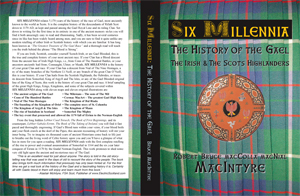
Six
Millennia
The History of the Gael
The Irish and Scots Highlanders
Auther : Robert Bruce MacColla MacNial MacIntyre
pp. 204
Illustrated
Hardback full glossy colour
Have thoroughly enjoyed reading such a well written, well researched
historic account of the story of the origin of the race of the Gael and
thus the Scot. I remain deeply moved by the depth of sincerity of belief
of the author in his work. That he is a Gael with a difference. There can
be no mistake!
To
tackle such a project without some uncanny insight into the real origin of
the Gael, defies explanation by normal standards. And to compress such
detailed history into 204 pages staggers belief.
As
one who has naturally researched my Gaelic roots over a period of some 45
years, and my Native Gaelic speaking fathers before me, I recognise most
if not all of the facts quoted within the explicit text. With few
exceptions, I give his work first class merit in clearly present
phraseology and clarity of meaning. With certain reservations, I
personally recommend it as a foundation for all those serious students of
the Gael seeking a special and vary rare insight into the truth of our
past, our ancestors, and the Royal Blood Line of the Gael.
Such a book is long overdue. I predict that it will effectively counter
most of the Gaelic/Celtic antagonism that has passed for Scottish history
ever since the Norman Invasion in c1066. I warmly welcome it on our
Library Shelves!
Ranald Alasdair MacDonald of Keppoch
Chief of the Honourable Clan Ranald of Lochaber
Mac Mhic Raonuill
Dun Eideann
Visit
the Six
Millenia of the Gael by Bruce MacIntyre web site |



