|
I have always viewed language as such a
precious entity. Endowed with a rich tapestry and heritage undergoing
constant reshaping as knowledge is created, distributed and valued as
the principle method by which we converse with one another.
To learn of a UNESCO warning that upwards of half the world's several
thousand languages are threatened with extinction by 2050 fills me with
a profound sense of alarm. As it should each and everyone of us.
UNESCO - Wikipedia
Around half my life ago I decided to spend
seven years, part-time, via The Open University to complete a Bachelors
of Art Honours Degree followed up by an Advanced Diploma in Language &
Linguistics, reinforcing my hopefully somewhat unpretentious passion
towards learning, always learning.
So, as I read the United Nations agency report highlighting the
Information Age, led by a nascent artificial intelligence as the main
culprit to such a global linguistic culling, my stance motivated me to
check out how Scots might survive, or not.
At the outset I was surprised to discover no one has comprehensively
made the connection between the Scottish language and the burgeoning
digital era despite all its disruptive elements.
Until now...
Novel research carried out by me reveals the language is set fair to
actually strengthen its position as the century evolves and AI continues
to influence how we connect in our daily lives. To the point of
threatening to undo centuries - if not millennia - of communications we
have all come to rely on and take for granted through the ages.
A trio of quotes highlighted illustrate the language's development
through the ages, reinforced by three inextricably-linked levels of
digital take-up, evident in a first-time Glossary I have compiled
featuring an initial one hundred examples of informal and more formal
appropriation.
This research, conducted over a three-month period, indicates a
sturdiness and highly-flexible adaptability towards such fundamental
change along with a unique standing in the world. Whilst, unfortunately,
other languages fall by the wayside.
The Scottish language embraces innumerable inflections and cadences
taking in the Gaelic, Highland, Doric, Borders, Celtic, Ulster Scots
together with influences including the Auld Alliance and other standout
universal strengths heightened by Scotland's global influence through
the Age of Enlightenment (1687-1789).
Fast forward over two centuries and the language's inherent flexibility
towards adapting through the times is evident. Frontrunners of the
information age are "Digital Natives" - born since 1980-81 - whip-cybersmart
Millennials and Generation Z and Alphas.
As they increasingly make the language their own, I was surprised to
discover, collectively they number at least two million in Scotland
alone, with Gen Beta, born between 2025-2039, expected to be fully AI
integrated and instrumental in further linguistically shaping the
mid-21st century onwards.
Quote - "It is an ancient and honourable tongue, wi rules deep i'
the yird; aulder than muckle o' the English", is how this pioneer in the
use of Scots in literature, through blending dialogue with standard
English narrative, highlights its historical significance resulting in a
multilingual, realistic portrayal of a post-Union Scotland popularising
Scots culture and dialect influencing European literature and elsewhere
in the world - Sir Walter Scott (1771-1832).
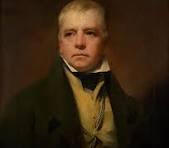
Sir Walter Scott, 1771 - 1832. Novelist and poet
Quote - "The Oxford English Dictionary
has lately given Scots-flavoured internet and social media words a wider
platform..not necessarily listing new words but old words" - Reddit
online global forum.
clever and smart man Vector Numbers, letters and formulas inside the
head of a man using a computer clip art of a computer geek stock
illustrations
Quote - "Millennials, Gen Z & Alpha are
programmed - and want to keep up with - rapidly changing technologies",
the late best-selling author and creator of the term "Digital Native",
who included Scotland in his exhaustively researched seminal global
essay on the cultural phenomenon and its profound impact on language -
Mark Plensky. |



