|
As I write, digital is rapidly coming of age
but what this means to the future wellbeing of communications remains to
be fully realised. Millennial techies might typically describe the loss
of a single language as "it disappeared into the ether", with a swift
dash of a computer key before rapidly moving on (see Glossary). Or, in
an example of what has become something of a digital native
coded/foreign language: "Really had to go onto insta and tik to talk
about this mic drop."
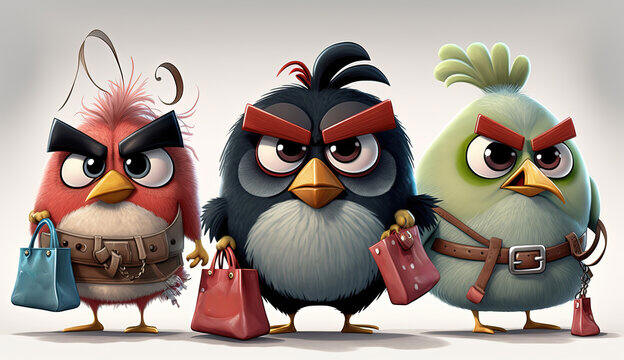
Angry Birds Cartoon
There is no stopping such digitally savvy
individuals with their online activity centred on software applications
- apps - continuing to grow exponentially. Where an ever-increasing
number of acronyms and abbreviated terms are endlessly microblogged,
texted and photos shared, in what's become known as #realtime on
innumerable social media platforms like TikTok, Instagram, Reddit, X
(formerly Twitter) plus extensive online/mobile channel activity.
Online discussions during "Angry Birds" in a virtual gaming arcade via a
purchased and very latest Nintendo Switch are enthusiastically embraced.
As AI continues to be hyped as a panacea for all our ills, ranging from
eliminating all diseases to reproducing human intelligence, the World
Economic Forum warns that as its adoption accelerates, we are all
ill-prepared for its impact as governance fails to keep up in what is
labelled as an era of "misinformation" and "alternative facts."
It's not stopping Big Tech marketers continuing to claim the phenomenon
represents the single biggest, most important "invention" in the history
of humanity. The Victorians might beg to differ!
Three Levels of Digital Take-up
When I embarked on my novel research, I fully appreciated it would be a
work-in-progress but didn't fully realise just how much would be the
Scottish language cyber take-up, as Digital Native-inspired expressions
continue to take on board terms and idioms once regularly found in
playground slang and beyond.
A further dimension and extra layer towards the language's survival
rapidly became apparent: how short forms and acronyms have not only been
picked up socially but also re-applied formally by the global technology
sector. To explain out often highly-complex online practices and tools,
software apps, and IT solutions.
It goes even further: there is already ample evidence of such terms
being employed within digital's still relatively new cyber cousin AI,
representing more evidence of the power of the Scottish language in
computational linguistics and language usage in terms of syntax, grammar
and phonetics.
Professional hands typing on modern laptop with glowing AI neural
network interface in atmospheric teal and amber lighting.

Carry-Over" Words Aplenty
Of course digital is not a new word. Originating from the latin digitus
meaning finger or toe evolving in more modern times to involve computers
using numerical digits from approximately the 1960s onwards. My glossary
lists an initial number of varying strengths of "carry over" clusters of
words, terms, phrases and idioms.
It is very much an informal list as the examples did not present
themselves in a tidy orderly fashion. In digital reality they cropped up
and popped-up the more my research advanced with scores more examples
unearthed but no room here to fully list.
Overall, a number may be coincidental even, at times, tenuous, but given
a ratio of, perhaps, 1:10 it still appears highly impressive in terms of
real strength-of-language. Also, there are some surprises along the way. |



