|
Introduction
If you walk the Bruce Trail
near Georgetown and go to trail 13, you will be walking on the land of the
Fallbrook Farm, known until 1943 as the McKay farm, or Uncle Sandy’s place.
It is an idyllic setting, renowned for its natural beauty and the fact that
the an original pioneer log cabin stills stands, in mint condition, hidden
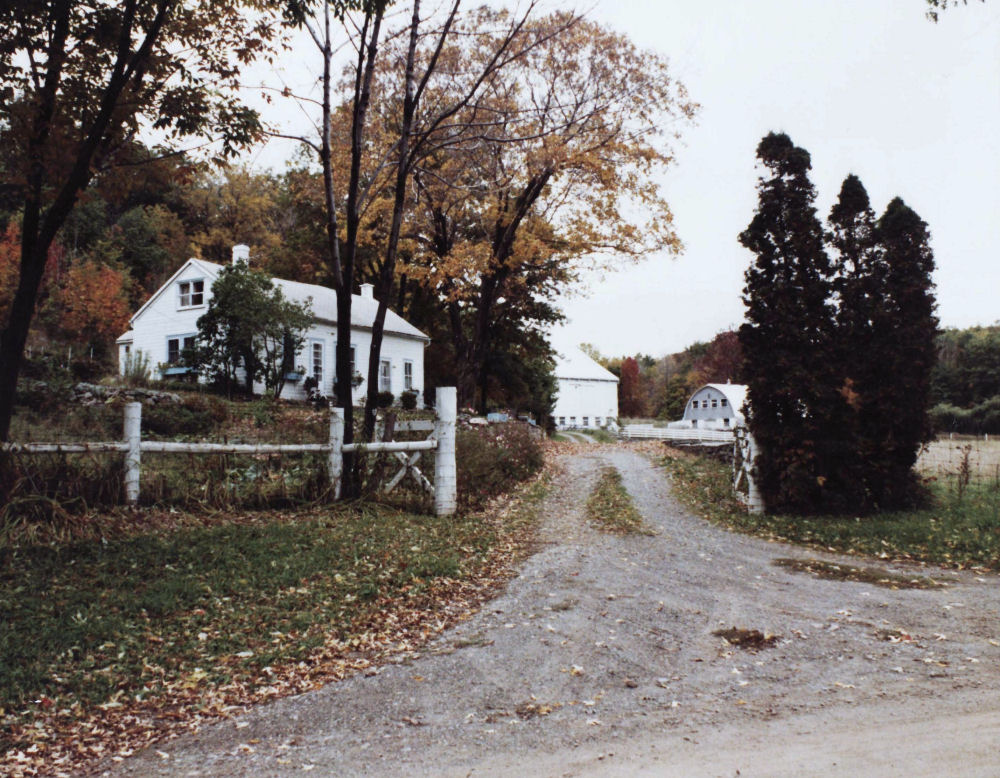
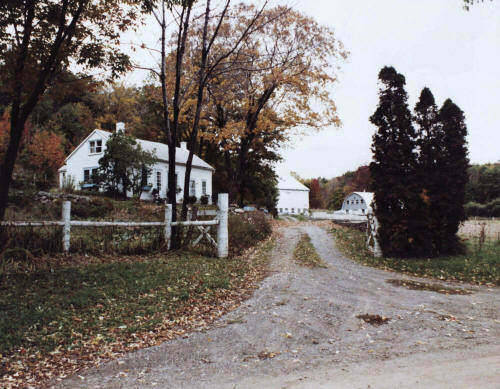
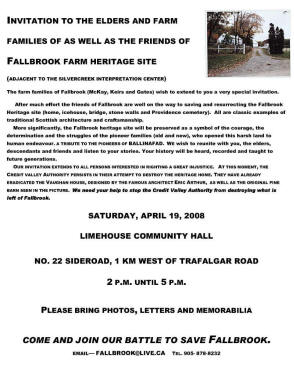
discretely by wooden siding. Until 1999 it looked exactly like you see in
this picture, but, tragically, the original barn was torn down. Since 2001
the home has been abandoned after 150 years of sheltering the farm families
who cleared and developed that inhospitable land. First settled in the
1850’s, the Silver Creek area, bordering on the Niagara Escarpment was not
well suited to profitable farming. The toil and struggles of the Scottish
immigrants, many crofters expelled from their homeland, who opened this
region has never been told or even recognised as historically significant.
The battle for Fallbrook is not only a quest to resurrect the homestead as a
living teaching museum but also as a memorial to these farm families, of
whom we are the descendants. The heritage site consists of the homestead, an
icehouse, classical highlander stone walls and an arch bridge over Silver
Creek, together with the Providence cemetery, on William McKay’s land, where
Donald, his wife and son William are buried.
The history of Fallbrook
The original tract of land
was purchased from the Canada Land Company in …... The family of William
McClure used it as a woodlot, but never settled there, having established
their family farm two side roads away. In 18??, it was purchased by the
John McDonald. We suspect it is he who chose the location and built the
original cabin. Fresh water was always a problem in the SilverCreek area, so
the proximity of the farm to SilverCreek would have been a major factor.
There was a huge stand of ancient pine trees just behind the front field.
The wood for the home and the original barn were taken from that pine
forest.
Donald McKay, my great
grand-father, together with his wife Jessie, emigrated from Glasgow,
Scotland in directly to Toronto, in 1869. After a short stint as a taxi
driver , he bought the tract of land at Silver Creek and moved his wife and
newborn son, my grandfather David, into the log cabin and began the arduous
task of creating a working farm. The McKay’s stayed for seventy years, until
my great uncle Sandy, in 1943, sold the farm for $10000 to the Vaughn’s of
the T.E. Eaton Company. The last farm family to work the farm were the Keirs,
who emigrated from the region of Aberdeen, Scotland. It is a coalition of
the McKay-Keirs, inspired by their matriarchs, Rachel Swann McKay and Cathie
Kier, and supported by a vigorous team of history buffs and justice seekers
who are leading the battle for Fallbrook. It is far from won but progress
has been made. To destroy this heritage jewel would be a tragedy.
Stories of the early life
Little information is
available on the day to day life of the early settlers of SilverCreek. We
can only imagine what it was like to arrive in those huge forests, and seek
to carve out a life and actually survive. Sheltering in a form of lean-to,
no roads, no stores near by, threatened by wild animals, devoured by bugs
in the summer and striving to stay warm in the bitterly cold winters, we can
only imagine from the cozy comfort of our modern homes what it was like.
With our resident historians and genealogists, Joan Kadoke, Graham Bruce (Durness,
Scotland) and Hilary Dawson, we are researching this story and tracing the
crofter roots of these early pioneers. But we do have the witness of my Aunt
Rachel, who spent many summers on the farm with my deceased father between
1925 and 1943. As memories come back and we meet other elders of SilverCreek,
we will add to this history. The Scottish Studies Department of the
University of Guelph is helping in this endeavour.. The surviving elders of
SilverCreek are all women over 80, keen and bright as the waters of
SilverCreek. Aunt Rachel continues to be a champion bridge player.
Fallbrook as related by
Aunt Rachel
Rachel would travel alone or
with my father by train from Owen Sound to Georgetown which took 4 hours.
She would be met by Donald’s son Sandy in a model T ford and driven back to
the McKay farm. The name Fallbrook became the common name during the reign
of the Keirs, who emigrated from Scotland to Fallbrook in …..As the Silver
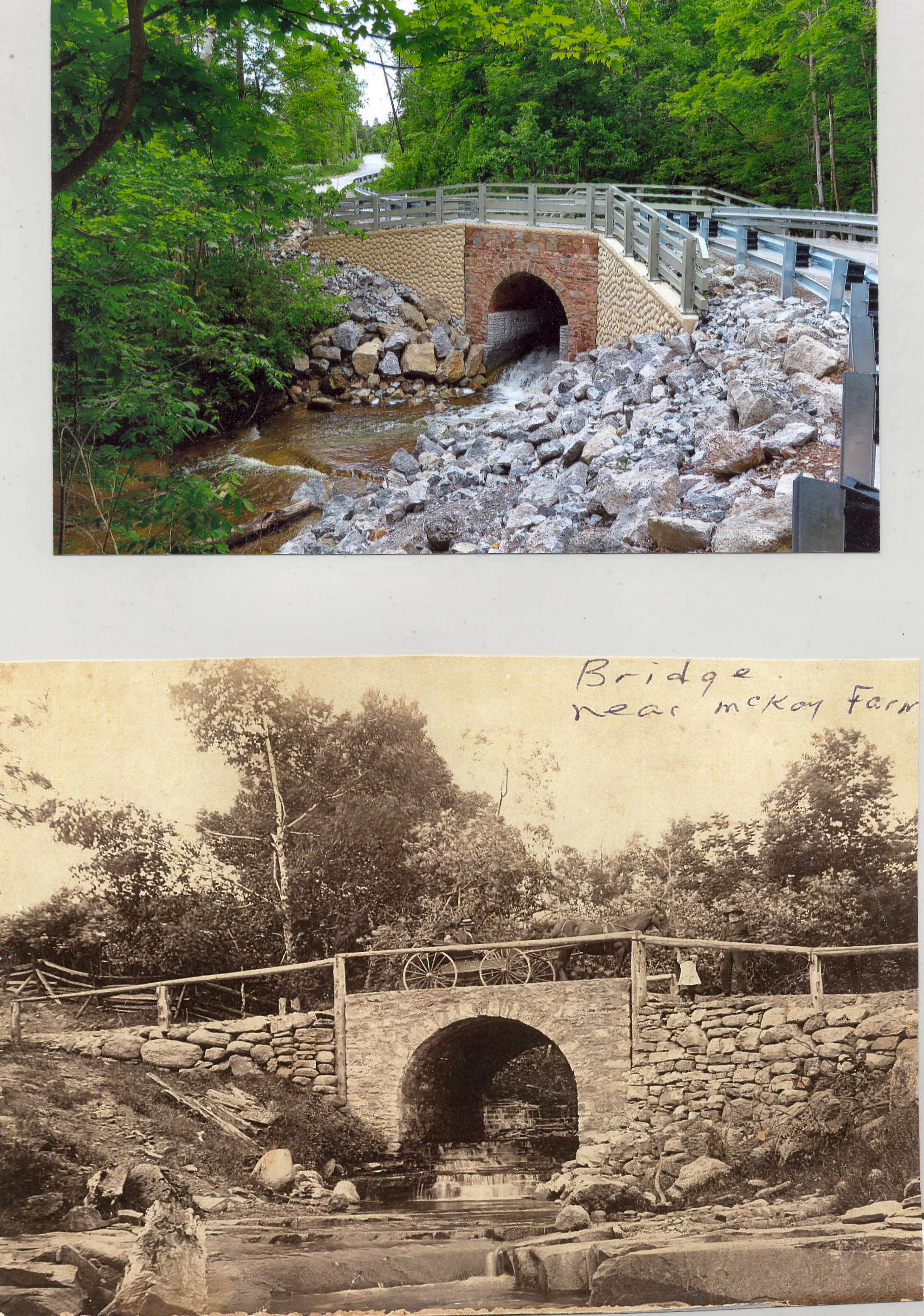
Creek descends step by step under the stone bridge, a classic example of
Scottish craftsmanship which can be
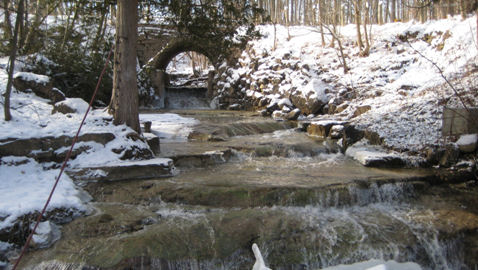
Old Bridge re-built 2015
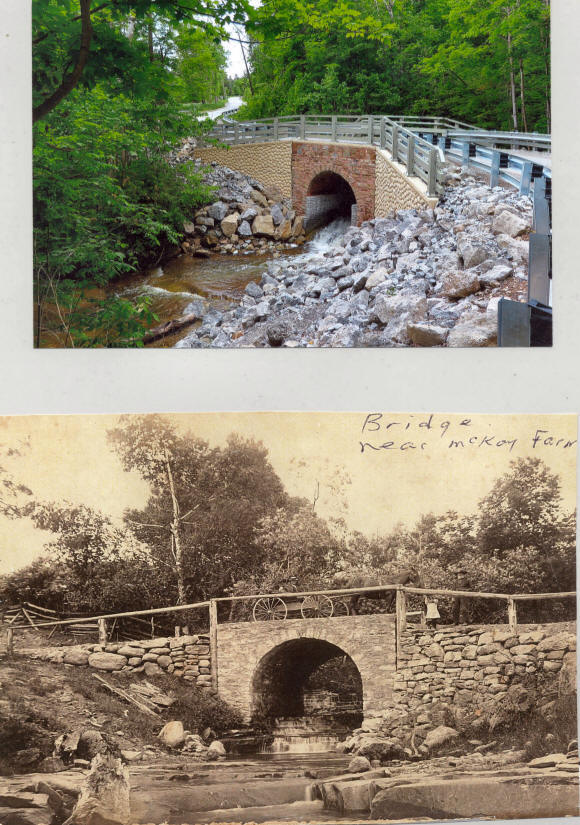
seen in many tourist
pamphlets, we understand the name Fallbrook. Rachel would walk up the steps
in bare feet. ``Your toes would freeze stiff even on the hottest July day,``
recalls Rachel. Unable to hand pump water up the 40’ incline to the house,
all water was carried in milk pails without the assistance of yokes. This
included the water for the animals in winter. “We bought 3 pumps, all
guaranteed, but none ever worked. My pail was a little smaller than the
others. This is what we did after breakfast, once we had walked up to get
the Globe and Mail for Donald, the patriarch.” (Yesterday’s copy had arrived
from Toronto by horse during the night.) In his later years, Donald’s life
centred on reading the Globe. One of two aunts, Nell or Kate, had already
risen at 4 A.M. to go and get the cows for milking. That sometimes was not
an easy chore because they often wandered off through the dense forest. "My
sister Mary remembers sharing a bed with one of the aunts whose bed attire
was a long night robe and sleeping cap.“
Rachel had lots of young
visitors from neighbouring farms who came to visit. Of course there was no
electricity and all cooking and heating of water was done on the woodstove.
There was no summer kitchen, so in summer the house sweltered. The original
home consisted of a large kitchen/living room and two small bedrooms in
which 9 persons lived. Donald later added an upstairs dormer and a cold
cellar. We will show pictures in an upcoming article. Most of the long day
was spent clearing the forest or taking rocks off the fields. All of this
was very labour intensive. The rocks were moved by brute strength, using a
stone boat. This was a wooden sled, without wheels pulled by a single horse.
The stones were picked, loaded onto the boat and drawn to the wall being
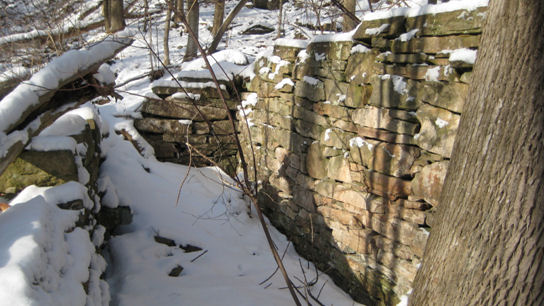
built at the time. One such wall is actually part of what is commonly
called Robbie’s Ice House, where ice, cut in spring was stored for use in
the summer .
On August 10, Rachel’s
birthday, the neighbouring children would come for the day than the adults
would come and socialize in the evening. But the McKay’s were dour, strict
Presbyterians who worked from dawn to dusk and socialising was rare. Uncle
Sandy did play the fiddle in his later years and was known to go to the
Legion and have a few nips. `` He would never dare to drink at home, or even
in the barn. Lord knows why he did not drive off the bridge into the Creek.
There were no guard rails. Must have been only a nip or two.`` In following
articles, we will tell you more of these wonderful stories from the Silver
Creek elders.
The battle to save
Fallbrook - The serendipity of Durness
The campaign to save The
Fallbrook Heritage site from demolition is a story in itself. As youngsters
growing up in Guelph, we were brought over to visit Uncle Sandy and Aunt
Kate (Sandy’s wife, Eggie Cole had died much earlier) twice a year and to go
to our ancestors’ burial site at Providence cemetery on William’s farm.
When we moved from Guelph, my younger brother Robert kept returning but I
was far away in Quebec or working in the far North as a nurse and never
returned for over 50 years. All Donald’s descendants had drifted away from
Fallbrook, dispersed to all corners of the country. More about that in a
later article..
For the first time, I visited The Scottish Highlands in September of 2007. I
had no intention of tracing family, more interested in living history than
chasing ghosts. I got involved as a volunteer helping with the John Lennon
festival in Durness, the most isolated village in northwest Scotland. I
became assistant to the community director of the festival, Graham Bruce,
also chairperson of the MacKay Community Trust and his wife Jill, both
school directors. Through pure chance, we became to understand that, as
relatives of the Keir family, they had often visited on a heritage farm in
Georgetown. We finally confirmed that the Keir farm is the original McKay
homestead. The day after my return from Scotland, I revisited the ancestral
farm with Cathie Keir, the last farm woman of Fallbrook. Since, our luck
continues as we vigorously pursue our campaign to save Fallbrook. Many
things fall into place. Thus the serendipity of Durness!
Conclusion
The battle for Fallbrook is a
campaign to resurrect this precious heritage site as a memorial to the
Celtic farm families, old and new of SilverCreek. Without their toil and
struggles, the Halton Hills region would not know the incredible prosperity
that it now experiences. It is essential that young people today be taught
this vital history.
I would like to cite a Royal
Commission on the plight to crofters in Scotland, as quoted in James
Hunter’s definitive work "The Making of the Crofting Community" (John Donald
Publishers, 1976 and 2000, p.281)
"Above all. The crofters have
the feeling that the croft, its land, its houses are their own. They
have gathered its stones and reared its buildings and occupied it as their
own all their days. They have received it from their ancestors who won it
from the wilderness and they cherish the hope that they will transmit it to
generations to come. Whatever be the legal theory, they feel it to be their
own..."
Thank you so much for your
encouragement,
Sandy James McKay (great
grandson of Donald McKay)
CONTACT: The Friends of Falling Brook E-mail:
fallbrook@live.ca
Visit the North Halton Celtic Historical Society forum here!
Download
the Brochure here!
-
You can read the Impact Statement
here!
-
Update 1 - What we've done to date
-
Update 2 - Some information on the families
-
Update 3 - MacKay Biography
-
Update 4 - How do you decide if a site is worth preserving?
-
Update 5 (.pdf file)
-
Update 6 - The sawmill and other matters
-
Update 7 - Walking the site
-
Update 8 - News about chinking
-
Update 9 - Information on the Millrace and other matters
-
Update 10 - Meeting
-
Update 11 - Results of Meeting
-
Update 12 - More discoveries at Fallbrook
-
Update 13
- Survey report
-
Update 14 -
September 2008 Newsletter (pdf file)
-
Update 15 - Letter to Michael Chong, Federal Member of Parliament
27th Sept. 2008
-
Update 16 - Letter to Hon. Aileen Carroll, Minister of Culture and
Seniors
-
Update 17 - Credit Valley
Conservation, Ontario Heritage Trust & letters, etc.
-
Update 18 -
Aunt Rachel Schwann-McKay
-
Update 19 -
Ballinafad Community Roots, etc.
-
Update 20 -
The Anniversary of the Ballinafad United Church, 3 May,
2009
-
Update 21
- The Icing on the Fallbrook Heritage Cake, August 21, 2009, The
Culvart.
-
Update 22
- Finding of Halton Hills "Consideration
for Designation of Fallbrook Farm (formerly
known as Beecham
House) under Section IV of the Ontario
Heritage Act, 14513 27 Side
Road, Con 9, Lot 28. File No.:
R01 FA" June 20,
2008. (pdf file)
-
Update 23 - Copy of Halton Hills
Heritage Register as at December 23, 2008 (pdf file)
-
Update 24 - Group, trying to save Fallbrook Beecham house, invites
public to share 'pioneer' memories
[External Link]
-
Update 25 - The deplorable state of things at Scotsdale Farm &
Beecham House. Posted in the Georgetown Forum [External Link]
-
Update 26 - I attended the Fall
Colloquium at the University of Guelph where Sandy MacKay was giving a
talk about the Fallbrook project. You can see pictures and a video
of his talk at this link.
-
Update 27 - Update for 27th
October 2009.
-
Update 28 -
Campaign for Historical significance
-
Update 29 - Oral
History Gathering on 29th November 2009
-
Update 30 -
Tom Murison
-
Update 31 -
Council designates
the entire Fallbrook Farm.
-
Seasons Greetings
- Greetings from the Fallbrook Team and good wishes for 2010
-
Update 32 -
Silvercreek Education Centre at Fallbrook
-
Update 33 - Found a book "Records and
Memories of Boston Church in the "Scotch Block" Esquesing Township,
County of Halton, 1820 - 1920" by John McColl D.D. (pdf)
-
Update 34 - Scottish
Studies Foundation help fund Business Plan.
-
Update 35 - Press Articles
-
Update 36 - Press Articles
-
Update 37 - Lloyd McIntyre's Update
for April 2010
-
Update 38 - Meeting on 13th April
2010
-
Update 39 - Iroquois connection
-
Update 40 - Become a member
-
Update 41 - Council meeting of June 9,
2010 (pdf)
-
Update 42 - July 25, 2010 (pdf)
-
Update 43 -
Constitution, Green preservation and opening agenda (pdf)
-
Update 44
- Rachel Schwan-McKay - In
Memoriam August 11, 2010
-
Update 45
- First meeting of the new company and election of the board
-
Update 46 -
Report of Incorporation meeting by
newly elected President Bill McKay, great grandson of Donald McKay,
Fallbrook Patriarch
-
Update 47 - Report on Council Meeting
-
Update 48 -
The Tweedsmuir Histories and the
Ballinafad Settlers
-
Update 49 - The Fallbrook Bridge and the
Halton Master Cycle Plan (pdf)
-
Update 50 - October 2010 update on
activity
-
Update 51 - Elora
-
Update 52 - Ada Thompson of Erin
-
Update 53 - December 2010 Report
-
Update 54 - Kirkwood Family
-
Update 55 - Scotsdale Farm
-
Update 56 - The Ballinafad Oral History
Series
-
Update 57 - The Life and Times of James
Palmer Kirkwood plus additional information on the Kirkwood family sent
in by Marion Kirkwood.
-
Update 58 - Report of the Society June
2011
-
Update 59 - The Significance of Community
Past and Present
-
Update 60 -
Alma Sinclair (McEnery), who spent all her life in
the Fad, has passed away.
-
Update 61 -
McKay Twins
-
Update 63 -
Campaign History
-
Oral Histories
-
MacKay family
history beginning at Rogart North Eastern Highlands
External Links
|